by Dr Shellie M Bowman Sr Editor, Public Agenda Senior Contributor, The Spotsylvania Gazette
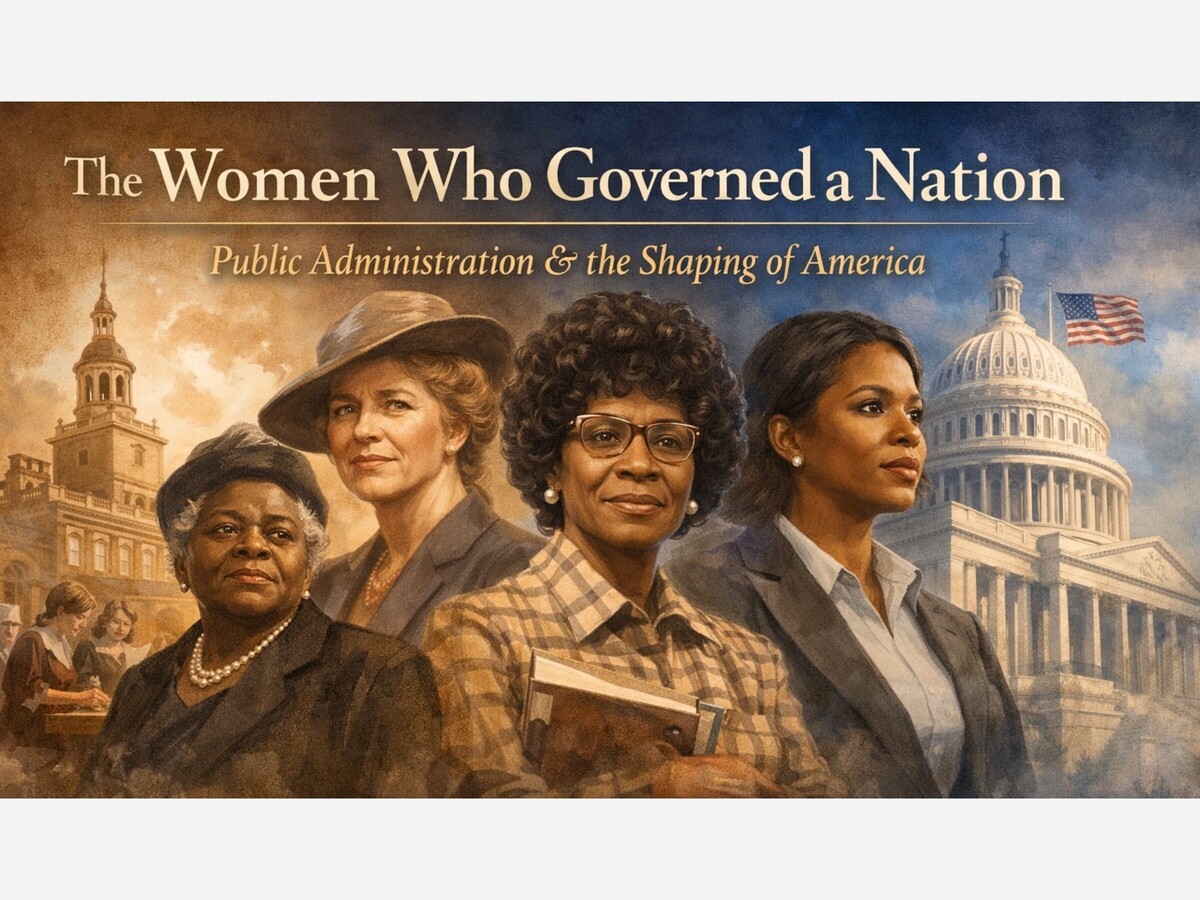
Public administration did not begin in a classroom. It began in kitchens, in community halls, in church basements, and in municipal offices where records were kept by hand and governance required moral courage as much as legal authority. In the early years of the United States, women were not formally recognized as public administrators. They could not vote. They could not hold most offices. Yet, they governed. They organized. They managed. They influenced. They shaped the architecture of American democracy long before the academy gave the discipline a name. As we close Black History Month, it is appropriate that we widen the lens. We must examine the women who built public administration in practice, especially Black women whose leadership often occurred without institutional protection, recognition, or reward. Before Public Administration Had a Name Woodrow Wilson’s 1887 essay, The Study of Administration, is often cited as the formal beginning of public administration as an academic discipline (Wilson, 1887). Yet administration as a practice predates that moment. Municipal reform, settlement houses, public health systems, and social welfare networks were advanced by women who operated within and around government systems. Jane Addams, for example, did not merely provide charity through Hull House. She professionalized service delivery, developed data-driven social reform models, and influenced municipal policy structures (Addams, 1910). Women were often the de facto managers of early public welfare infrastructure. They organized sanitation campaigns, labor reform initiatives, and education improvements. These were administrative functions, even if the title did not yet exist. The discipline’s early intellectual framework, as later articulated by scholars such as Luther Gulick and Lyndall Urwick in the 1930s, emphasized planning, organizing, staffing, directing, coordinating, reporting, and budgeting (Gulick, 1937). Women had already been doing this work. Black Women and Administrative Leadership Under Constraint For Black women, administrative leadership was often forged under systems of exclusion. Their contributions were not peripheral. They were foundational. Consider Mary McLeod Bethune. Beyond being an educator, she served as Director of the Division of Negro Affairs within the National Youth Administration during the Roosevelt administration. In that role, she helped administer federal programs affecting employment and education opportunities for Black youth (Hine, 1994). That was federal program management in practice. Septima Clark developed citizenship education programs that operationalized voter registration training and civic literacy in the Jim Crow South. Her work was administrative in design and implementation, coordinating curriculum, instructors, funding, and institutional partnerships (Charron, 2009). Ella Baker’s leadership model emphasized participatory governance. She built decentralized administrative networks within the Southern Christian Leadership Conference and later the Student Nonviolent Coordinating Committee. Baker’s approach rejected hierarchical bureaucracy in favor of distributed leadership, a concept that contemporary public administration scholars now explore under collaborative governance models (Roberts, 2008). These women did not merely advocate. They administered. They managed resources. They coordinated people. They structured accountability. They delivered outcomes. In doing so, they expanded the moral imagination of American governance. Public Administration as Democratic Stewardship Public administration is not neutral machinery. It is democratic stewardship. Contemporary scholarship reminds us that public administrators are not only implementers of policy but guardians of public values (Denhardt & Denhardt, 2015). Trust, equity, transparency, and responsiveness are not abstract ideals. They are operational standards. Black women have often been at the forefront of insisting that public institutions honor those standards. Shirley Chisholm, although best known as an elected official, reshaped the relationship between representation and administrative accountability. Barbara Jordan elevated constitutional literacy in public discourse. More recently, scholars such as Camilla Stivers have explored the historically gendered dimensions of public administration, arguing that the field’s development cannot be separated from women’s lived governance experiences (Stivers, 2002). In contemporary practice, Black women serve as city managers, agency directors, policy analysts, and nonprofit executives. They oversee budgets in the billions. They implement emergency management systems. They manage health departments. They supervise compliance infrastructures. Their leadership is not symbolic. It is structural. Intersectionality and Administrative Ethics Kimberlé Crenshaw’s theory of intersectionality reminds us that race and gender are not separate analytical categories (Crenshaw, 1989). In public administration, intersectionality reveals how governance structures can unintentionally marginalize populations when administrative discretion is exercised without equity consciousness. Black women administrators have frequently led efforts to integrate equity into budgeting, program design, and regulatory enforcement. Research in public administration increasingly recognizes that representative bureaucracy matters, not merely for symbolic inclusion but for substantive outcomes (Meier & Nicholson-Crotty, 2006). When administrative bodies reflect the communities they serve, policy implementation becomes more responsive. That is not ideology. That is empirical observation. The Moral Courage of Administration Public administration is often described as technical. It is compliance. It is budgeting. It is human resources. It is reporting. Yet beneath those mechanics lies moral courage. Black women in public administration have often operated within systems that doubted their competence, limited their authority, and scrutinized their performance. Still, they administered with excellence. Their stewardship reminds us that administration is an ethical act. Every licensing decision, tax assessment, procurement approval, or program eligibility determination reflects values. The field of public administration now emphasizes collaborative governance, equity budgeting, and inclusive service delivery. Those frameworks did not appear in a vacuum. They are rooted in decades of administrative leadership by women who insisted government serve all people. As We Close Black History Month Black History Month is not a siloed observance. It is a reminder that American history is incomplete without acknowledging those who built it under constraint. Women public administrators shaped this nation quietly and persistently. Black women public administrators shaped it with extraordinary resilience. Their legacy calls current leaders to higher standards. It calls us to stewardship worthy of the public trust. It calls us to governance that is competent, transparent, and equitable. Public administration is not only about systems. It is about people. And many of the people who built those systems were women whose names deserve to be remembered, studied, and honored. As we conclude this month of reflection, let us not simply celebrate history. Let us operationalize it. Let us administer with integrity. Let us govern with courage. Let us steward public trust with excellence. I invite you to reflect: Who are the women public administrators in your community who are quietly shaping policy, budgets, compliance, and service delivery? How might our institutions look different if their leadership models were more fully studied, supported, and elevated? Join the conversation in the comments. Let us not simply commemorate history. Let us strengthen the stewardship of public trust in our own time.
References Addams, J. (1910). Twenty years at Hull-House. Macmillan. Charron, K. M. (2009). Freedom’s teacher: The life of Septima Clark. University of North Carolina Press. Crenshaw, K. (1989). Demarginalizing the intersection of race and sex. University of Chicago Legal Forum, 1989(1), 139–167. Denhardt, J. V., & Denhardt, R. B. (2015). The new public service: Serving, not steering (4th ed.). Routledge. Gulick, L. (1937). Notes on the theory of organization. In L. Gulick & L. Urwick (Eds.), Papers on the science of administration (pp. 1–45). Institute of Public Administration. Hine, D. C. (1994). Hine sight: Black women and the re-construction of American history. Indiana University Press. Meier, K. J., & Nicholson-Crotty, J. (2006). Gender, representative bureaucracy, and law enforcement. Public Administration Review, 66(6), 850–860. Roberts, N. (2008). The age of direct citizen participation. M.E. Sharpe. Stivers, C. (2002). Gender images in public administration: Legitimacy and the administrative state (2nd ed.). Sage Publications. Wilson, W. (1887). The study of administration. Political Science Quarterly, 2(2), 197–222
Public Agenda is free today. But if you enjoyed this post, you can tell Public Agenda that the writing is valuable by pledging a future subscription. You won’t be charged unless payments are enabled.
Patchy rain nearby, with a high of 98 and low of 70 degrees. Patchy rain nearby in the morning, sunny in the afternoon, patchy rain nearby in the evening, light rain overnight.
 77° and Patchy light rain