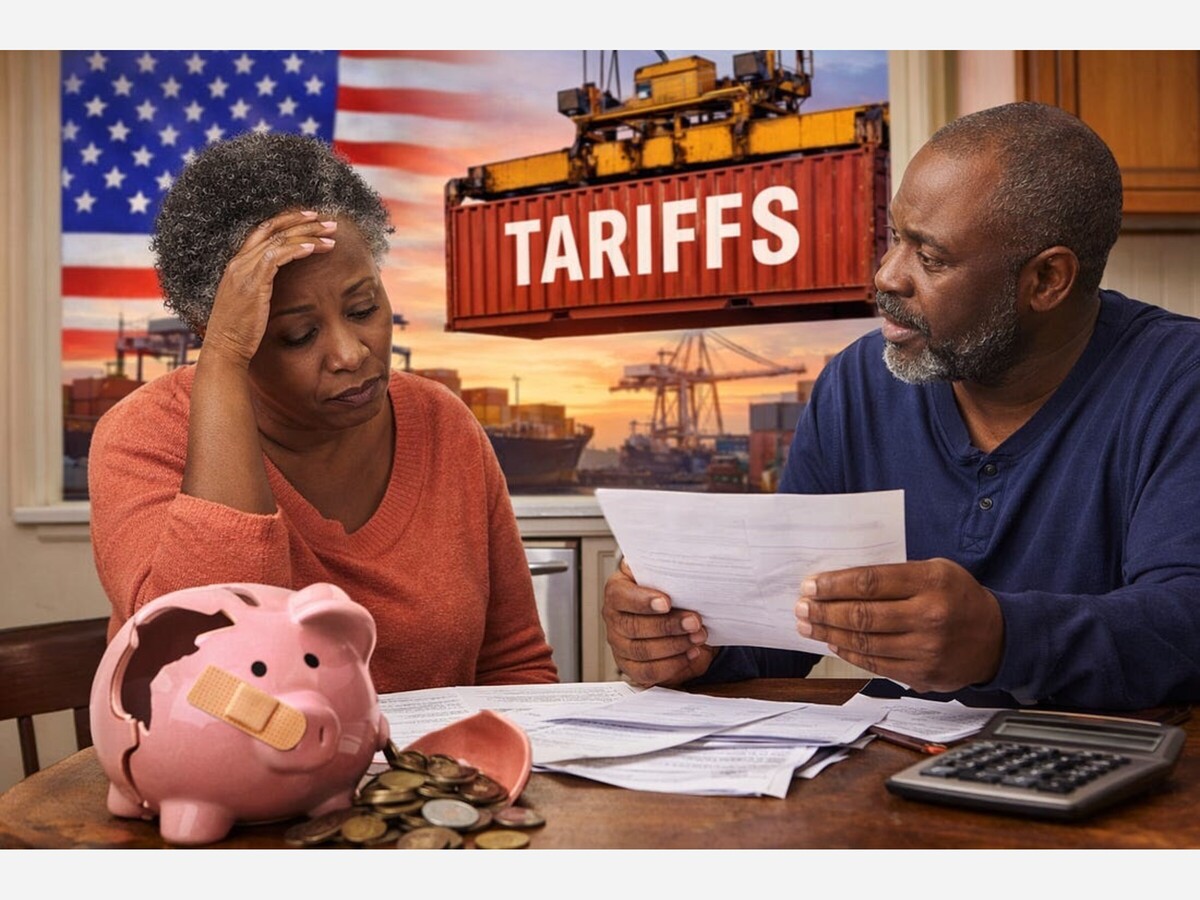
Public finance is rarely abstract. It reaches the dinner table. It shapes retirement stability. It determines whether small businesses expand or contract. When the federal government imposes global tariffs, those decisions do not remain at the port of entry. They move through supply chains, into balance sheets, and ultimately into household budgets.
As a former IRS Revenue Officer and former federally licensed tax professional, I approach this issue not as a partisan observer, but as a student of fiscal policy and administrative consequence. Tariffs are legal instruments of trade policy. The constitutional authority is clear. The economic consequences, however, deserve careful examination.
What Is a Tariff in Practical Fiscal Terms?
A tariff is a tax imposed on imported goods. While it is assessed at the border, its economic incidence does not necessarily remain with foreign producers. A substantial body of empirical research examining the 2018 to 2019 U.S. tariff actions concluded that the costs of those tariffs were borne largely by U.S. importers and, ultimately, U.S. consumers (Amiti, Redding, & Weinstein, 2019; Fajgelbaum et al., 2020).
Amiti et al. (2019), analyzing import data and price changes, found that the full incidence of U.S. tariffs fell on domestic importers rather than foreign exporters. Similarly, Fajgelbaum et al. (2020) concluded that the welfare losses from tariffs were regressive in their distributional effects, meaning lower income households bore proportionally larger burdens.
This matters because tariffs function as consumption taxes in effect, even though they are not structured as such in statute.
Are Tariffs Tax Deductible?
For individual citizens, tariffs are not directly deductible on personal income tax returns. Individuals do not claim tariff payments as itemized deductions. Instead, the tariff cost is embedded in the price of goods purchased.
For businesses, however, the treatment differs.
Under federal tax principles, tariffs paid on imported inventory are generally capitalized into the cost of goods sold under Section 263A of the Internal Revenue Code, the uniform capitalization rules. In practical terms, which means tariffs increase inventory basis and become part of Cost of Goods Sold when the goods are sold.
While this provides tax deductibility through COGS for businesses, it does not eliminate the economic burden. The higher input cost reduces gross margins unless passed on to consumers. In competitive markets, that cost is frequently passed forward.
Therefore, even though businesses may deduct tariffs indirectly through COGS, the economic impact remains present in the marketplace.
Household Impact and Cost of Living
Research from the Congressional Budget Office estimated that tariffs enacted during the prior trade escalation reduced real household income on average due to higher consumer prices (Congressional Budget Office, 2019). The Tax Foundation similarly estimated that tariffs functioned as a tax increase on U.S. households by raising prices of affected goods (York, 2020).
The impact is not evenly distributed.
Lower income households spend a higher proportion of income on tradable goods such as clothing, electronics, and household essentials. When tariffs increase prices in these sectors, the effective burden is regressive.
Senior citizens on fixed incomes are particularly vulnerable. Their income streams do not adjust automatically with price increases. Cost of living adjustments may lag or fail to fully offset price shocks.
The economically disenfranchised experience similar stress. When the marginal dollar is already committed to essentials, incremental price increases compound financial fragility.
Arguments that tariffs have little to no fiscal impact on households are inconsistent with peer reviewed evidence documenting price pass through and consumer incidence (Amiti et al., 2019; Fajgelbaum et al., 2020).
The Current Policy Context
Trade policy decisions made by the current White House administration must be evaluated through this economic lens. Tariffs are sometimes defended as tools for strategic industrial policy or geopolitical leverage. Those may be legitimate policy objectives. However, every trade instrument carries distributive consequences.
Public administration requires evaluating both intent and impact.
A tariff designed to protect domestic industry may simultaneously raise input costs for domestic manufacturers reliant on imported intermediate goods. Those increased costs may cascade to consumers.
Fiscal analysis demands that we ask: who ultimately pays?
What Households Can Do
While individual citizens cannot control federal trade policy, there are steps to mitigate financial stress:
Compare domestic alternatives where feasible.
Evaluate bulk purchasing strategies for non-perishable goods.
Utilize state and local relief programs where eligible.
Consult qualified tax professionals regarding potential credits and deductions unrelated to tariffs that may offset broader cost increases.
This is not tax advice. Each individual situation is unique, and readers should consult a qualified tax advisor before making financial decisions.
Policy Options for Relief
If tariffs remain in place, policymakers at multiple levels can reduce fiscal stress.
Federal Policymakers
Federal authorities can: • Target tariff exclusions for essential consumer goods. • Expand refundable tax credits for low-income households. • Increase oversight of tariff incidence reporting. • Pair trade policy with direct relief measures.
State Policymakers
States can: • Temporarily suspend sales tax on essential goods during inflationary spikes. • Expand earned income tax credits. • Enhance utility assistance programs.
Local Revenue Departments
Local revenue departments and constitutional officers, including Commissioners of the Revenue across municipalities and counties, play a delicate role.
They must uphold the rule of law while avoiding unnecessary hardship.
Best practices include: • Offering reasonable installment agreements. • Providing clear communication about assessment timelines. • Implementing hardship review procedures. • Prioritizing voluntary compliance before enforcement escalation.
Tax administration is not merely about collection. It is about trust. Enforcement without empathy erodes public confidence.
A Public Administration Perspective
Tariffs are not inherently partisan instruments. They are fiscal tools. But fiscal tools must be evaluated for distributive equity and administrative consequence(s).
As a scholar of public administration, I am concerned not only with legality, but with legitimacy. When households experience rising costs without corresponding income growth, public trust declines.
Trade policy must therefore be paired with transparency, data driven evaluation, and responsive fiscal mitigation.
If tariffs are pursued for strategic reasons, their secondary effects must be acknowledged and addressed openly.
Public governance is strongest when it anticipates consequence rather than reacting to crisis.
The fiscal conversation around tariffs should not be reduced to slogans. It should be grounded in evidence.
And the evidence is clear: tariffs can and do transmit cost to American households, particularly those least able to absorb them.
The question is not whether tariffs are lawful. The question is whether their design and implementation adequately protect the people they inevitably affect.
Public administration requires that we ask both.
References
Amiti, M., Redding, S. J., & Weinstein, D. E. (2019). The impact of the 2018 tariffs on prices and welfare. Quarterly Journal of Economics, 134(4), 1879 to 1939.
Congressional Budget Office. (2019). The budget and economic outlook: 2019 to 2029.
Fajgelbaum, P. D., Goldberg, P. K., Kennedy, P. J., & Khandelwal, A. K. (2020). The return to protectionism. Quarterly Journal of Economics, 135(1), 1 to 55.
York, E. (2020). The economic impact of tariffs. Tax Foundation.
Public Agenda is free today. But if you enjoyed this post, you can tell Public Agenda that the writing is valuable by pledging a future subscription. You won’t be charged unless payments are enabled.
Patchy rain nearby, with a high of 98 and low of 70 degrees. Patchy rain nearby in the morning, sunny in the afternoon, patchy rain nearby in the evening, light rain overnight.
 77° and Patchy light rain