54° and Overcast



Image
Fall Back Tonight: Set Your Clocks Back One Hour
By The Spotsylvania Gazette
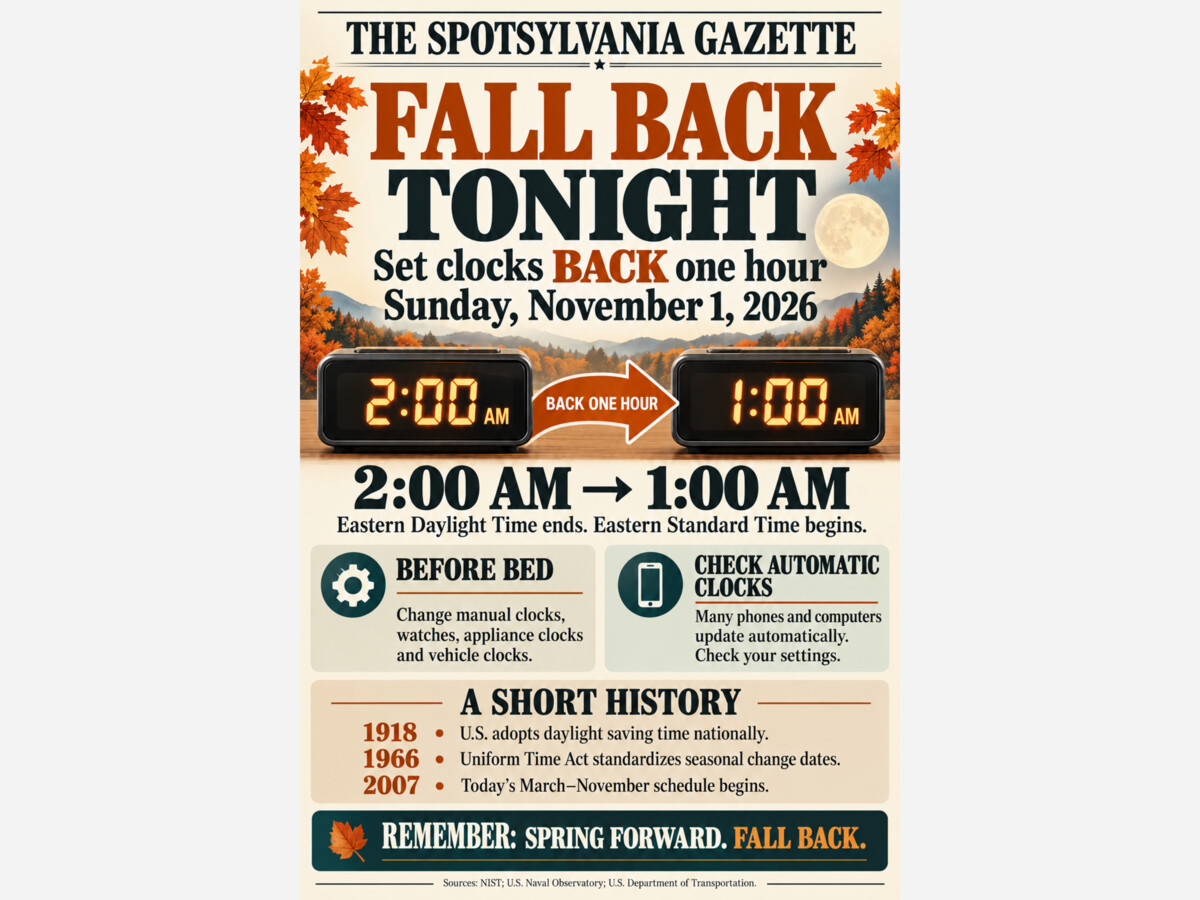
Before heading to bed tonight, Spotsylvania residents should turn manually operated clocks back one hour.
Daylight saving time ends at 2 a.m. Sunday, November 1, 2026. At that moment, clocks return to 1 a.m., and Virginia moves from Eastern Daylight Time to Eastern Standard Time. The repeated hour gives Sunday a 25-hour day. (nist.gov)
For anyone heading to church, work or another Sunday morning commitment, checking the clocks tonight can help avoid arriving an hour early.
Which Clocks Need Attention?
Many smartphones and computers update automatically when their time settings are configured correctly. Wall clocks, watches, appliance clocks and some vehicle clocks may need a manual adjustment. Check each device rather than assuming it has changed. (nist.gov)
The familiar reminder is simple: Spring forward. Fall back.
Returning to standard time shifts daylight toward the morning. Sunrise and sunset occur an hour earlier by the clock than they would under daylight saving time. Changing the clocks does not change the amount of daylight available. (nist.gov)
How Did Clock Changing Begin in America?
The story involves two related developments: standard time zones and seasonal clock changes.
In 1883, American and Canadian railroads adopted a coordinated time-zone system to reduce confusion caused by numerous local times. Federal recognition followed with the Standard Time Act of 1918, which also introduced daylight saving time nationally during World War I. (transportation.gov, aa.usno.navy.mil)
Congress repealed the national daylight saving requirement in 1919, while keeping standard time zones. Seasonal clock changes became a matter for states and local communities. (aa.usno.navy.mil)
Wartime Changes and Local Confusion
During World War II, the United States again adopted daylight saving time nationally. It remained in effect continuously from February 9, 1942, through September 30, 1945.
After the war, practices again varied among states and communities. The Uniform Time Act of 1966 established consistent starting and ending dates for places observing daylight saving time, while allowing states to exempt themselves. (aa.usno.navy.mil)
Why Do We Change in November?
The dates have changed several times.
During the energy crisis, daylight saving time began in January in 1974 and February in 1975. A later change moved the regular starting date to the first Sunday in April, beginning in 1987. (aa.usno.navy.mil)
The Energy Policy Act of 2005 established the schedule used since 2007: daylight saving time begins on the second Sunday in March and ends on the first Sunday in November. (nist.gov)
Not Every State Changes Its Clocks
Hawaii and most of Arizona remain on standard time throughout the year. The Navajo Nation observes daylight saving time, including within Arizona. (nist.gov)
For Spotsylvania residents, tonight’s task is straightforward: Set manual clocks back one hour before bed, and check that automatic clocks show the correct time Sunday morning.


Cloudy, with a high of 65 and low of 46 degrees. Cloudy in the morning, overcast in the afternoon and evening, clear overnight.