67° and Clear



Image
By Dr Shellie M Bowman Sr
Americans often tell the story of civil rights through landmark court decisions, constitutional amendments, and legislative victories. We remember the abolition of slavery, the ratification of the Fourteenth Amendment, the passage of the Civil Rights Act of 1964, and the Voting Rights Act of 1965. These moments deserve their place in history because they expanded the promise of liberty and equality under the law.
Yet there is another part of the story that receives far less attention.
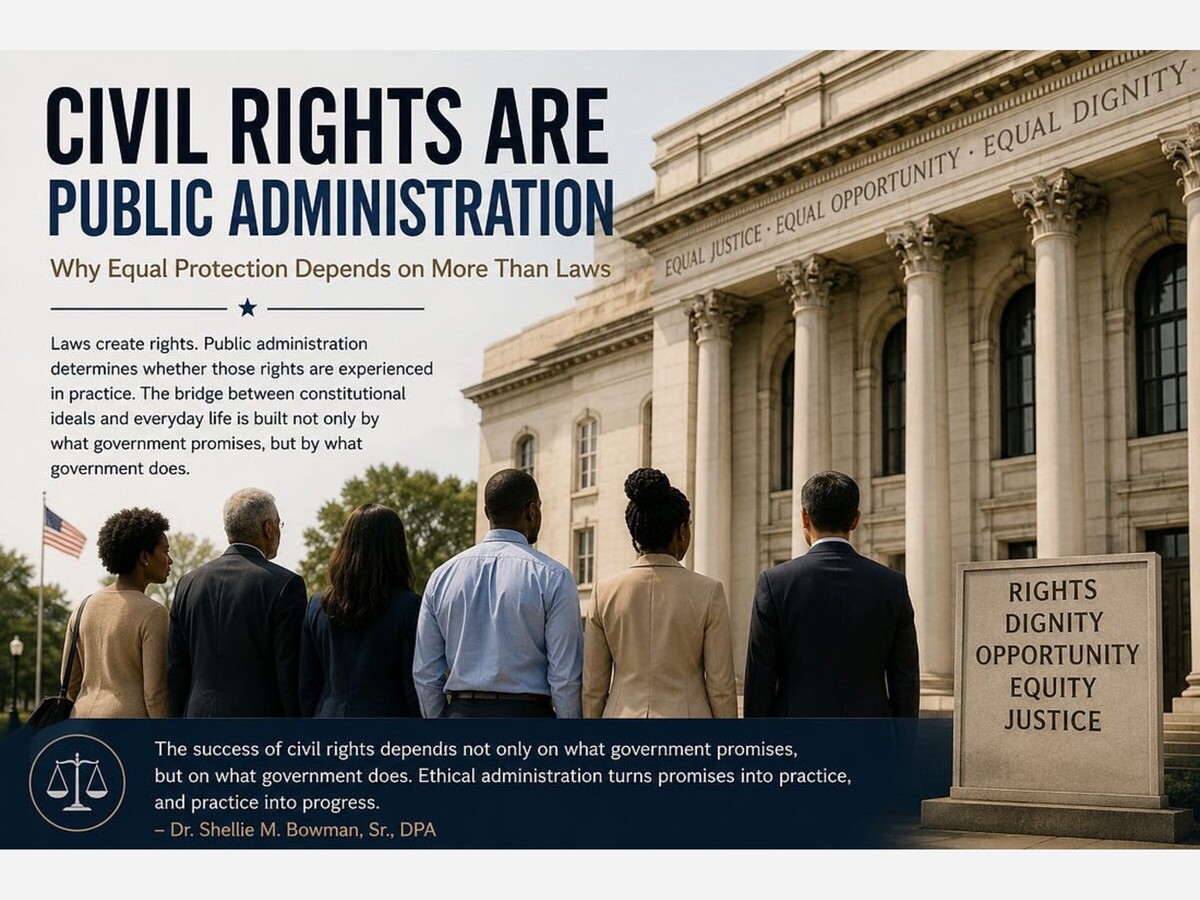
Civil rights are not realized simply because a law is passed or a court issues a ruling. Rights become meaningful when public institutions administer them fairly, consistently, and ethically. The history of civil rights in the United States is therefore not only a legal history. It is also a history of public administration.
The distinction matters because government does not operate solely through elected officials. Citizens experience government most often through public administrators. They encounter teachers in public schools, election officials at polling locations, tax administrators, police officers, housing authorities, social workers, permit offices, public health agencies, and countless other public servants who transform laws into lived experiences.
In many ways, public administration serves as the bridge between constitutional ideals and everyday life.
A right written into law is not the same as a right experienced in practice.
The Constitution may guarantee equal protection under the law, but equal protection must still be administered. Voting rights may be legally protected, but elections must still be organized and conducted. Housing discrimination may be prohibited, but fair housing laws must still be enforced. Educational opportunities may be expanded, but school systems must still implement policies that make access possible.
This distinction has existed throughout American history.
Following the Civil War, constitutional amendments expanded citizenship and voting rights for formerly enslaved people. However, the administration of those rights varied dramatically across states and localities. In many places, bureaucratic practices, administrative barriers, and uneven enforcement limited access to rights that existed on paper (Foner, 2014).
Likewise, after the Supreme Court’s decision in Brown v. Board of Education (1954), school desegregation did not occur automatically. Public institutions were required to implement the ruling. Some jurisdictions complied. Others resisted. The effectiveness of the Court’s decision ultimately depended upon administrative action.
The lesson is simple.
Rights may begin in law, but they are experienced through administration.
At its best, public administration serves as a guardian of civil rights.
Public administrators translate public values into operational realities. They ensure citizens receive equal treatment. They create processes that reduce barriers to participation. They administer programs intended to expand opportunity and protect vulnerable populations.
The implementation of the Voting Rights Act provides one example. While Congress established legal protections, public agencies and election officials were responsible for administering voter registration, monitoring compliance, and ensuring access to the ballot box (U.S. Commission on Civil Rights, 1968).
The same principle applies to disability rights. The Americans with Disabilities Act created legal protections, but those protections become meaningful only when public institutions provide accessible facilities, accommodations, and services. In this way, public administration transforms legal rights into practical realities.
Citizens often focus on political leaders because they create policy. Yet public administrators frequently determine whether those policies succeed or fail.
The opposite is also true.
History demonstrates that civil rights can be weakened through administrative decisions even when legal protections exist.
Public administrators exercise discretion. They establish procedures. They interpret regulations. They allocate resources. They prioritize enforcement activities.
When these responsibilities are exercised unfairly, the effects can be profound.
Throughout American history, administrative practices have been used to exclude individuals from voting, limit educational opportunities, restrict housing access, and create unequal treatment within public institutions. In some cases, these actions occurred openly. In others, they emerged through seemingly neutral procedures that produced unequal outcomes.
This reality highlights an uncomfortable truth.
Government systems are not inherently fair simply because they exist.
Fairness requires intentional administration.
Transparency requires intentional administration.
Accountability requires intentional administration.
Without those commitments, rights can become increasingly difficult to access despite remaining legally protected.
Public administration is often described as the implementation of public policy.
While accurate, that definition may be incomplete.
Public administration is also the stewardship of democratic values.
Every public servant exercises a degree of influence over citizens’ experiences with government. Whether processing a permit application, conducting an assessment, administering a public benefit program, or enforcing regulations, public administrators help determine whether citizens experience government as fair, trustworthy, and responsive.
This responsibility extends beyond technical competence.
It requires ethical judgment.
It requires accountability.
It requires respect for human dignity.
It requires an understanding that every administrative decision affects real people and real communities.
Public administrators may not write laws, but they play a critical role in ensuring those laws serve their intended purpose.
Civil rights are often discussed in national terms, but their administration frequently occurs at the local level.
Citizens encounter local government through schools, elections, public safety, permitting, taxation, zoning, and public services. The quality of these interactions shapes public trust in government.
When residents believe they are treated fairly, trust grows.
When government communicates transparently, trust grows.
When public institutions are accessible and responsive, trust grows.
The opposite is also true.
Communities lose confidence when they perceive favoritism, inconsistency, or indifference.
This is why ethical administration matters.
Public trust is not built through slogans. It is built through daily interactions between citizens and the institutions that serve them.
Civil rights are often remembered as legislative victories and judicial milestones. Those achievements deserve recognition because they expanded the promise of American democracy.
However, rights do not become realities simply because they are written into law.
They become realities when public institutions administer them fairly.
They become realities when public servants embrace accountability.
They become realities when government honors the dignity of every citizen.
The success of civil rights therefore depends not only on what government promises, but on what government does.
Public administration is the mechanism through which democratic ideals become lived experiences.
When administration is ethical, rights become meaningful.
When administration fails, rights may exist on paper while remaining inaccessible in practice.
For that reason, civil rights are not merely a legal matter.
They are, and always have been, a public administration matter.
Brown v. Board of Education, 347 U.S. 483 (1954).
Foner, E. (2014). The second founding: How the Civil War and Reconstruction remade the Constitution. W. W. Norton & Company.
U.S. Commission on Civil Rights. (1968). Political participation: A study of the participation by Negroes in the electoral and political processes in 10 Southern states since passage of the Voting Rights Act of 1965. U.S. Government Printing Office.
Public Agenda is free today. But if you enjoyed this post, you can tell Public Agenda that the writing is valuable by pledging a future subscription. You won’t be charged unless payments are enabled.
Follow us on TikTok @DrShelliePublicAgenda
📢 Stay Connected with Public Agenda by Dr. Shellie M. Bowman
Let’s rebuild public leadership together; one insight, one question, one breakthrough at a time.
eLEADt On with Purpose.

Sunny, with a high of 96 and low of 64 degrees. Overcast during the morning, light rain shower in the afternoon, patchy rain nearby for the evening, clear overnight.