77° and Partly Cloudy
Image
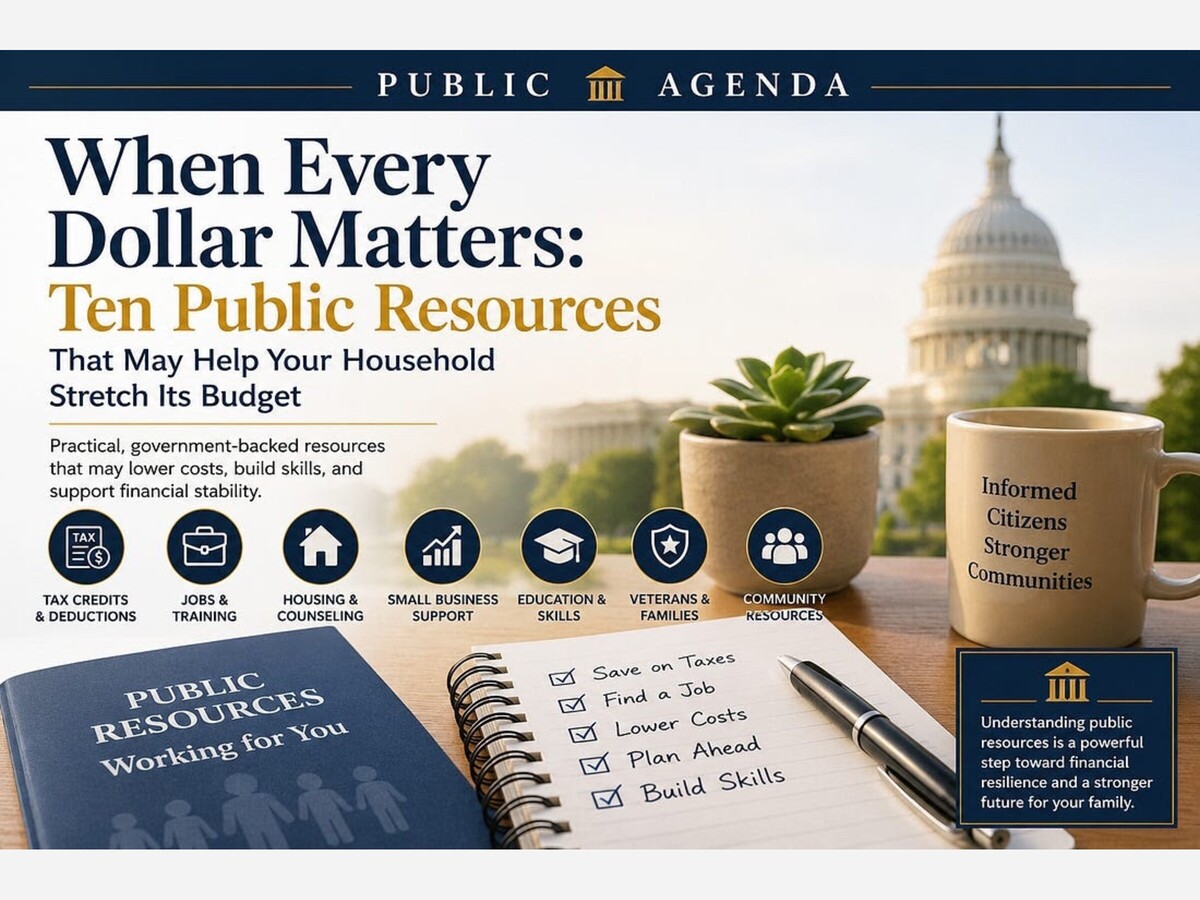



Affordability is not an abstract policy discussion for households deciding how to pay for groceries, housing, transportation, education, insurance, and childcare. In May 2026, consumer prices were 4.2 percent higher than one year earlier. The labor market also showed signs of measured growth rather than rapid expansion, with payroll employment increasing by 57,000 in June and the unemployment rate remaining at 4.2 percent (U.S. Bureau of Labor Statistics [BLS], 2026a, 2026b).
Government cannot eliminate every household financial challenge. It does, however, administer tax provisions, employment services, educational programs, counseling networks, and public information resources that may reduce costs or help people make better-informed decisions. Eligibility varies, and no single resource will fit every family. Yet understanding what public institutions provide is an important form of civic and financial literacy.
The federal tax system contains credits intended for taxpayers who satisfy specific income, filing-status, and family requirements. The Earned Income Tax Credit, for example, may be available to qualifying workers with low or moderate earned income, including some taxpayers without qualifying children. The Internal Revenue Service provides Publication 596, eligibility tables, and an online EITC Assistant to help taxpayers evaluate the applicable rules (Internal Revenue Service [IRS], 2025, 2026a).
Families should also review the official IRS guidance for credits related to children, dependent care, education, retirement savings, and other circumstances before filing. A tax credit is not automatically available merely because a taxpayer has heard of it. Eligibility depends on the governing statute and the facts reported on the return. Reviewing official guidance or consulting a qualified tax professional may prevent an eligible household from overlooking a provision while also reducing the risk of claiming one incorrectly.
Home-related tax provisions may provide another form of savings, although timing is now especially important. The IRS states that federal residential clean-energy and energy-efficiency credits generally applied to qualifying property installed through December 31, 2025. Taxpayers who completed eligible work during that period may still need to determine whether a credit belongs on their 2025 return or an amended return, but the credits are not available for qualifying expenditures made after the statutory termination dates (IRS, 2026b, 2026c).
A difficult job search can become expensive. Applicants may pay for résumé services, career assessments, certification advice, or training without first examining publicly supported alternatives. American Job Centers help individuals search for employment, identify training opportunities, and obtain answers to employment-related questions. The Workforce Innovation and Opportunity Act Adult Program also provides job-search assistance and training opportunities to eligible adults through state and local workforce systems (U.S. Department of Labor [DOL], n.d.-a, n.d.-b).
These services do not guarantee employment, and available assistance differs by location and eligibility. Nevertheless, an American Job Center can be an appropriate starting point before a worker purchases training independently. CareerOneStop and state eligible-training-provider systems can also help job seekers compare occupations, credentials, and approved training options using public workforce information (DOL, 2025).
Registered apprenticeships and work-based training deserve similar attention. These pathways may combine employment with structured instruction, allowing eligible participants to acquire occupational skills while earning wages. Because programs, sponsors, prerequisites, and compensation differ, prospective applicants should use official federal or state apprenticeship resources rather than assuming that every advertised “apprenticeship” carries the same standards or benefits.
Housing decisions can carry consequences lasting decades. The U.S. Department of Housing and Urban Development maintains a nationwide network of participating housing-counseling agencies. HUD-certified counselors may help consumers understand homebuying, renting, mortgage delinquency, reverse mortgages, and other housing matters. HUD also provides a searchable directory and telephone assistance for locating participating agencies, including services offered in multiple languages (U.S. Department of Housing and Urban Development [HUD], n.d.).
Housing counseling does not make every housing option affordable, nor does it replace legal or financial advice. Its practical value is that consumers may obtain informed assistance before entering a major transaction or after encountering difficulty.
The Consumer Financial Protection Bureauoffers another publicly funded source of guidance. Its consumer tools address credit reports, debt collection, mortgages, bank accounts, student loans, fraud, and money management. The Bureau also provides instructions for disputing credit-report errors and a complaint process for problems involving consumer financial products and services (Consumer Financial Protection Bureau [CFPB], 2025, 2026).
Using an impartial government resource before purchasing commercial credit-repair or financial-education services may help consumers distinguish between information they can obtain without charge and assistance for which professional representation is genuinely needed.
For people considering self-employment or trying to stabilize an existing business, the Small Business Development Center network provides individualized advising and technical assistance to entrepreneurs and small businesses. The U.S. Small Business Administration also maintains online training and connections to other resource partners (U.S. Small Business Administration [SBA], 2025a, 2025b).
These services do not promise profitability or replace accountants, attorneys, lenders, or other licensed professionals. They may, however, help an entrepreneur avoid preventable mistakes, evaluate a business concept, understand government contracting, or prepare more effectively before paying for specialized services.
Households may also overlook Cooperative Extension. Through land-grant universities and public partnerships, Extension provides nonformal education and resources related to family well-being, food, health, agriculture, home management, and community vitality. The specific classes and materials differ among states and local offices, but the national system is designed to make research-based knowledge available beyond the university campus (U.S. Department of Agriculture, National Institute of Food and Agriculture [USDA NIFA], 2025, 2026).
Veterans, service members, and eligible family members should examine benefits through the Department of Veterans Affairs rather than relying solely on informal descriptions. VA education benefits may assist with tuition, training, school selection, and career counseling. Veteran Readiness and Employment may provide eligible veterans with employment planning, training, résumé development, accommodations, or assistance exploring self-employment (U.S. Department of Veterans Affairs [VA], 2026a, 2026b).
Eligibility depends on service history, disability status, benefit elections, and other program requirements. The financial value of reviewing these benefits is therefore not based on an assumption that every veteran qualifies. It rests on the importance of obtaining an official determination before paying personally for education or employment services that an earned benefit might cover.
These resources illustrate a broader principle. Public administration affects household finances not only through taxes and fees, but also through the accessibility of information, benefits, counseling, training, and consumer protections.
The ten opportunities discussed here are the EITC, other household tax credits, prior-year home-energy credits, American Job Centers, WIOA training, apprenticeships, HUD housing counseling, CFPB consumer tools, SBDC advising, Cooperative Extension, and veterans’ education and employment benefits. Some categories overlap, and each carries its own eligibility requirements.
Public resources provide little value when citizens do not know they exist or cannot understand how to access them. When every dollar matters, learning how to navigate government can become part of a household’s financial resilience. The prudent first step is not assuming eligibility. It is consulting the administering agency, reading the applicable guidance, and asking informed questions.
This article provides general educational information. Program availability, eligibility, deadlines, and benefits vary. Readers should consult the administering agency’s current official guidance before making tax, employment, housing, educational, or financial decisions.
Consumer Financial Protection Bureau. (2025). Credit reports and scores. https://www.consumerfinance.gov/consumer-tools/credit-reports-and-scores/
Consumer Financial Protection Bureau. (2026). Adult financial education tools and resources. https://www.consumerfinance.gov/consumer-tools/educator-tools/adult-financial-education/tools-and-resources/
Internal Revenue Service. (2025). Publication 596: Earned income credit. https://www.irs.gov/publications/p596
Internal Revenue Service. (2026a). Earned income and Earned Income Tax Credit tables. https://www.irs.gov/credits-deductions/individuals/earned-income-tax-credit/earned-income-and-earned-income-tax-credit-eitc-tables
Internal Revenue Service. (2026b). About Form 5695, residential energy credits. https://www.irs.gov/forms-pubs/about-form-5695
Internal Revenue Service. (2026c). Working families tax cuts. https://www.irs.gov/newsroom/working-families-tax-cuts
U.S. Bureau of Labor Statistics. (2026a). Consumer prices up 4.2 percent over the year ended May 2026. https://www.bls.gov/opub/ted/2026/consumer-prices-up-4-2-percent-over-the-year-ended-may-2026.htm
U.S. Bureau of Labor Statistics. (2026b). The employment situation, June 2026. https://www.bls.gov/news.release/empsit.nr0.htm
U.S. Department of Agriculture, National Institute of Food and Agriculture. (2025). What we do: Extension. https://www.nifa.usda.gov/about-nifa/what-we-do/extension
U.S. Department of Agriculture, National Institute of Food and Agriculture. (2026). Division of Family & Consumer Sciences. https://www.nifa.usda.gov/offices/division-family-consumer-sciences
U.S. Department of Housing and Urban Development. (n.d.). Housing counseling services. https://www.hud.gov/i_want_to/talk_to_a_housing_counselor
U.S. Department of Labor. (n.d.-a). American Job Centers. https://www.dol.gov/general/topic/training/onestop
U.S. Department of Labor. (n.d.-b). WIOA Adult and Dislocated Worker Program. https://www.dol.gov/agencies/eta/workforce-investment/adult
U.S. Small Business Administration. (2025a). Small Business Development Centers. https://www.sba.gov/local-assistance/resource-partners/small-business-development-centers-sbdc
U.S. Small Business Administration. (2025b). SBA Learning Platform. https://www.sba.gov/sba-learning-platform
U.S. Department of Veterans Affairs. (2026a). VA education and training benefits. https://www.va.gov/education/
U.S. Department of Veterans Affairs. (2026b). Veteran Readiness and Employment. https://www.va.gov/careers-employment/vocational-rehabilitation/
A Note to Public Agenda Readers
Beginning with our next publication cycle, Public Agenda will move from two articles per week to one substantive weekly publication.
This change is intentional. Public Agenda has continued to develop as a source of scholarly yet accessible analysis concerning public administration, governance, public finance, and civic life. Moving to a weekly schedule will provide additional time to examine primary documents, verify factual assertions, develop stronger analysis, and ensure that each article is supported by authoritative government, institutional, or peer-reviewed sources.
The goal is not simply to publish less often. It is to publish with greater depth, practical value, and lasting relevance.
Readers can expect one carefully researched article each week that explains how public institutions affect everyday life and helps citizens engage government with greater knowledge and confidence.
Thank you for reading, sharing, and continuing to support Public Agenda.
Public Agenda is free today. But if you enjoyed this post, you can tell Public Agenda that the writing is valuable by pledging a future subscription. You won’t be charged unless payments are enabled.
Follow us on TikTok @DrShelliePublicAgenda
📢 Stay Connected with Public Agenda by Dr. Shellie M. Bowman
Let’s rebuild public leadership together; one insight, one question, one breakthrough at a time.
eLEADt On with Purpose

Overcast, with a high of 77 and low of 59 degrees. Overcast in the morning, partly cloudy in the afternoon, clear in the evening, light rain shower overnight.