49° and Clear



Image
Executive Reflection
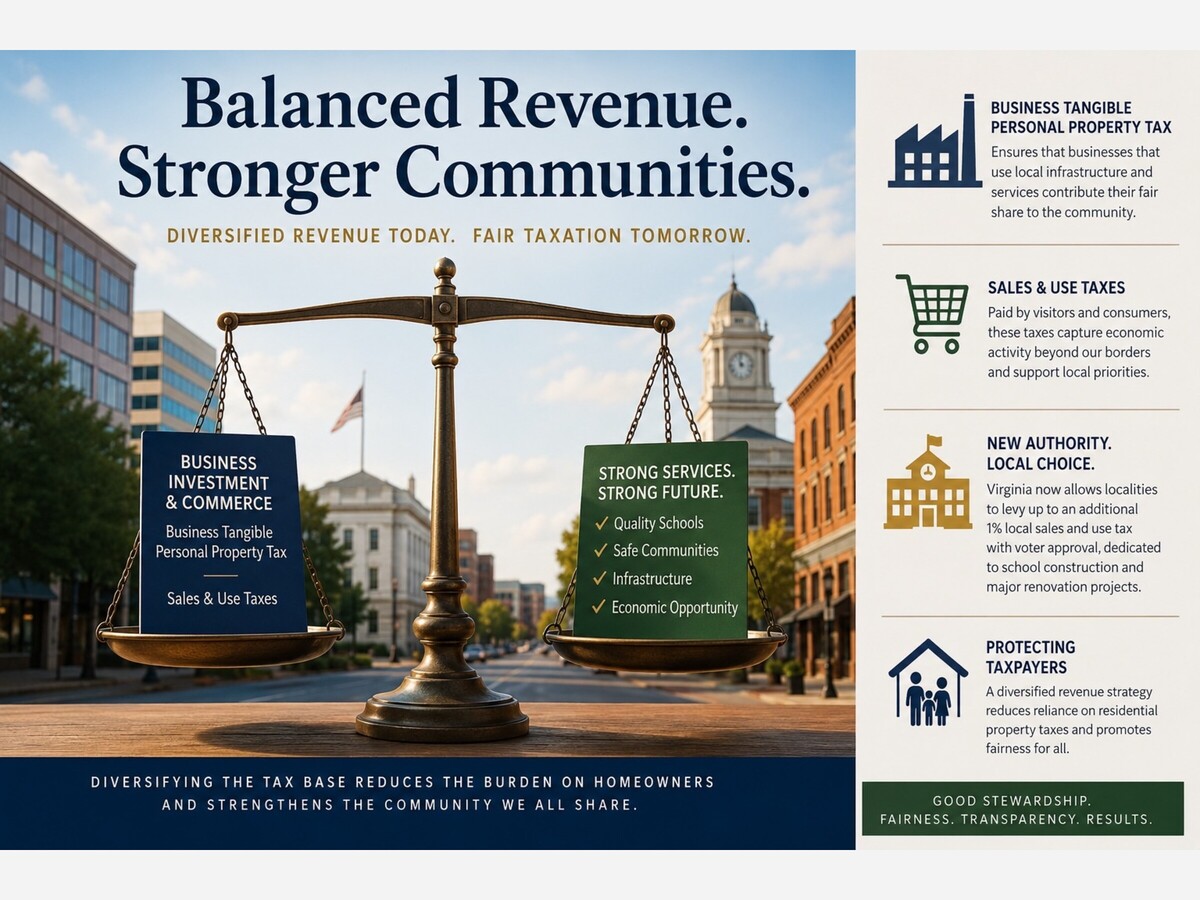
Healthy local governments depend upon balanced revenue systems rather than excessive reliance on a single tax source. Business Tangible Personal Property (BTPP) taxes and local sales and use taxes are examples of revenue mechanisms that broaden the tax base by capturing economic activity beyond residential real estate. When these sources are thoughtfully incorporated into local fiscal policy, they can strengthen public services while reducing long-term pressure to increase taxes on homeowners (Government Finance Officers Association [GFOA], 2021).
Introduction
Public discussion about local taxation often focuses on real estate assessments because they are highly visible to homeowners. However, sound public finance emphasizes diversification. A resilient revenue structure draws from multiple lawful sources so that essential services are not financed disproportionately by one class of taxpayers (GFOA, 2021). Two important components are Business Tangible Personal Property taxation and local sales and use taxes.
Business Tangible Personal Property
BTPP taxes generally apply to machinery, equipment, furniture, fixtures, and other tangible assets used in business. In Virginia, local taxation of tangible personal property is authorized by state law and administered by local governments (Va. Code Ann. § 58.1-3500 et seq.). Businesses benefit from public infrastructure, emergency services, transportation systems, and the rule of law. BTPP taxation helps ensure commercial users participate in financing those shared public goods (Virginia Department of Taxation, n.d.).
Sales and Use Taxes
Sales and use taxes diversify revenue by capturing a portion of consumer spending and economic activity. Unlike property taxes, these revenues expand as commerce expands. Virginia law authorizes qualifying localities, subject to voter approval and statutory requirements, to levy an additional local sales and use tax dedicated to school capital projects (Va. Code Ann. § 58.1-605.1). This illustrates a stewardship principle by matching an appropriate revenue source to a defined public purpose rather than relying solely on property taxation.
Why Diversification Matters
Communities that underutilize lawful commercial revenue sources frequently experience greater dependence on residential real estate taxes. While every revenue instrument has advantages and limitations, overreliance on a single source can increase fiscal pressure on homeowners during periods of rising property values. A diversified revenue portfolio distributes responsibility across multiple segments of the local economy, including business investment and consumer activity (GFOA, 2021).
Stewardship and Governance
Revenue diversification is not synonymous with increasing taxes. Rather, it is the deliberate design of a balanced revenue system. Fiscal stewardship requires elected officials and constitutional officers to evaluate whether existing revenue sources are aligned with community needs, economic development, and long-term taxpayer fairness (GFOA, 2021). Business investment, equipment ownership, and commercial activity all represent opportunities to broaden the tax base without automatically shifting additional burden to homeowners.
Conclusion
Strong local governments evaluate revenue systems as portfolios rather than isolated taxes. Business Tangible Personal Property taxes and appropriately authorized local sales and use taxes can strengthen fiscal resilience, improve alignment between economic activity and public services, and reduce excessive dependence on residential property taxation. The objective is not to tax more, but to tax more wisely through balanced, transparent, and sustainable revenue policy (GFOA, 2021; Virginia Department of Taxation, n.d.).
References
Government Finance Officers Association. (2021). Best practices for revenue diversification.
Virginia Code Ann. § 58.1-3500 et seq.
Virginia Code Ann. § 58.1-605.1.
Virginia Department of Taxation. (n.d.). Business tangible personal property tax. https://www.tax.virginia.gov/
Virginia Department of Taxation. (n.d.). Retail sales and use tax. https://www.tax.virginia.gov/


Sunny, with a high of 65 and low of 46 degrees. Sunny in the morning, clear in the afternoon and evening,