72° and Moderate or heavy rain shower
Image
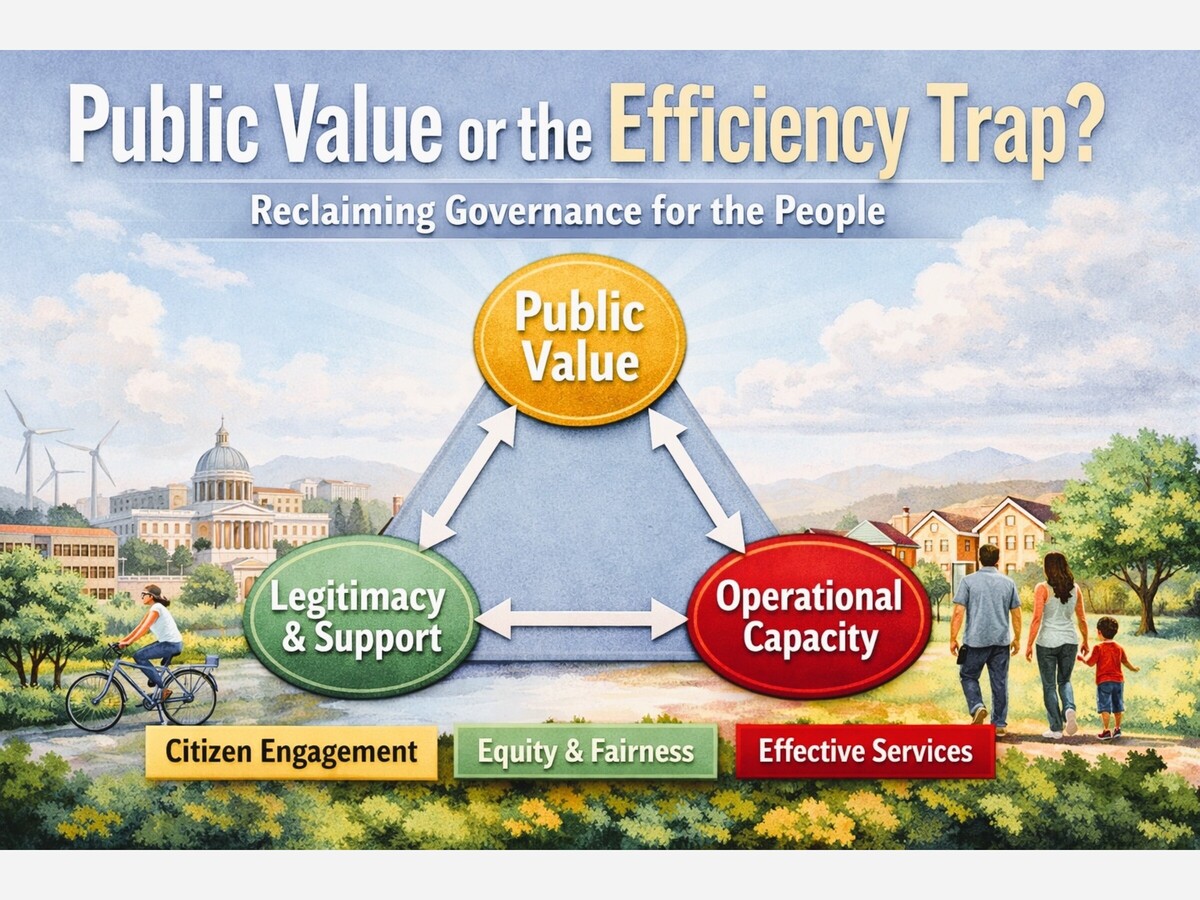



Public administration has long pursued efficiency as a defining virtue. Agencies are evaluated on how quickly they process cases, how inexpensively they deliver services, and how effectively they reduce operational burdens. These are important goals. However, when efficiency becomes the dominant objective, governance risks falling into what can be described as an efficiency trap: a condition in which systems perform well administratively while failing to deliver meaningful public value to the people they serve.
Public value theory, as articulated by Mark H. Moore, provides a corrective framework. Moore (1995) argues that public managers are not merely administrators of programs but stewards of public value, responsible for aligning operational capacity, political legitimacy, and substantive outcomes that benefit society. This alignment is captured in the strategic value triangle, which emphasizes three interdependent components: public value creation, legitimacy and support, and operational capacity (Moore, 1995). When one of these components is overemphasized at the expense of others, governance becomes imbalanced.
The Efficiency Trap in Modern Governance
Modern governance systems, particularly those influenced by New Public Management, often prioritize efficiency, cost containment, and measurable outputs (Hood, 1991). While these approaches introduced valuable discipline into public administration, they also narrowed the scope of success. A system can be efficient and still fail its citizens.
Consider property tax administration. Local governments rely on property assessments to determine tax liabilities. From an efficiency perspective, the goal may be to process assessments quickly, standardize valuation models, and ensure revenue stability. Yet for citizens, these assessments materialize as monthly mortgage payments, escrow adjustments, and, ultimately, financial strain or stability within the household. When assessments are perceived as inaccurate or unresponsive to local realities, efficiency in processing does not translate into fairness in outcome.
Research supports this tension. Public service performance that focuses solely on efficiency can undermine trust if citizens perceive outcomes as inequitable or disconnected from their lived experiences (Van de Walle & Bouckaert, 2003). In contrast, trust in government is strongly associated with perceptions of fairness, responsiveness, and outcome quality (OECD, 2017). The implication is clear: efficiency alone is insufficient as a governing objective.
Public Value as a Governance Standard
Public value theory expands the definition of success. It asks whether policies and services improve the well being of the public, whether they are perceived as legitimate, and whether they are sustainably delivered. This framework aligns closely with contemporary governance challenges, where citizens demand not only effective services but also transparency, equity, and voice.
Empirical evidence reinforces the connection between governance quality and citizen wellbeing. Studies have shown that higher levels of government effectiveness and institutional quality are associated with improved life satisfaction and societal wellbeing (Helliwell et al., 2021). This relationship underscores a central premise of public value theory: when governance reflects the needs and voices of the people, the result is not only better policy outcomes but also a more satisfied and engaged citizenry.
From my professional experience in tax administration, public administration strategy, and IT Business Relationship Management, this principle is not theoretical. It is operational. In tax administration, I have observed how compliance systems that prioritize throughput over understanding can erode trust. Conversely, when systems are designed to consider taxpayer circumstances, provide clear communication, and ensure equitable treatment, compliance improves alongside public confidence.
In IT Business Relationship Management, the alignment between business needs and technology solutions mirrors Moore’s strategic triangle. Technology initiatives that are efficient but not aligned with stakeholder needs fail to deliver value. Similarly, public sector digital transformation must go beyond automation and cost savings. It must enhance accessibility, responsiveness, and trust.
Counterarguments and Rebuttal
Critics may argue that efficiency is necessary to manage limited public resources and that expanding the scope to public value introduces subjectivity and complexity. This argument holds that measurable outputs provide accountability, while broader concepts like public value are difficult to quantify.
While resource constraints are real, this perspective is incomplete. Efficiency without legitimacy and value can produce systems that are technically sound but socially rejected. The administrative burden literature demonstrates that overly complex or impersonal systems can discourage participation and reduce program effectiveness (Herd & Moynihan, 2018). In such cases, efficiency gains are offset by reduced uptake, increased appeals, and diminished trust.
Furthermore, public value is not inherently unmeasurable. Indicators such as citizen satisfaction, trust in government, service accessibility, and equity outcomes provide meaningful metrics for evaluating value creation (OECD, 2017). The challenge is not measurement itself, but the willingness to broaden what is measured.
From Policy to Household Impact
Public value governance becomes most tangible when viewed through its impact on daily life. Property assessments influence mortgage payments. Zoning decisions affect housing affordability. Transportation policies determine commute times and access to opportunity. Environmental policies shape air quality and public health.
When citizens feel that their voices are heard and reflected in these decisions, governance gains legitimacy. When decisions are perceived as disconnected or imposed, trust declines. Public value theory emphasizes that governance must be responsive to the people it serves, not merely efficient in its internal processes.
Toward a Modernized Public Value Approach
Implementing a public value framework requires intentional leadership. It involves:
1. Engaging citizens meaningfully in policy development and evaluation.
2. Aligning operational systems with real world outcomes, not just administrative metrics.
3. Leveraging technology strategically to enhance accessibility and transparency.
4. Balancing efficiency with equity and responsiveness in decision making.
These steps are not abstract ideals. They are practical strategies grounded in both research and experience.
Conclusion
The choice between efficiency and public value is not binary, but the prioritization matters. When efficiency dominates, governance risks losing sight of its purpose. When public value guides decision making, efficiency becomes a tool rather than an end.
Public administration must evolve to meet the expectations of modern citizens. This evolution requires a shift from managing systems to serving people. It requires recognizing that the true measure of governance is not how efficiently services are delivered, but how meaningfully they improve the lives of those they are intended to serve.
In the end, public value is not an abstract concept. It is the lived experience of the people. When governance reflects their voices, addresses their needs, and produces fair and equitable outcomes, the result is a stronger, more trusted, and more effective public sector.
References
Helliwell, J. F., Layard, R., Sachs, J. D., & De Neve, J. E. (2021). World happiness report 2021. Sustainable Development Solutions Network.
Herd, P., & Moynihan, D. P. (2018). Administrative burden: Policymaking by other means. Russell Sage Foundation.
Hood, C. (1991). A public management for all seasons? Public Administration, 69(1), 3–19.
Moore, M. H. (1995). Creating public value: Strategic management in government. Harvard University Press.
OECD. (2017). Trust and public policy: How better governance can help rebuild public trust. OECD Publishing.
Van de Walle, S., & Bouckaert, G. (2003). Public service performance and trust in government: The problem of causality. International Journal of Public Administration, 26(8–9), 891–913.



Overcast, with a high of 88 and low of 66 degrees. Sunny in the morning, patchy rain nearby in the afternoon, light rain shower in the evening, overcast overnight.