70° and Clear
Image



Introduction
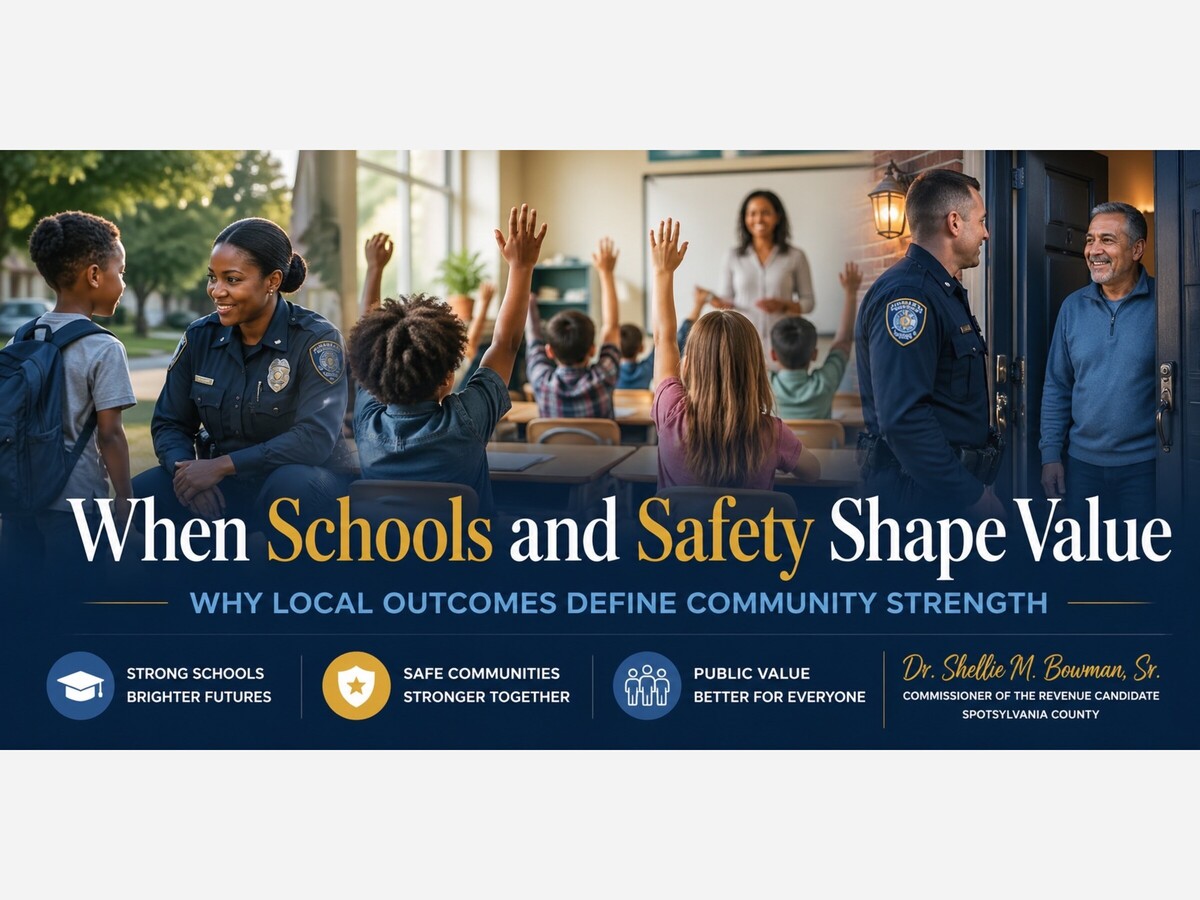
Local government is where public policy meets everyday life. It is experienced not in abstract terms, but in classrooms, neighborhoods, and the daily sense of security residents carry with them. Among the many responsibilities of local government, two stand out for their direct and lasting impact on community well-being: public education and public safety.
From a public administration perspective, the quality of a locality’s schools and its ability to provide safe communities are not isolated outcomes. They are foundational drivers of what scholars describe as public value. Public value refers to the collective benefits that government provides to society, including improved quality of life, trust in institutions, and long-term community sustainability (Moore, 1995).
When education systems perform well and communities feel safe, the effects extend beyond those domains. They influence economic stability, property values, civic engagement, and public trust. Conversely, when either education or safety falters, the consequences are often felt across the entire local system.
Public Value and Local Government
Public value is created when government actions align with the needs and expectations of the community while producing measurable improvements in outcomes. Moore (1995) conceptualized public value as the result of effective service delivery, legitimacy, and operational capacity. In the local context, schools and public safety are among the most visible and measurable expressions of this framework.
Education and safety serve as signals. They communicate to residents, businesses, and potential newcomers whether a locality is stable, well-managed, and prepared for growth. These signals influence decisions about where people live, work, and invest.
The Role of Public Education
Public education is one of the most significant long-term investments a locality can make. Strong school systems contribute to workforce readiness, higher lifetime earnings, and increased civic participation. They also shape perceptions of a community’s future.
Research shows that school quality is closely linked to property values. Families often prioritize access to strong schools when making housing decisions, which in turn influences local tax bases and economic activity (Black, 1999). A locality with high-performing schools is more likely to attract and retain residents, strengthening its fiscal capacity over time.
Education also contributes to social stability. Students who receive quality education are more likely to graduate, pursue further education or employment, and engage constructively in their communities. This reduces long-term demand on public services and supports broader economic growth (Hanushek & Woessmann, 2015).
Conversely, underperforming school systems can create a cycle of disadvantage. Lower educational attainment can lead to reduced economic opportunity, which in turn affects local revenue and increases demand for social services. From a public administration standpoint, this represents a misalignment between service delivery and long-term public value.
The Role of Public Safety
Public safety is equally central to public value. The ability of a locality to provide effective policing, emergency response, and crime prevention directly affects residents’ sense of security and quality of life.
Studies consistently show that higher crime rates are associated with lower property values and reduced economic activity. When residents perceive their environment as unsafe, they are less likely to invest in property, participate in community activities, or remain in the area long term (Chalfin & McCrary, 2017).
Effective public safety systems do more than respond to incidents. They build trust between residents and institutions. Procedural justice research demonstrates that when individuals perceive law enforcement as fair and transparent, they are more likely to cooperate and comply with the law (Tyler, 2006). This cooperation enhances overall community stability.
Public safety also affects local government costs. High crime environments often require increased spending on law enforcement, courts, and corrections. This can strain local budgets and divert resources from other priorities, including education and infrastructure.
The Interconnection of Education and Safety
Education and safety are not independent systems. They are deeply interconnected.
Communities with strong schools often experience lower crime rates over time, as educational attainment is associated with reduced likelihood of criminal activity (Lochner & Moretti, 2004). At the same time, safe environments are necessary for effective learning. Students perform better in environments where they feel secure and supported.
This interdependence means that improvements in one area can reinforce progress in the other. Localities that invest in both education and safety are more likely to achieve sustained increases in public value.
Measuring Public Value in Practice
Leading localities across the United States increasingly rely on performance measurement frameworks to assess and improve public value. These frameworks often include:
Educational outcomes such as graduation rates, test performance, and postsecondary placement
Public safety metrics such as crime rates, response times, and community trust indicators
Economic indicators, including property values and business development
Resident satisfaction and engagement measures Performance management systems, such as those associated with results-based accountability and balanced scorecard approaches, allow local governments to track progress and align resources with outcomes (Kaplan & Norton, 1996; Behn, 2003).
These methods emphasize continuous improvement. They encourage leaders to move beyond assumptions and base decisions on data, outcomes, and community feedback.
Reasonable Examples
Consider a locality that invests in improving its school system through targeted support for teachers, updated facilities, and student services. Over time, graduation rates increase, families are drawn to the area, and property values rise. The expanded tax base provides additional resources for public services, reinforcing the locality’s overall strength.
Now consider a locality that prioritizes community-based public safety strategies, including transparency, responsiveness, and engagement. As trust improves and crime decreases, businesses are more likely to invest, and residents feel more secure. This contributes to economic growth and a stronger sense of community cohesion.
In both cases, the improvements in education and safety generate broader benefits that extend well beyond their immediate domains. This is the essence of public value creation.
A Practical Tip for Public Leaders
Public leaders seeking to improve public value should adopt a simple but powerful practice:
Regularly align budget decisions with measurable outcomes in education and public safety.
This means moving beyond incremental budgeting and asking a fundamental question:
Are resources being allocated in ways that improve outcomes residents can see and feel?
By tying funding decisions to clear performance metrics, leaders can ensure that investments in schools and safety translate into tangible improvements. This approach strengthens accountability, builds public trust, and enhances long-term sustainability.
Conclusion
The quality of public education and the effectiveness of public safety systems are not merely operational concerns. They are defining elements of a locality’s public value.
Communities that invest in strong schools and safe environments create conditions for growth, stability, and opportunity. Those who struggle in these areas often face broader challenges that affect every aspect of local life.
From a public administration perspective, the path forward is clear. Public value is not created by intention alone. It is created through disciplined investment, measurable outcomes, and a commitment to aligning services with community needs.
When schools succeed, and communities feel safe, local government fulfills its most important purpose. It improves the lives of the people it serves.
References
Behn, R. D. (2003). Why measure performance? Different purposes require different measures. Public Administration Review, 63(5), 586–606.
Black, S. E. (1999). Do better schools matter? Parental valuation of elementary education. The Quarterly Journal of Economics, 114(2), 577–599.
Chalfin, A., & McCrary, J. (2017). Criminal deterrence: A review of the literature. Journal of Economic Literature, 55(1), 5–48.
Hanushek, E. A., & Woessmann, L. (2015). The knowledge capital of nations: Education and the economics of growth. MIT Press.
Kaplan, R. S., & Norton, D. P. (1996). The balanced scorecard: Translating strategy into action. Harvard Business School Press.
Lochner, L., & Moretti, E. (2004). The effect of education on crime: Evidence from prison inmates, arrests, and self-reports. American Economic Review, 94(1), 155–189.
Moore, M. H. (1995). Creating public value: Strategic management in government. Harvard University Press.
Tyler, T. R. (2006). Why people obey the law. Princeton University Press.



Sunny, with a high of 89 and low of 69 degrees. Sunny for the morning, clear in the afternoon and evening,