By Shellie Bowman Editor Public Agenda Senior Columnist The Spotsylvania Gazette February 12, 2026
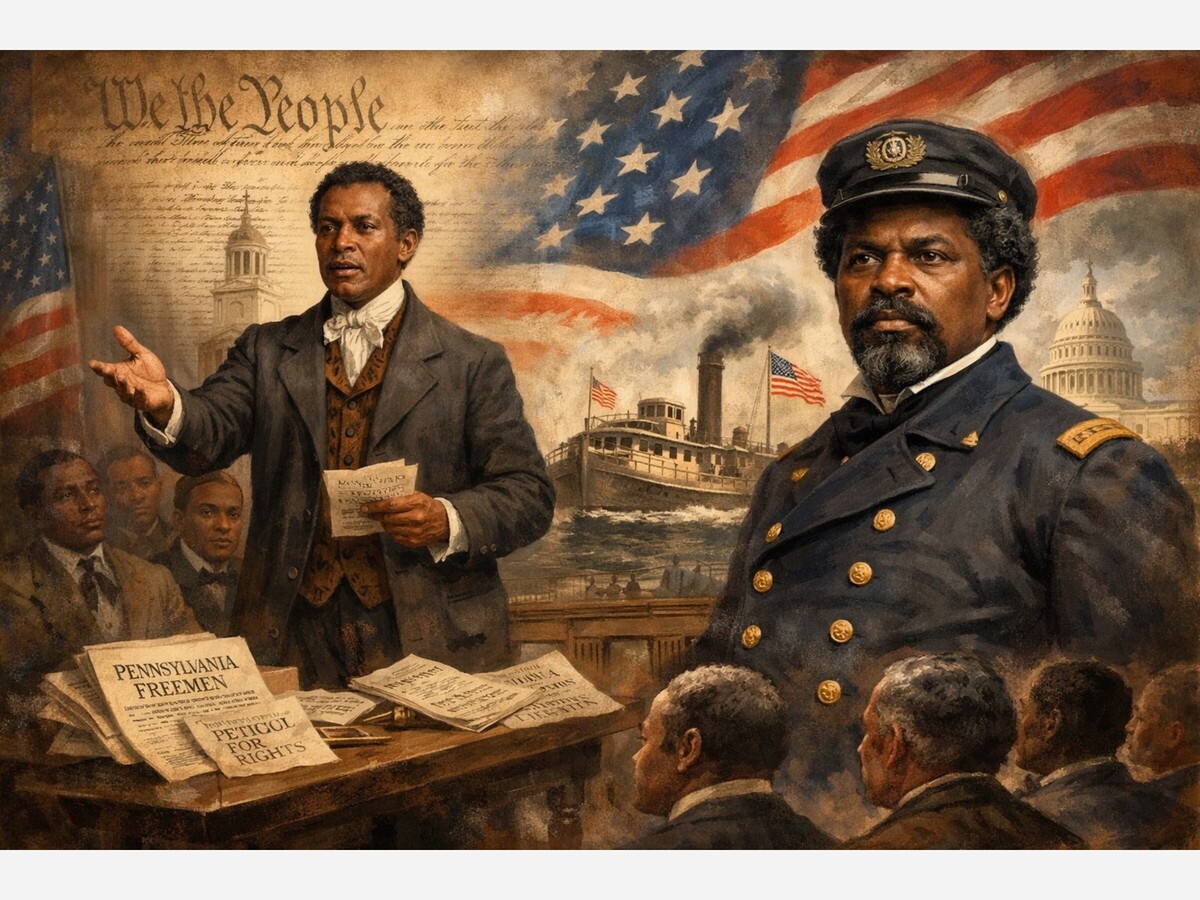
Black History Month often invites us to revisit familiar names. Yet the architecture of American democracy was not shaped by a single generation of founders, nor by one race alone. Alongside Madison and Hamilton stood Black statesmen whose contributions to constitutional governance, civic reform, and public administration demand equal intellectual regard. Two figures in particular, James Forten and Robert Smalls, illuminate how Black political thought and institutional leadership helped shape the American constitutional order.
James Forten was born free in Philadelphia in 1766, but freedom in law did not translate into equality in life. As a teenager, he served aboard an American privateer during the Revolutionary War. Captured by the British, he endured imprisonment on a ship where the air was thick with disease and the stench of confinement. The wooden hull creaked beneath men who had wagered their lives on an experiment in republican self-government that did not yet fully include them. Forten survived. He returned to Philadelphia and built a prosperous sailmaking business, but he did not retreat into private success. He entered public life.
Forten became one of the most influential Black civic leaders in the early republic. In 1813, he authored a series of pamphlets opposing a proposed Pennsylvania law that would have required Black residents to register and carry documentation verifying their freedom. His argument was constitutional in structure and civic in tone. He framed Black Pennsylvanians as citizens entitled to the protections of republican government, not as supplicants asking for charity (Winch, 2002). Forten and other Black leaders organized petitions, mobilized public opinion, and ultimately defeated the proposed measure. His activism helped define early American constitutional discourse around citizenship, due process, and equal protection before those phrases were formally embedded in the Fourteenth Amendment.
Historians have documented that free Black communities in the early republic developed sophisticated political networks, petition campaigns, and civic associations that influenced state policy and national debates (Berlin, 2003). Forten was central to this movement. He supported abolitionist efforts, funded anti-slavery newspapers, and worked alongside reformers to shape public dialogue. In an era when the Constitution was still being interpreted and contested, Forten practiced statesmanship through civic engagement and constitutional argumentation. His work foreshadowed later struggles over equal protection and civil rights.
If Forten represents constitutional advocacy in the early republic, Robert Smalls represents constitutional reconstruction after slavery. Smalls was born enslaved in Beaufort, South Carolina, in 1839. As a young man, he was hired out to work on the Charleston waterfront. In 1862, during the Civil War, Smalls piloted the Confederate transport ship Planter. In the predawn darkness of May 13, he executed one of the most daring acts of self liberation in American history. With his family and other enslaved crew members hidden aboard, Smalls donned the captain’s hat, navigated past Confederate checkpoints, and delivered the ship to Union forces. He secured freedom not only for himself but for others who trusted him with their lives.
Smalls later served in the Union Navy and entered politics during Reconstruction. He was elected to the South Carolina legislature and then to the United States House of Representatives. As a delegate to the South Carolina Constitutional Convention of 1868, Smalls helped craft one of the most progressive state constitutions of the nineteenth century. It established a system of free public education and expanded civil and political rights (U.S. House of Representatives, 2008). Reconstruction scholars note that Black legislators played decisive roles in building public school systems, revising tax structures, and redefining citizenship in the former Confederacy (Foner, 1988). Smalls stood among them as both symbol and policymaker.
Biographer Stephen Miller describes Smalls as a “Gullah statesman” whose leadership bridged local knowledge and national politics (Miller, 1995). He advocated for equal access to public accommodations and defended federal civil rights legislation. Smalls understood public administration not as abstract theory but as lived governance. He had known bondage. He had navigated literal waters under threat of death. In legislative halls, he navigated constitutional waters with similar courage.
Framing Forten and Smalls alongside the so called founding fathers is not rhetorical excess. It is historical correction. Both men engaged constitutional principles at moments of national vulnerability. Forten intervened when states tested the boundaries of citizenship. Smalls rebuilt governance structures after the collapse of slavery. Each operated within, and expanded, the American constitutional project.
Their stories also speak to contemporary governance. Debates today over voting access, citizenship, public education, and equal protection echo the very questions Forten and Smalls confronted. Public administrators and civic leaders continue to wrestle with how institutions can embody constitutional values in practice. The expansion of public schooling during Reconstruction, shaped in part by leaders like Smalls, laid groundwork for modern administrative states. The petition campaigns organized by Forten prefigured organized civic advocacy that remains central to democratic accountability.
As a Doctor of Public Administration, I view their legacies not merely as historical anecdotes but as institutional contributions. They remind us that constitutional governance is strengthened when those once excluded become architects of the system. They demonstrate that civic courage can translate into durable public institutions. And they challenge us to broaden our understanding of who counts as a founder.
Black History Month should not confine these figures to commemorative space. It should restore them to constitutional space. Forten and Smalls were not peripheral actors. They were statesmen. They engaged the law, shaped policy, and strengthened the republic under conditions that would have broken lesser spirits. To study them is to see American democracy more clearly, and to understand that its endurance has always depended on voices determined to widen its promise.
As we honor Black History Month, may it be a season not only of remembrance, but of intellectual renewal and civic clarity. May we study our past with honesty, preserve it with integrity, and teach it without dilution or convenience. Black history is American history. It is not a footnote to the national story, but part of its constitutional foundation, and it deserves to be told as it was, in full truth and full dignity.
If this reflection enriched you in any way, I invite you to share it with someone who may find it enlightening as well. Let us continue learning, teaching, and strengthening our democracy together.
Peace, Dr. Shellie
References
Berlin, I. (2003). Generations of captivity: A history of African American slaves. Harvard University Press.
Foner, E. (1988). Reconstruction: America’s unfinished revolution, 1863–1877. Harper and Row.
Miller, S. (1995). Gullah statesman: Robert Smalls from slavery to Congress, 1839–1915. University of South Carolina Press.
U.S. House of Representatives. (2008). Black Americans in Congress, 1870–2007. U.S. Government Printing Office.
Winch, J. (2002). A gentleman of color: The life of James Forten. Oxford University Press.
Public Agenda is free today. But if you enjoyed this post, you can tell Public Agenda that the writing is valuable by pledging a future subscription. You won’t be charged unless payments are enabled.
 69° and Overcast