


Image
The Question Behind Public Trust
Imagine discovering an error in a government record that affects your financial obligations. You contact the responsible agency, explain the problem, and eventually receive a correction. From the citizen’s perspective, the immediate concern has been resolved. Yet a larger question remains: What would have happened if you had never discovered the error?
Would the agency’s internal processes have identified it? Would someone have investigated its cause? And perhaps most importantly, would the institution have taken steps to prevent the same mistake from affecting someone else?
These questions reach the heart of government accountability.
Public discussions often emphasize transparency, particularly access to government records, public meetings, financial reports, and explanations of official decisions. These mechanisms are essential to democratic governance. However, transparency and accountability are not interchangeable.
Transparency makes government actions visible. Accountability requires institutions and officials to answer for those actions and respond appropriately when their performance falls short.
That distinction is noteworthy because citizens should not have to become investigators merely to receive fair, lawful, and competent public service.
Accountability Must Exist Before the Public Asks
The Organisation for Economic Co-operation and Development (OECD, 2020) explains that public accountability encompasses answerability and enforcement. Answerability involves providing information, explanations, and justifications for official conduct. Enforcement concerns the institutional capacity to respond to unlawful, improper, ineffective, or inefficient actions.
Together, these dimensions establish an important principle: Providing information is necessary, but it is not sufficient.
An agency might publish its expenditures while lacking adequate procedures to verify their accuracy. A department might disclose performance statistics without investigating persistent service failures. An elected official might explain a decision without establishing a meaningful process for evaluating its consequences.
In each case, transparency exists to some degree, but the mechanisms needed to demonstrate accountability may remain incomplete.
This is why public accountability must operate continuously, including when there is no public controversy, media inquiry, or election approaching.
The Green Book: Accountability by Institutional Design
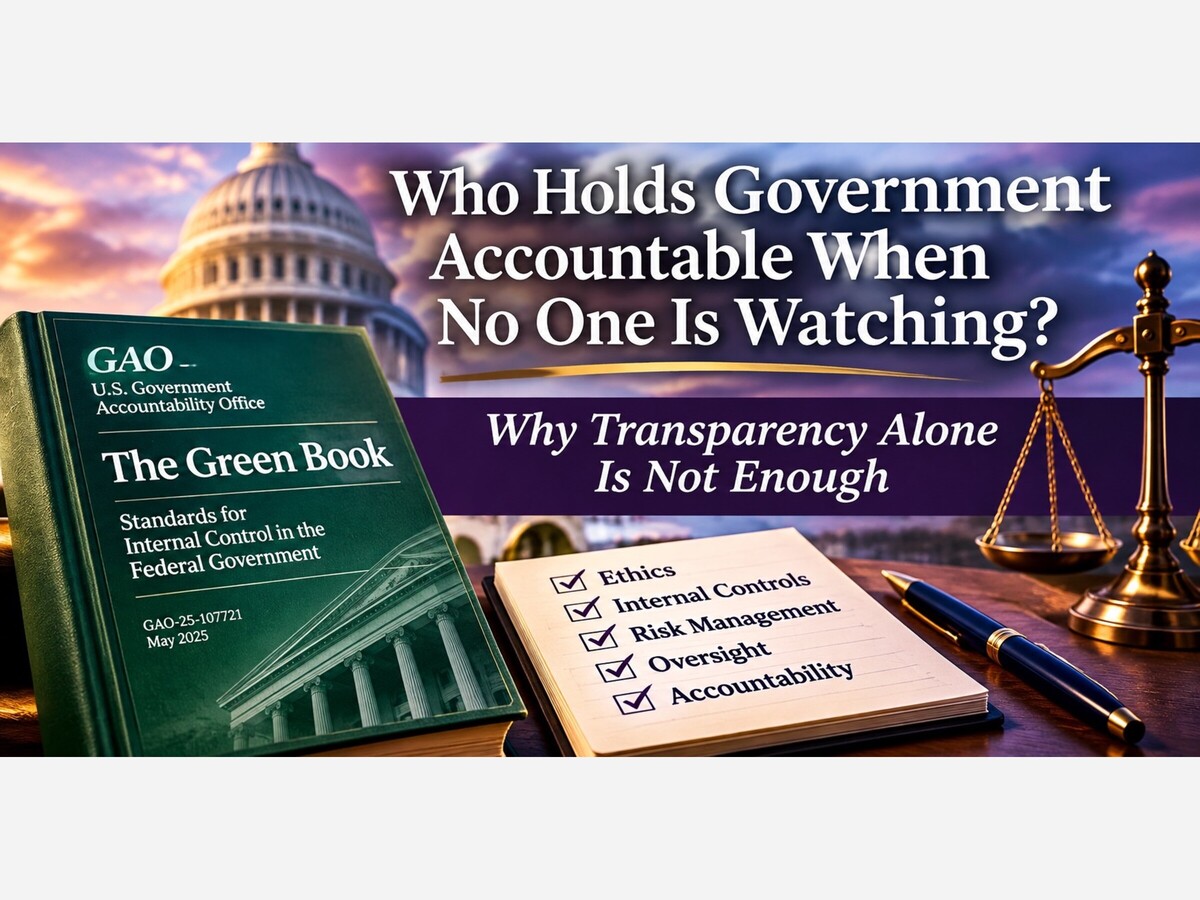
The U.S. Government Accountability Office (GAO) offers an authoritative framework for understanding how accountability can become part of everyday government operations.
Its Standards for Internal Control in the Federal Government, commonly known as the Green Book, establish standards for designing, implementing, and maintaining effective internal controls. Updated in May 2025 and effective beginning in fiscal year 2026, the framework emphasizes management responsibility, preventive controls, risk assessment, and the protection of public resources (GAO, 2025).
Although developed for federal agencies, the Green Book may also be adopted by state and local governments and other organizations seeking to strengthen internal control systems (GAO, n.d.).
The framework organizes internal control around five interconnected components:
Control environment. Leadership establishes ethical expectations, organizational responsibilities, and standards of conduct.
Risk assessment. Institutions identify and evaluate conditions that could prevent them from achieving their objectives.
Control activities. Policies and procedures help prevent, detect, and address errors or improper actions.
Information and communication. Reliable information moves to the people who need it, supporting informed decisions and responsible oversight.
Monitoring activities. Institutions evaluate whether controls are functioning and address identified deficiencies.
These components illustrate why accountability cannot depend exclusively on the personal integrity of a single leader.
Ethical leadership matters enormously. Nevertheless, even well-intentioned public servants operate within systems that may contain outdated technology, unclear responsibilities, inadequate training, or insufficient oversight.
A responsible institution recognizes those vulnerabilities and establishes safeguards rather than assuming that good intentions will always produce good outcomes.
Preventing Harm Is Better Than Explaining It
One particularly important feature of the 2025 Green Book revision is its increased emphasis on preventive controls.
GAO (2025) identifies fraud, improper payments, information security, and significant organizational changes as areas requiring deliberate risk management. The updated standards also emphasize documenting risk assessments and adapting internal controls when circumstances change.
These requirements reflect a fundamental principle of public stewardship: Government should seek to prevent avoidable harm rather than relying entirely on corrective action after damage occurs.
Consider the implications for everyday public administration.
An inaccurate tax record may create an improper financial obligation. An inadequate payment control may permit public money to be disbursed incorrectly. A weak information-security process may expose confidential records. An unclear administrative procedure may cause residents to receive inconsistent treatment.
These are illustrative possibilities, not allegations concerning any particular agency.
What connects them is the importance of institutional safeguards.
Effective controls cannot guarantee that errors will never occur. They can, however, reduce exposure to preventable risks, improve the likelihood of detecting problems, and establish responsibility for responding when something goes wrong.
For citizens, these safeguards are not abstract administrative concepts. They are mechanisms of protection.
Who Actually Holds Government Accountable?
The answer is neither one person nor one institution.
Public accountability operates through overlapping responsibilities.
Elected officials exercise oversight and answer to the electorate. Public administrators must manage operations according to applicable laws, professional standards, and organizational responsibilities. Auditors, inspectors general, courts, and other oversight bodies provide independent scrutiny within their respective jurisdictions.
Citizens, journalists, and civic organizations also contribute by asking questions, examining public information, and bringing concerns to institutional attention.
Yet external scrutiny cannot substitute for sound internal management.
The OECD (2020) emphasizes that internal and external accountability mechanisms are both necessary. Internal controls help organizations manage irregularities and generate reliable information, while external oversight provides scrutiny that may be more independent of organizational leadership.
This relationship deserves particular attention.
An agency that relies entirely on external complaints to discover errors places an unreasonable burden on the people it serves. Conversely, an agency that relies only on its own assurances risks overlooking weaknesses that independent review might reveal.
The objective is not to create an atmosphere of suspicion. It is to establish an institutional culture in which questions are welcomed, evidence is examined, and corrective action is treated as a professional responsibility.
Accountability Is Also a Leadership Obligation
Public leadership carries responsibilities that extend beyond legal compliance.
A leader may satisfy a reporting requirement while failing to communicate meaningfully with the public. An institution may follow an established procedure while overlooking evidence that the procedure produces unnecessary hardship.
Responsible leadership requires the willingness to examine not only whether an action was authorized, but whether the institution is fulfilling its public purpose.
This distinction becomes especially important when mistakes occur.
An accountable leader should be prepared to acknowledge verified deficiencies, identify their causes, establish corrective measures, and evaluate whether those measures work.
That approach does not require perfection. It requires honesty, professional discipline, and a commitment to organizational learning.
Indeed, an institution’s response to an error may reveal more about its commitment to accountability than the absence of reported problems.
The goal should never be to create a government that appears incapable of making mistakes.
The goal should be to build a government capable of recognizing mistakes, correcting them responsibly, and learning from them.
From Public Visibility to Public Protection
Ultimately, government accountability is inseparable from the interests of the people.
Citizens entrust public institutions with financial resources, personal information, legal authority, and decisions that can substantially affect their lives. That trust creates an obligation to establish systems worthy of the responsibility.
The Green Book provides a practical framework for meeting that obligation. The OECD’s public integrity research reinforces the importance of answerability, independent oversight, and appropriate institutional responses.
Together, these perspectives demonstrate that accountability must be more than a promise made during a public meeting or election campaign.
It must be embedded in how government operates.
When citizens ask whether their government is accountable, they should be able to examine more than published reports and official statements. They should be able to identify credible safeguards, clear responsibilities, meaningful opportunities for review, and evidence that identified problems are addressed.
And that returns us to the opening question.
Who holds government accountable when no one is watching?
The answer should be found in the institution itself: in its ethical culture, its internal controls, its professional standards, and its willingness to accept independent scrutiny.
Because the true measure of government accountability is not simply what officials reveal when questioned. It is what public institutions are prepared to prevent, discover, correct, and improve, even when no one is asking.
That is how accountability moves beyond transparency.
And that is how public trust becomes something government earns through its conduct.
References
Organisation for Economic Co-operation and Development. (2020). OECD public integrity handbook. OECD Publishing. https://doi.org/10.1787/ac8ed8e8-en
U.S. Government Accountability Office. (n.d.). The Green Book. https://www.gao.gov/greenbook
U.S. Government Accountability Office. (2025). Standards for internal control in the federal government (GAO-25-107721). https://www.gao.gov/products/gao-25-107721


Sunny, with a high of 69 and low of 41 degrees. Sunny in the morning, clear in the afternoon and evening,