

Image
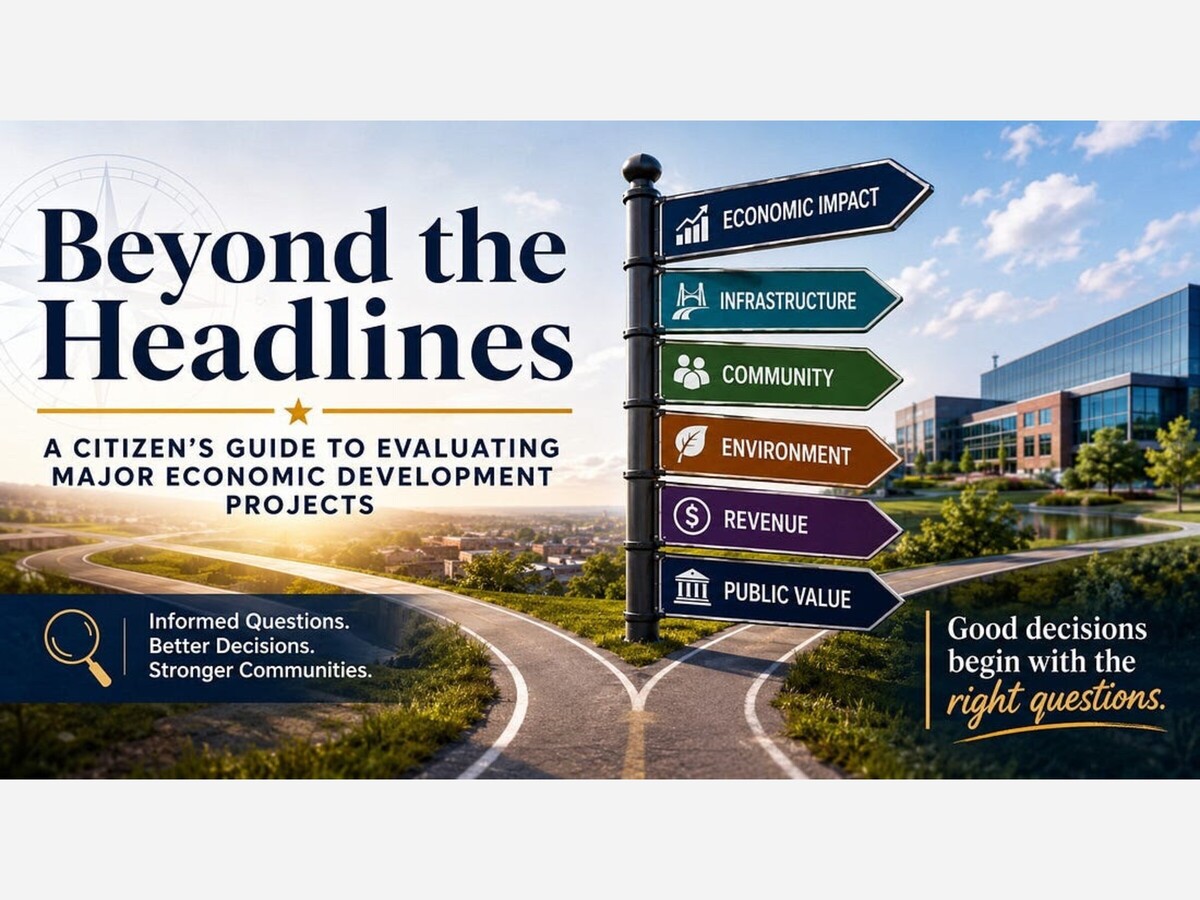
Few topics generate more public discussion than major economic development projects. Whether the proposal involves a manufacturing facility, mixed-use development, transportation investment, distribution center, technology campus (data center), sports complex, or another large-scale initiative, citizens are often presented with competing narratives. Supporters emphasize economic growth, jobs, tax revenue, and future opportunity. Opponents raise concerns about infrastructure, environmental impacts, quality of life, public costs, and unintended consequences.
In many cases, citizens are encouraged to choose a side before they have been given the tools necessary to evaluate the proposal itself.
This challenge is not unique to any one locality or project. Communities across the United States regularly confront decisions involving growth, investment, and development. The question is not whether citizens should support or oppose a particular project. The more important question is how citizens can evaluate such proposals in a thoughtful, informed, and evidence-based manner.
Major economic development projects should be evaluated not by promises or fears alone, but through a disciplined assessment of public value, projected benefits, anticipated costs, long-term sustainability, and measurable outcomes. This article offers a practical framework that citizens can use to evaluate development proposals regardless of their size, location, or purpose.
Economic development is often discussed in terms of jobs, investment, and tax revenue. While these factors are important, public administration scholars have argued that governments should evaluate public decisions through the broader concept of public value. Moore (1995) defined public value as the ability of government action to create outcomes that are beneficial to society, politically legitimate, and administratively feasible.
Under this framework, a project’s success cannot be measured solely by its economic output. Citizens and public officials must also consider whether the project advances community goals, distributes benefits fairly, and can be implemented responsibly.
Economic development projects therefore present both opportunities and obligations. They may create new sources of economic activity, but they also require communities to evaluate costs, tradeoffs, and long-term consequences.
Before evaluating any proposal, citizens should understand its stated purpose.
Projects are often presented as solutions to specific challenges, such as:
· Expanding the local tax base
· Creating employment opportunities
· Diversifying the economy
· Supporting infrastructure improvements
· Attracting new investment
· Increasing regional competitiveness
Understanding the problem being addressed helps citizens determine whether the proposed solution is appropriately aligned with the stated objective.
A project cannot be evaluated effectively if its purpose remains unclear.
Most development proposals include forecasts regarding economic or community benefits.
These projections may include:
· Job creation
· Capital investment
· New tax revenue
· Infrastructure improvements
· Secondary economic activity
· Increased business attraction
Citizens should carefully distinguish between projected benefits and guaranteed outcomes.
Forecasts are estimates based on assumptions. While projections can be valuable planning tools, they are not promises. Public administration research has repeatedly demonstrated that large projects often experience differences between projected and actual outcomes (Flyvbjerg, 2021).
This does not mean projections are inherently unreliable. It means they should be examined critically and transparently.
A comprehensive evaluation requires examining costs alongside benefits.
Financial costs may include:
· Public infrastructure improvements
· Utility expansions
· Road enhancements
· Public safety needs
· Administrative oversight
However, not all costs are financial.
Communities may also experience:
· Increased traffic
· Environmental impacts
· Changes in land use patterns
· Additional service demands
· Quality-of-life concerns
Effective decision-making requires evaluating both the visible and less visible costs associated with a project.
One of the most important questions in public administration concerns the distribution of benefits and burdens.
A project may create significant benefits for a community overall while affecting neighborhoods, businesses, or residents differently.
Citizens should ask:
· Who receives the economic benefits?
· Who experiences the direct impacts?
· Are benefits and burdens distributed equitably?
· Are affected stakeholders included in the decision-making process?
Denhardt and Denhardt (2000) argue that citizens should be viewed not merely as customers of government services but as participants in democratic governance. Meaningful participation strengthens both legitimacy and public trust.
Many public discussions focus heavily on projected outcomes but spend far less time discussing accountability.
Citizens should ask:
· What specific outcomes are expected?
· How will those outcomes be measured?
· What timeline will be used?
· Who will monitor performance?
· Will results be publicly reported?
Performance measurement has become an increasingly important component of modern public administration because it provides a mechanism for evaluating whether public investments are producing intended results (Moynihan, 2008).
Without measurable outcomes, it becomes difficult to determine whether a project has achieved its stated goals.
Every major project involves uncertainty.
Economic conditions change.
Population growth changes.
Consumer demand changes.
Technology changes.
Public administrators and elected officials therefore have a responsibility to consider multiple scenarios rather than relying solely on best-case assumptions.
Citizens should ask:
· What risks have been identified?
· What contingency plans exist?
· How will costs be managed if projections fall short?
· How resilient is the project under changing conditions?
Flyvbjerg (2021) notes that effective planning requires realistic forecasting and an acknowledgment of uncertainty. Responsible governance does not assume perfection. It prepares for variability.
The quality of a decision is influenced not only by the outcome but also by the process used to reach it.
Procedural justice research demonstrates that citizens are more likely to view decisions as legitimate when processes are transparent, consistent, and inclusive (Tyler, 2006).
For this reason, communities should evaluate:
· The availability of information
· Opportunities for public participation
· Clarity of decision-making processes
· Responsiveness to citizen concerns
Even when disagreements remain, transparent processes help strengthen confidence in public institutions.
Public discourse often encourages citizens to become either advocates or opponents of major projects.
While advocacy has an important place in democratic governance, informed citizenship requires something more fundamental: evaluation.
Communities benefit when citizens ask difficult questions, examine evidence, consider tradeoffs, and engage constructively with competing perspectives.
The goal is not to eliminate disagreement. The goal is to improve the quality of decision-making.
Major economic development projects often shape communities for decades. Their effects can influence public finances, infrastructure, employment opportunities, land use patterns, and quality of life. As a result, citizens have a legitimate interest in understanding how such decisions are made and how their consequences are evaluated.
Effective civic participation requires more than support or opposition. It requires a framework for analysis. By asking what problem a project seeks to solve, what benefits and costs are anticipated, who receives those benefits, how success will be measured, and how uncertainty will be managed, citizens can engage more thoughtfully in public discussions about growth and development.
In a democratic society, informed citizenship is not merely a right. It is a responsibility. Communities are best served when decisions are guided by evidence, transparency, stewardship, and a shared commitment to the public good. An informed citizen is the most effective citizen.
Denhardt, J. V., & Denhardt, R. B. (2000). The new public service: Serving rather than steering. Public Administration Review, 60(6), 549–559.
Flyvbjerg, B. (2021). How big things get done. Currency.
Moore, M. H. (1995). Creating public value: Strategic management in government. Harvard University Press.
Moynihan, D. P. (2008). The dynamics of performance management: Constructing information and reform. Georgetown University Press.
Tyler, T. R. (2006). Why people obey the law(2nd ed.). Princeton University Press.
Public Agenda is free today. But if you enjoyed this post, you can tell Public Agenda that the writing is valuable by pledging a future subscription. You won’t be charged unless payments are enabled.
Follow us on TikTok @DrShelliePublicAgenda
📢 Stay Connected with Public Agenda by Dr. Shellie M. Bowman
Let’s rebuild public leadership together; one insight, one question, one breakthrough at a time.
eLEADt On with Purpose.



Overcast, with a high of 63 and low of 51 degrees. Overcast during the morning, clear during the afternoon and evening, overcast overnight.