59° and Partly Cloudy



Image
By Dr Shellie M Bowman Sr
Data centers have transformed local government finance with unusual speed. Cloud computing, artificial intelligence, digital commerce, and remote information services all depend on the physical infrastructure housed in these facilities. Virginia, especially Northern Virginia, now sits at the center of that transformation, hosting the largest concentration of data center capacity in the world: approximately 13 percent of reported global operational capacity and one-quarter of the capacity in the Americas (Joint Legislative Audit and Review Commission [JLARC], 2024).
For local governments, this growth creates a major fiscal opportunity. Data centers require large investments in land, buildings, electrical systems, servers, cooling equipment, and related infrastructure. Although they typically employ far fewer permanent workers than the size of the investment might suggest, the property associated with data centers can generate substantial local tax revenue.
The opportunity is real, but it requires disciplined public governance.
Government’s responsibility does not end when private investment arrives. Public officials must determine whether tax policies, incentive agreements, infrastructure commitments, and development decisions continue to deliver a fair and measurable return for residents and existing businesses. The central question is not whether data centers are inherently good or bad. It is whether governments are structuring data center development in ways that protect economic opportunity, fiscal sustainability, taxpayer equity, and public trust.
Virginia’s leadership in the data center industry reflects several strategic advantages: extensive fiber connectivity, proximity to major population and government centers, available land, reliable electrical service, and favorable state and local tax policies.
The industry now contributes substantially to Virginia’s economy. JLARC estimated that data centers support approximately 74,000 jobs, $5.5 billion in labor income, and $9.1 billion in annual gross domestic product. Much of this activity comes from construction: a single data center building may take 12 to 18 months to complete and involve about 1,500 workers at peak construction. By contrast, an operating facility may employ about 50 permanent workers, including contractors (JLARC, 2024).
This distinction matters. Data centers are exceptionally capital-intensive, but they are not necessarily large permanent employers. Their most important ongoing benefit to local government may therefore come from taxable property rather than employment growth.
That does not diminish their value. Data centers can purchase services from local companies, support construction and skilled trades, create high-paying technical positions, and produce significant real and personal property tax revenue. Research from the Federal Reserve Bank of Richmond found that Virginia data center jobs paid considerably more than the statewide private-sector average and described positive fiscal effects in established data center jurisdictions, though outcomes vary by tax structure, development maturity, and fiscal-impact assumptions (Mullin, 2023).
Revenue diversification is a core element of sound local fiscal policy. A government that depends too heavily on one category of taxpayer becomes vulnerable to economic change and may place increasing pressure on that group as expenditures rise.
For many Virginia counties, residential real estate taxes remain a central source of local revenue. As property values, school costs, public safety demands, infrastructure needs, and debt obligations increase, homeowners can face increasingly burdensome tax bills.
Commercial investment can broaden the tax base. Data centers are especially important because their equipment can represent billions of dollars in taxable value. When properly classified, assessed, and taxed, that property can help fund public services without relying exclusively on homeowners.
Yet broadening the taxable base is not the same as realizing the full public benefit. The actual return depends on several factors:
· Applicable tax rates
· The percentage of original cost used to determine assessed value
· Depreciation schedules
· Exemptions and abatements
· Infrastructure expenses
· Incentive agreements
· Equipment replacement cycles
· The duration of any preferential tax treatment
A locality can attract substantial capital investment while retaining only a limited portion of its potential taxable value. For that reason, the announcement of a large development does not, by itself, prove that the agreement is sound fiscal policy.
State and local governments often use tax incentives to influence business-location and expansion decisions. Virginia’s retail sales and use tax exemption for qualifying data center equipment is one prominent example.
JLARC found that the exemption meaningfully influenced data center location and expansion decisions in Virginia and produced positive, though moderate, economic benefits. At the same time, it was Virginia’s largest economic-development tax incentive and accounted for more than one-fifth of the Commonwealth’s economic development incentive spending between fiscal years 2010 and 2017 (JLARC, 2019).
Benefits and costs can exist at the same time. Research on geographically targeted tax incentives shows that their effects are often complex, uneven, and difficult to capture through simple measures of net growth. Incentives may encourage new investment, but their effects on existing businesses, closures, employment, and regional development vary substantially (Bondonio & Greenbaum, 2007).
The better question is not whether incentives are always beneficial or always harmful. It is whether a particular incentive is:
1. Necessary to secure the investment
2. Proportional to the expected public benefit
3. Measurable through identifiable outcomes
4. Limited to an appropriate period
5. Transparent to the public
6. Subject to meaningful evaluation
An incentive is a public investment. It represents revenue that government chooses not to collect in anticipation of broader economic or fiscal benefits. Like any public investment, it should be evaluated against its actual return.
Virginia law now requires periodic reporting on qualifying data center expenditures, the estimated value of the state tax benefit, employment, capital investment, state and local revenue, and the overall return associated with the exemption (Virginia Department of Taxation, 2026). That requirement recognizes that continued public support should rest on evidence, not assumption.
Local tax classifications help explain why ongoing fiscal evaluation matters.
Spotsylvania County currently lists a tax rate of $1.25 per $100 of assessed value for data center computer equipment and peripherals. By comparison, the county lists $4.55 for furniture and fixtures used by other businesses and $1.90 for qualifying machinery and tools. The county also applies a depreciation schedule under which recently acquired data center equipment is assessed at a declining percentage of original cost over time (Spotsylvania County, 2026).
Different classifications are not inherently improper. Virginia law permits governing bodies to set different rates for authorized classes of tangible personal property. Different industries may also impose different public costs or respond differently to taxation.
However, significant disparities still raise legitimate taxpayer-equity questions.
A locally owned restaurant, medical practice, retailer, contractor, or professional office may pay a substantially higher tax rate on its furniture and equipment than a globally financed data center pays on its computing equipment. A preferential rate may be justified if it produces sufficient additional investment and public revenue. It should not, however, be treated as permanently beneficial without evidence of continuing need and measurable return.
When a preferential rate remains in place for an extended period, the locality may lose flexibility. Inflation may raise the cost of government. Infrastructure needs may grow. Technology may change equipment values and replacement cycles. The industry may mature to the point that incentives are no longer decisive. Meanwhile, residents and ordinary businesses may continue paying substantially higher rates.
Foregone revenue creates opportunity cost. A locality may need to defer services, borrow funds, increase another tax, raise fees, or continue relying heavily on residential and ordinary business property. This does not mean every incentive creates a budget shortfall. It means government must determine whether the revenue being forgone remains justified by the public value being received.
Economic development is often judged by visible accomplishments: new buildings, capital investment, construction employment, and corporate announcements. These markers create an understandable sense of progress.
Visible activity, however, is not the same as demonstrated public value.
Public administration requires governments to measure what happens after a policy is adopted. Performance information should help officials assess results, recognize complexity, account for equity, and revisit assumptions that no longer match operating conditions (Radin, 2006).
This principle is especially important for data centers because development is accelerating faster than many governments can evaluate its full effects.
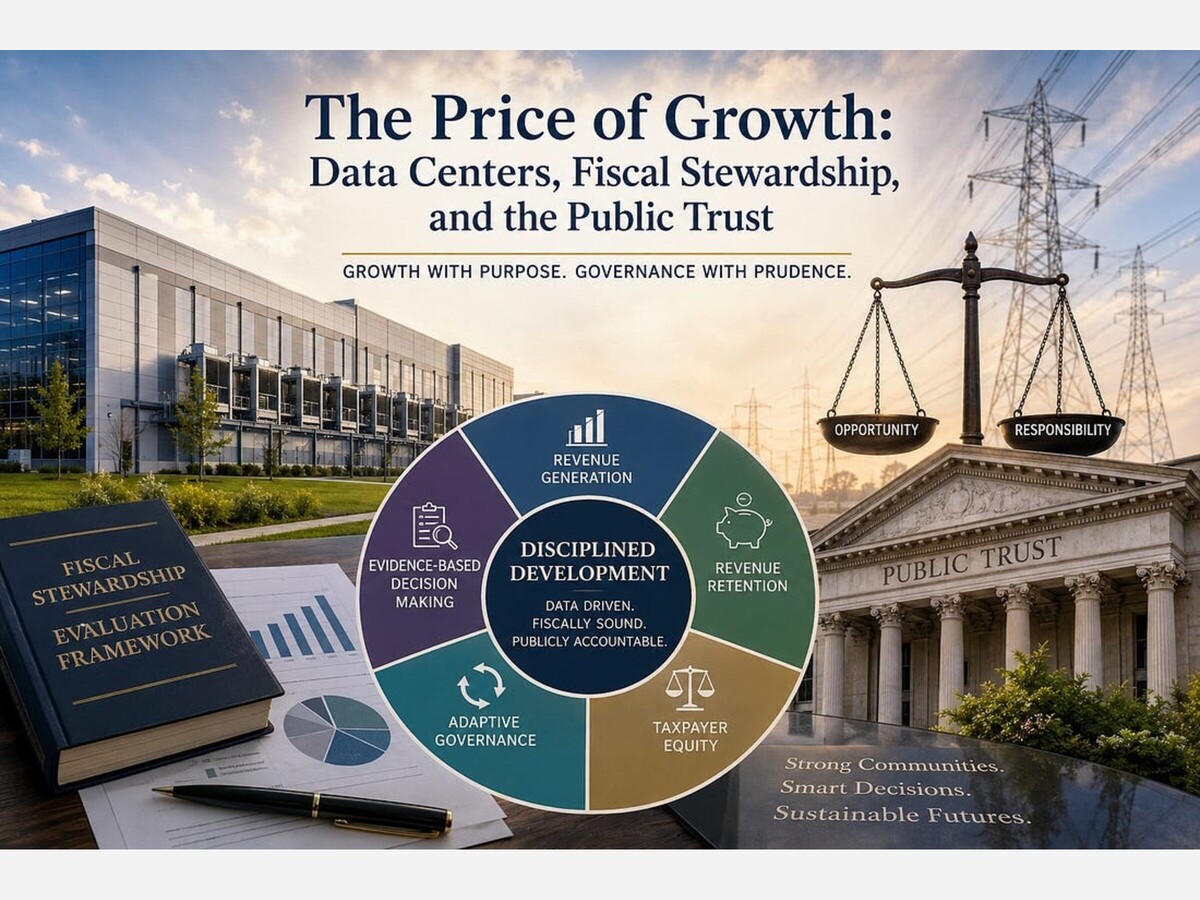
A useful governing approach may be described as Disciplined Development: the deliberate alignment of economic growth with continuing fiscal evaluation, infrastructure capacity, environmental stewardship, institutional learning, and taxpayer equity.
Disciplined Development allows governments to pursue investment while preserving their ability to test whether actual outcomes match public projections.
It is not opposition to growth. It is opposition to governing without sufficient evidence.
The pace of development should be matched by the pace of governance.
Large economic-development decisions necessarily rely on forecasts. Governments estimate capital investment, future tax revenue, employment, utility demands, infrastructure costs, and regional economic effects. Those forecasts are useful and often unavoidable.
Those forecasts, however, are not results.
A governing blind spot emerges when policy commitments move faster than government’s ability to evaluate their actual consequences.
For data centers, these blind spots may appear when officials cannot yet answer essential questions:
JLARC’s analysis shows why these questions matter. Virginia’s data centers generate substantial economic and fiscal benefits, but the industry is also expected to drive extraordinary increases in electrical demand. Meeting even part of that forecast demand may require major generation and transmission investments. The state must therefore evaluate economic development, infrastructure, utility costs, environmental effects, and fiscal policy as interconnected issues rather than isolated decisions (JLARC, 2024).
Governments should not confuse accelerated development with accelerated learning. Approving additional projects does not necessarily create enough time to understand the consequences of projects already approved.
Effective institutions learn from experience and adjust when conditions change.
Adaptive governance does not mean changing policy unpredictably. Businesses need reasonable stability, and governments should honor lawful commitments. Future agreements can still include review periods, performance measures, reporting requirements, sunset provisions, and other mechanisms that preserve both predictability and public accountability.
An incentive that made sense when a locality was entering a competitive market may not remain necessary after the market is firmly established. Likewise, a tax classification based on earlier technology and investment conditions may warrant review as equipment, energy requirements, and development patterns evolve.
Periodic evaluation is not evidence that the original decision was wrong. It is evidence that government takes its stewardship responsibility seriously.
Local governments can use five practical considerations to evaluate data center proposals and incentive structures.
Does the development measurably broaden the tax base and increase long-term fiscal capacity?
Officials should distinguish between announced investment and taxable value that will actually generate local revenue.
After exemptions, abatements, preferential rates, depreciation, grants, infrastructure costs, and other public commitments are considered, how much revenue will the locality retain?
Gross revenue projections should not be presented as net public benefit.
Are incentives proportional to demonstrated public benefits? Are residents and existing businesses carrying an unreasonable share of the fiscal burden while a highly capitalized industry receives preferential treatment?
Equity does not require identical taxation, but material differences should have a defensible public purpose.
Does the policy permit periodic review? Are there performance requirements, expiration provisions, clawbacks, or opportunities to reconsider future tax treatment?
Long-term development should not require long-term blindness.
Will future decisions be based on measured fiscal, infrastructure, environmental, and community outcomes, or will they continue relying primarily upon original projections?
Good governance uses data not merely to justify decisions, but also to test them.
Virginia’s data center industry is a major economic achievement. It supports construction, creates highly compensated technical jobs, generates substantial taxable property, and places the Commonwealth at the center of the global digital economy.
Those benefits should be recognized. So should the responsibilities that come with them.
Governments must ensure that growth does not outpace infrastructure, analytical capacity, or fiscal oversight. They must understand both the revenue generated and the revenue forgone. They must examine whether tax preferences remain necessary, whether costs are fairly distributed, and whether residents and existing businesses receive an equitable return.
This is not an argument against data centers. It is an argument for governing them responsibly.
Communities should not have to choose between economic development and responsible government. The strongest jurisdictions pursue both.
Data centers create opportunity. Fiscal stewardship determines whether that opportunity becomes lasting public value.
As Virginia continues to lead the nation in digital infrastructure, its local governments can also lead in disciplined development, taxpayer equity, transparent evaluation, and evidence-based governance. These practices are not barriers to prosperity. They are the conditions that allow prosperity to endure.
Bondonio, D., & Greenbaum, R. T. (2007). Do local tax incentives affect economic growth? What mean impacts miss in the analysis of enterprise zone policies. Regional Science and Urban Economics, 37(1), 121–136. https://doi.org/10.1016/j.regsciurbeco.2006.08.002
Joint Legislative Audit and Review Commission. (2019). Data center and manufacturing incentives: Economic development incentives evaluation series (Report No. 518). Commonwealth of Virginia. https://rga.lis.virginia.gov/Published/2020/RD148
Joint Legislative Audit and Review Commission. (2024). Data centers in Virginia. Commonwealth of Virginia. https://rga.lis.virginia.gov/Published/2025/RD206
Mullin, J. (2023). Virginia’s data centers and economic development. Econ Focus, 23(2). Federal Reserve Bank of Richmond. https://www.richmondfed.org/publications/research/econ_focus/2023/q2_fe…
Radin, B. A. (2006). Challenging the performance movement: Accountability, complexity, and democratic values. Georgetown University Press.
Spotsylvania County. (2026). Tax rates. https://www.spotsylvania.va.us/586/Tax-Rates
Virginia Department of Taxation. (2026). Virginia tax exemptions for data centers: Fiscal years 2024 and 2025. Commonwealth of Virginia. https://rga.lis.virginia.gov/Published/2026/RD40



Light drizzle, with a high of 60 and low of 54 degrees. Light drizzle during the morning, overcast during the afternoon and evening, light rain shower overnight.