

Image
By Dr Shellie M Bowman Sr
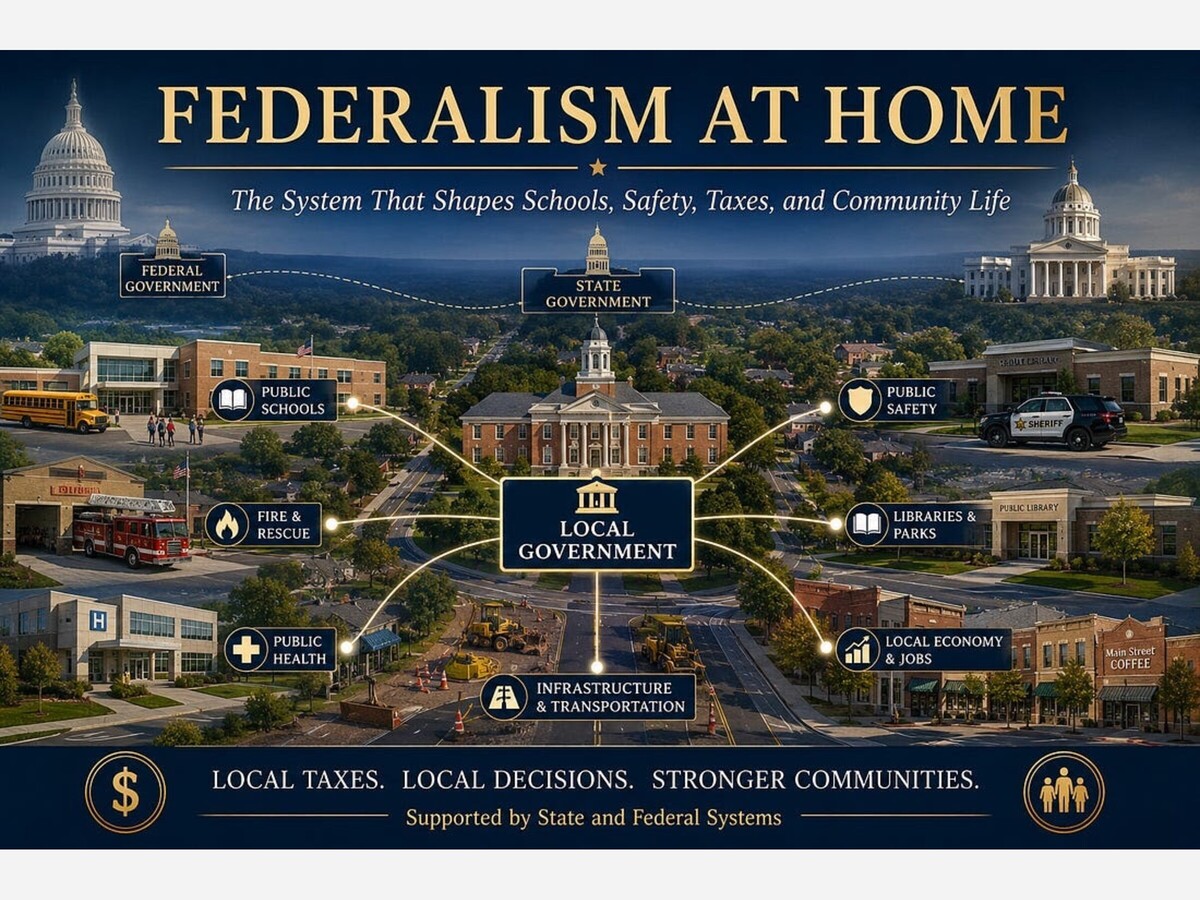
Most Americans can identify the President of the United States. Many can name their governor. Far fewer can identify the members of their local governing body, school board, or constitutional offices. Yet the quality of the schools their children attend, the effectiveness of local public safety services, the condition of roads and infrastructure, the administration of local taxes, and even the economic competitiveness of their communities are often influenced more directly by local government than by any other level of government.
This reality is not accidental. It is the product of federalism.
Federalism is often discussed as a constitutional principle or legal framework. However, its greatest significance is not found in constitutional law textbooks. It is found in the everyday lives of citizens. Federalism determines how authority, responsibilities, and resources are distributed among federal, state, and local governments. More importantly, it provides communities with the ability to address local needs while remaining part of a larger national system.
Understanding federalism helps citizens understand why local government matters, why local elections matter, and why decisions involving taxes and public revenue have such a profound impact on community life.
What Is Federalism?
The United States Constitution established a federal system of government in which authority is divided among multiple levels of government. Rather than concentrating all governmental power in a single national authority, the Constitution distributes powers among federal and state governments while reserving additional powers to the states and the people through the Tenth Amendment.
James Madison described this arrangement in Federalist No. 45, arguing that the powers delegated to the federal government would be “few and defined,” while those remaining with state governments would be “numerous and indefinite” and would concern the lives, liberties, properties, and prosperity of the people (Madison, 1788/2001). Madison recognized that the issues most closely affecting daily life would often be addressed by governments operating closest to the people.
This division of authority was designed to promote both effective governance and accountability. National issues such as defense, foreign affairs, and interstate commerce would be addressed by the federal government. Meanwhile, many matters affecting daily life would remain primarily within state and local control.
More than two centuries later, that framework continues to shape American communities.
Federalism in Everyday Life
Many citizens think of government primarily through the lens of national politics. News coverage reinforces this perception by focusing heavily on federal elections, congressional debates, and presidential actions.
Yet citizens often experience government most directly at the local level.
When a child boards a school bus, federalism is at work.
When firefighters respond to an emergency, federalism is at work.
When a county health department administers a public health program, federalism is at work.
When a property owner receives a tax assessment, federalism is at work.
The practical operation of government depends upon an interconnected system in which federal, state, and local governments each perform distinct but complementary functions.
This arrangement allows communities to address local priorities while benefiting from broader state and federal support.
Schools, Safety, and Public Health
Perhaps nowhere is the impact of federalism more visible than in the delivery of essential public services.
Public education provides a useful example. While federal programs support certain educational initiatives, local governments and school boards often make decisions regarding facilities, staffing, curriculum implementation, and budget priorities. Consequently, local leadership decisions can significantly influence educational outcomes.
Public safety functions similarly. Law enforcement agencies, fire and rescue departments, emergency management programs, and local courts are largely administered at the state and local levels. These services are funded through a combination of local revenues, state support, and, in some cases, federal assistance.
Public health also illustrates the interdependent nature of federalism. Federal agencies establish broad policy frameworks and provide funding, states administer many health-related programs, and local health departments frequently serve as the primary point of contact for citizens.
In each case, federalism creates a layered system of governance designed to balance national consistency with local responsiveness.
Federalism and Local Revenue
Federalism is not merely a system of political authority. It is also a system of fiscal responsibility.
Governments cannot provide services without resources. Consequently, federalism requires the allocation of revenue-raising authority among different levels of government.
This concept is commonly known as fiscal federalism.
According to Oates (1999), one of the central questions of fiscal federalism concerns the assignment of functions and financial responsibilities among levels of government. The theory suggests that decentralized governments are often better positioned to respond to local preferences and needs because they operate closer to the populations they serve.
For local governments, revenue typically comes from sources such as:
These revenues support the services citizens rely upon every day.
As a result, discussions about taxation are ultimately discussions about community priorities.
Tax rates, assessments, economic development strategies, and budget decisions influence the resources available for schools, public safety, infrastructure, libraries, parks, and other public services.
Citizens often view taxes as a cost. However, taxes also represent an investment in the institutions and services that contribute to community well-being.
Why Local Voting Matters
Federalism provides local communities with significant influence over local outcomes. However, that influence depends upon citizen participation.
Local elections often receive substantially lower voter turnout than national elections. Yet the officials selected in local elections frequently make decisions that have immediate and visible effects on daily life.
School boards influence educational priorities.
Boards of supervisors and city councils establish budgets and tax policies.
Constitutional officers administer important public functions.
Planning commissions influence growth and development.
These decisions affect how public resources are allocated and how services are delivered.
Consequently, local elections are not merely administrative exercises. They are opportunities for citizens to influence the future direction of their communities.
A citizen’s vote for a local office may have a greater direct impact on community services than a vote cast in many national elections.
The Connection Between Revenue and Public Value
Citizens frequently ask a reasonable question:
What am I receiving for my tax dollars?
The answer lies at the intersection of federalism, public administration, and public value.
Revenue collection is not an end in itself. The purpose of revenue is to support public services and community outcomes.
Effective schools contribute to workforce development.
Reliable public safety services promote stability.
Infrastructure supports commerce and mobility.
Public health initiatives protect community well-being.
Economic development expands opportunities for businesses and residents.
In this sense, local tax and revenue systems function as mechanisms through which communities invest in their collective future.
The question is not simply how much revenue is collected. The more important question is whether those resources are managed effectively, transparently, and responsibly.
Federalism and Civic Responsibility
Federalism provides citizens with something many political systems throughout history have struggled to achieve: proximity.
The governments most responsible for many daily services are often located within the communities they serve.
This proximity creates opportunities for participation, accountability, and responsiveness.
Citizens can attend local meetings.
They can engage elected officials.
They can participate in public hearings.
They can vote in local elections.
And they can influence decisions affecting their schools, neighborhoods, businesses, and families.
Federalism works best when citizens understand both the responsibilities of government and their own role in shaping it.
Conclusion
Federalism is more than a constitutional arrangement. It is the system that shapes many of the services, institutions, and opportunities that define community life.
Through the division of authority among federal, state, and local governments, federalism helps ensure that decisions affecting schools, public safety, public health, economic development, and local taxation can be made closer to the people they serve.
The health of local communities depends not only upon effective government but also upon informed and engaged citizens.
While national politics often dominates public attention, the quality of local schools, the effectiveness of emergency services, the administration of public resources, and the strength of local economies are frequently determined much closer to home.
For that reason, understanding federalism is not simply a matter of civic education.
It is a matter of civic responsibility.
References
Madison, J. (2001). Federalist No. 45: The alleged danger from the powers of the Union to the state governments considered. In C. Rossiter (Ed.), The Federalist Papers (Original work published 1788).
Oates, W. E. (1999). An essay on fiscal federalism. Journal of Economic Literature, 37(3), 1120–1149.
Ostrom, V., Tiebout, C. M., & Warren, R. (1961). The organization of government in metropolitan areas: A theoretical inquiry. American Political Science Review, 55(4), 831–842.
Public Agenda is free today. But if you enjoyed this post, you can tell Public Agenda that the writing is valuable by pledging a future subscription. You won’t be charged unless payments are enabled.
Follow us on TikTok @DrShelliePublicAgenda
📢 Stay Connected with Public Agenda by Dr. Shellie M. Bowman
Let’s rebuild public leadership together; one insight, one question, one breakthrough at a time.
eLEADt On with Purpose.

Sunny, with a high of 72 and low of 50 degrees. Sunny in the morning, clear in the afternoon and evening,