

Image
By Dr Shellie M Bowman Sr
June 4, 2026
Every tax season, citizens across America ask a familiar question:
What am I getting for my tax dollars?
Some ask the question with frustration. Others ask it with curiosity. Many ask it because they genuinely struggle to see the connection between the taxes they pay and the services they receive. Regardless of the motivation, the question reveals something important about the relationship between citizens and government.
Most people are not simply evaluating taxation.
They are evaluating value.
In the private sector, investors routinely examine return on investment. Before committing resources, they want to understand whether the anticipated benefits justify the costs. While taxation differs fundamentally from private investment, many citizens evaluate taxes through a similar lens. They want to know whether the resources collected from their households are producing meaningful benefits for their families and communities.
Consequently, conversations about taxation should not begin and end with tax rates. They should also include discussions about value creation, public outcomes, and stewardship.
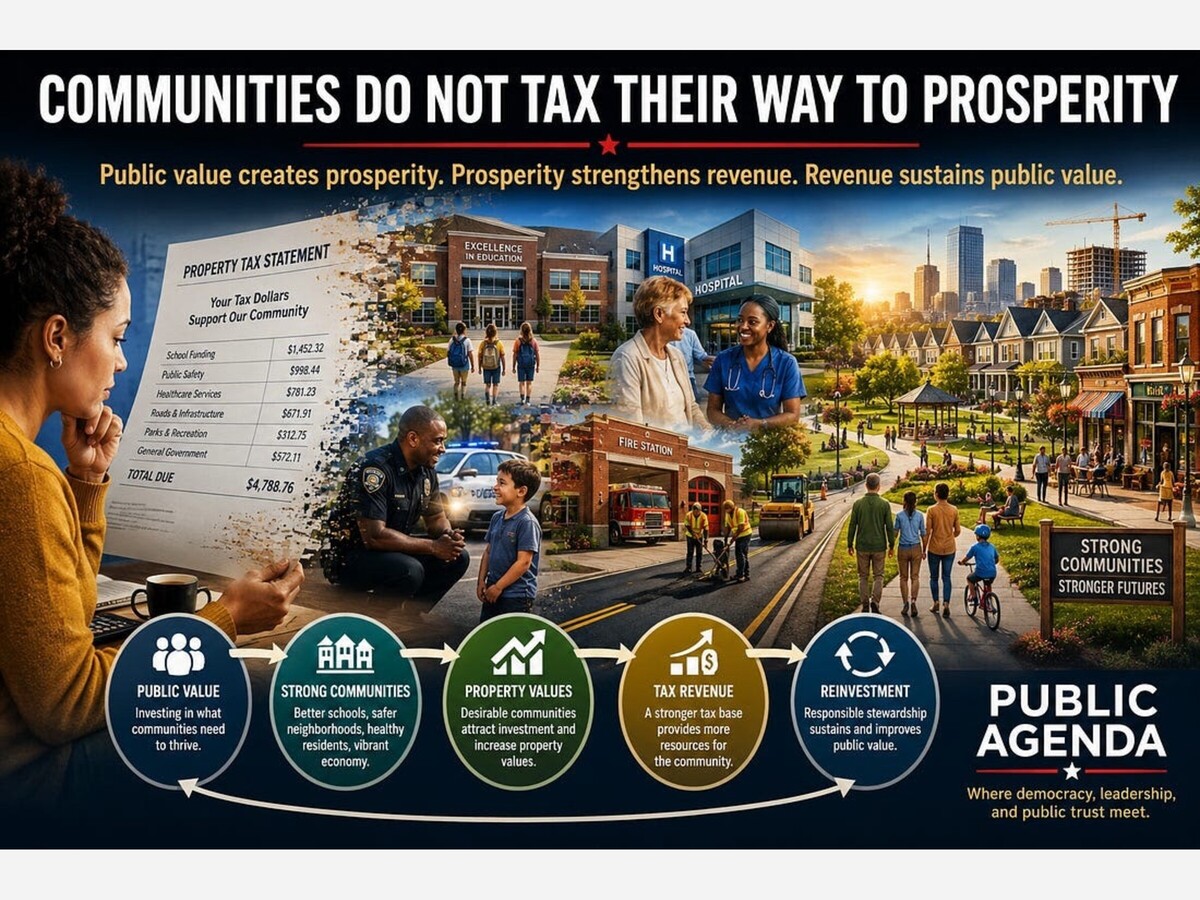
This distinction matters because communities rarely tax their way to prosperity.
More often, they govern their way to prosperity.
The Return on Tax Dollar Question
When citizens question taxation, they are often asking a deeper question:
What return am I receiving on my tax dollars?
This is not merely a financial question. It is a governance question.
A parent may evaluate local government through the quality of public schools. A senior citizen may evaluate government through emergency medical services and healthcare accessibility. A business owner may focus on infrastructure reliability, public safety, and economic opportunity. A homeowner may pay close attention to neighborhood stability and property values.
In each case, citizens are attempting to determine whether public institutions are producing value.
Public administration scholars have long argued that government exists to create public value rather than simply administer programs or collect revenue (Moore, 1995). Therefore, taxation should not be viewed solely as a mechanism for generating funds. Instead, taxation should be understood as one component of a broader system designed to support public goods, community well-being, and collective prosperity.
When citizens perceive strong schools, safe neighborhoods, effective emergency services, accessible healthcare, and trustworthy government, they often perceive greater value from the taxes they pay.
Conversely, when services deteriorate or trust declines, citizens may conclude they are receiving a poor return on their tax dollars regardless of the actual tax rate.
This perspective helps explain why discussions about taxation often become discussions about quality of life.
Public Value and Property Values
One of the most visible indicators of public value is found in the housing market.
Consider two homes with similar square footage, comparable construction, and similar amenities. One may command a substantially higher price than the other despite appearing nearly identical on paper.
Why?
The answer often extends beyond the property itself.
Families frequently evaluate school systems before purchasing a home. Prospective residents examine crime rates, healthcare access, transportation infrastructure, recreational opportunities, and economic vitality. Businesses consider workforce quality, transportation networks, and public safety when deciding where to invest.
In other words, people rarely purchase a house alone. They purchase access to a community.
Research by Oates (1969) demonstrated that local public services and public spending become capitalized into property values. Consequently, communities with desirable public services often experience stronger housing demand and higher property values.
Subsequent research has repeatedly confirmed that educational quality can significantly influence residential property values because families place substantial value on access to effective schools (Black, 1999).
Therefore, public services often function as economic assets.
Strong schools create value.
Safe communities create value.
Reliable infrastructure creates value.
Accessible healthcare creates value.
Effective governance creates value.
As these forms of value accumulate, communities become more attractive to residents, employers, and investors.
Why Revenue Generation Begins Before Revenue Collection
Many public discussions assume that local revenue generation begins when taxes are collected.
In reality, sustainable revenue generation often begins much earlier.
It begins when local governments create conditions that encourage people to live, work, invest, and raise families within a community.
Quality schools attract families.
Public safety encourages investment.
Healthcare infrastructure improves community resilience.
Transportation systems support economic activity.
Effective governance strengthens confidence.
Consequently, communities that consistently create public value often experience stronger economic activity and broader tax bases.
This distinction is important.
A locality can attempt to increase revenue through higher taxes. However, long-term fiscal health is often strengthened when communities focus on creating the conditions that naturally expand economic activity and property values.
From a public administration perspective, revenue generation should be understood as an outcome of public value creation rather than merely a function of tax policy.
This perspective does not diminish the importance of taxation. Rather, it places taxation within a larger ecosystem of governance, service delivery, and community development.
The Role of Education in Community Prosperity
Few public investments generate more long-term value than education.
Education influences workforce readiness, economic mobility, civic participation, and community competitiveness.
The relationship between educational quality and economic outcomes has been documented extensively. Communities with strong educational systems often attract families seeking opportunities for their children. Consequently, educational quality frequently influences residential location decisions and housing demand (Black, 1999).
Furthermore, educational attainment contributes to workforce development, innovation, and economic productivity. These factors strengthen local economies and support future revenue generation.
When citizens invest in education through their tax dollars, the return may not always be immediately visible. However, over time, educational investments often produce benefits that extend across generations.
This is one reason why education should be viewed not merely as an expense but as a strategic public investment.
Public Safety as an Economic Asset
Public safety is frequently discussed as a quality-of-life issue. It is also an economic issue.
Residents are more likely to invest in communities where they feel safe. Businesses are more likely to establish operations where employees and customers can thrive.
Research consistently demonstrates that crime and perceptions of crime can negatively affect property values and economic development (Linden & Rockoff, 2008).
Consequently, effective public safety systems create both social and economic benefits.
Police departments, fire services, emergency responders, and public safety professionals contribute to community stability. That stability supports investment confidence, housing demand, and business activity.
Therefore, public safety should be understood as a contributor to both public value and fiscal health.
Healthcare and Community Resilience
Healthcare access is another critical component of community prosperity.
Communities with strong healthcare systems often demonstrate greater resilience during crises, improved public health outcomes, and stronger economic performance.
Hospitals and healthcare systems frequently serve as major employers, economic anchors, and providers of essential services. Furthermore, healthcare accessibility influences residential decisions, workforce stability, and overall quality of life.
The World Health Organization (2021) has consistently emphasized the connection between health, economic productivity, and sustainable development.
Consequently, healthcare investments often produce benefits that extend well beyond individual patient outcomes.
Healthy communities are frequently more resilient, more productive, and better positioned for long-term prosperity.
Fiscal Stewardship and the Public Trust Dividend
Strong revenue alone does not create prosperous communities.
The manner in which resources are managed matters just as much as the amount collected.
Fiscal stewardship involves the responsible allocation, management, and evaluation of public resources. It requires transparency, accountability, and a commitment to producing measurable public value.
Citizens understandably want to know that public funds are being used wisely. Therefore, effective stewardship plays a critical role in maintaining public confidence.
Trust itself functions as a valuable public asset.
When residents trust local institutions, they are often more willing to support public initiatives, engage in civic life, and invest in their communities. Conversely, declining trust can undermine cooperation, confidence, and long-term planning.
The Organisation for Economic Co-operation and Development (OECD) has identified trust as a foundational element of effective governance and public-sector performance (OECD, 2024).
Consequently, public trust should not be viewed merely as a political concern. It is also a governance asset with meaningful social and economic implications.
Governing Toward Prosperity
At its core, this discussion is not really about taxation.
It is about value.
Citizens deserve to understand how public resources are being used. They deserve transparency concerning public priorities. They deserve competent administration and responsible stewardship.
Likewise, public leaders should recognize that taxpayers often evaluate government through a simple but important question:
Am I receiving value for the taxes I pay?
That question deserves thoughtful consideration.
Strong schools, accessible healthcare, effective public safety, reliable infrastructure, and trustworthy institutions do more than improve quality of life. They create public value. Furthermore, they strengthen property values, attract investment, broaden tax bases, and contribute to fiscal sustainability.
Communities that understand this relationship position themselves for long-term success.
After all, communities do not tax their way to prosperity.
They govern their way to prosperity.
A Final Thought
Every community has a story.
Some people can point to a teacher who changed the course of their lives. Others remember a police officer, firefighter, healthcare professional, coach, public servant, or neighbor who made a difference when it mattered most. Some have experienced frustration and disappointment. Others have witnessed firsthand how strong leadership, effective public services, and community investment can improve lives.
The reality is that public value is not measured solely in budgets, tax rates, or government reports. It is often experienced through the moments that shape our families, our neighborhoods, and our futures.
If this article resonates with you, I would love to hear your story.
How have education, public safety, healthcare, local government, or other public services impacted your life?
Do you believe you are receiving value for the taxes you pay?
What has your experience taught you about the relationship between public services, community prosperity, and quality of life?
Your perspective matters.
Many of the future conversations and essays published through Public Agenda will be informed not only by research and scholarship, but also by the lived experiences of the people who call our communities home.
If you would like to share your story or participate in a future Public Agenda Conversation, please reach out.
Some of the most important lessons about leadership, governance, and public value are found not in textbooks, but in the experiences of everyday people.
Author’s Note: Public Agenda Conversations
One of the goals of Public Agenda has always been to connect research, governance, and public policy with the lived experiences of real people.
To deepen that mission, I am launching Public Agenda Conversations, a new initiative designed to bring reader perspectives into future essays and discussions.
I am seeking 8 to 12 readers interested in participating in brief 12 to 15-minute virtual conversations inspired by topics explored in Public Agenda articles.
These conversations will be guided by themes from recent essays and may include topics such as public trust, taxation, leadership, education, healthcare, public safety, governance, community life, and civic engagement.
This is not a debate.
It is not a political forum.
It is not a campaign activity.
It is simply an opportunity to listen, learn, and better understand how people experience the institutions and issues that shape their daily lives.
As a qualitative researcher, I have long believed that data and policy tell only part of the story. Lived experiences often provide insights that numbers alone cannot reveal.
If you are interested in participating in a future Public Agenda Conversation, please reply to this article and briefly share why you would like to participate.
One article. One conversation. One perspective at a time.
Dr. Shellie M. Bowman, Sr.
References
Black, S. E. (1999). Do better schools matter? Parental valuation of elementary education. Quarterly Journal of Economics, 114(2), 577–599. https://doi.org/10.1162/003355399556070
Linden, L., & Rockoff, J. E. (2008). Estimates of the impact of crime risk on property values from Megan’s laws. American Economic Review, 98(3), 1103–1127. https://doi.org/10.1257/aer.98.3.1103
Moore, M. H. (1995). Creating public value: Strategic management in government. Harvard University Press.
Oates, W. E. (1969). The effects of property taxes and local public spending on property values: An empirical study of tax capitalization and the Tiebout hypothesis. Journal of Political Economy, 77(6), 957–971. https://doi.org/10.1086/259584
Organisation for Economic Co-operation and Development. (2024). Building trust to reinforce democracy: Main findings from the 2023 OECD survey on drivers of trust in public institutions. OECD Publishing.
World Health Organization. (2021). Health promotion and the sustainable development goals.
Public Agenda is free today. But if you enjoyed this post, you can tell Public Agenda that the writing is valuable by pledging a future subscription. You won’t be charged unless payments are enabled.
Follow us on TikTok @DrShelliePublicAgenda
📢 Stay Connected with Public Agenda by Dr. Shellie M. Bowman
Let’s rebuild public leadership together; one insight, one question, one breakthrough at a time.
eLEADt On with Purpose.

Sunny, with a high of 71 and low of 50 degrees. Sunny during the morning, clear in the afternoon and evening,