

Image
By Dr Shellie M Bowman Sr
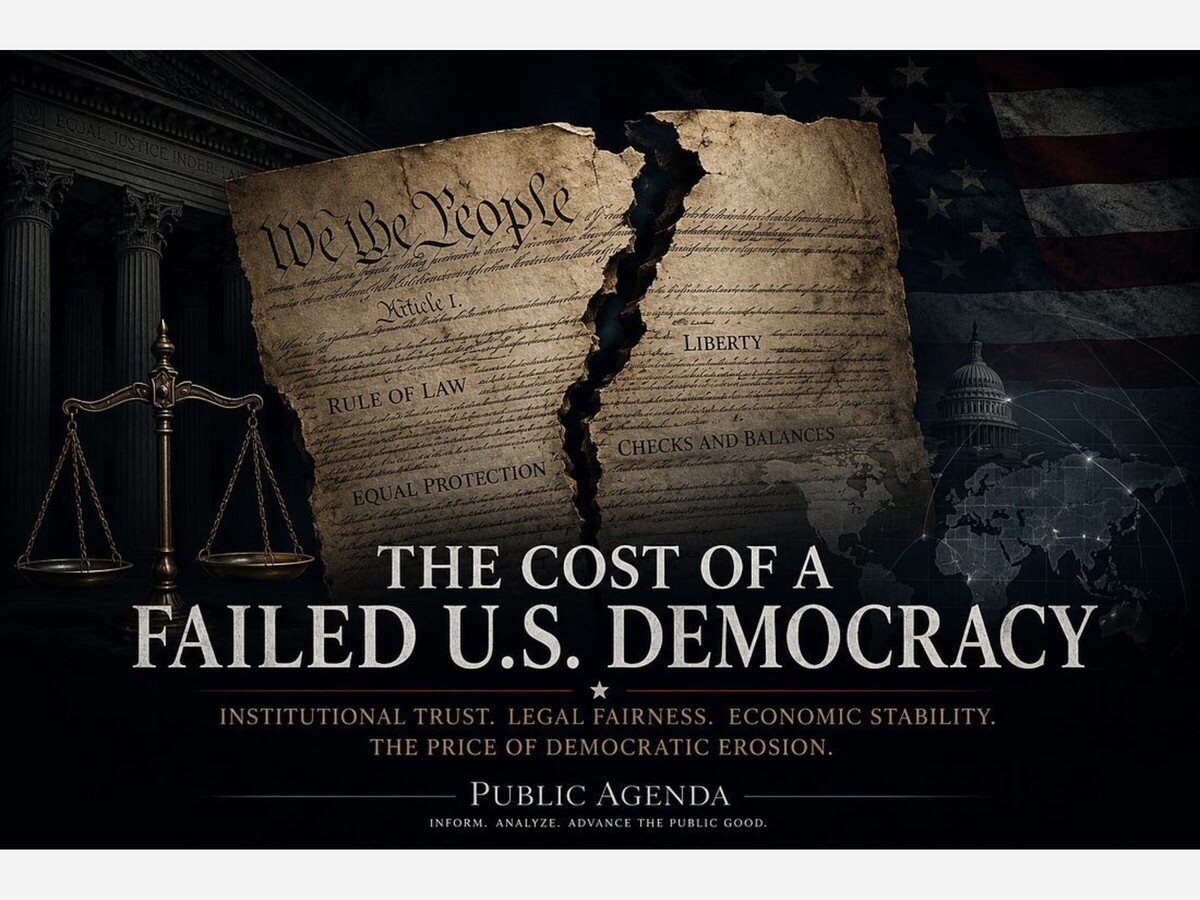
In 1984, George Orwell (1949) attempted to illuminate what society might resemble under authoritarian rule. His fictional world depicts controlled information, institutional fear, managed scarcity, and the systematic erosion of individual freedom. I am not inclined toward politically charged conspiracy theories, partisan rhetoric, propaganda, or hyperbole. I am a scholar. Yet there is often truth embedded within cautionary tales. Therefore, I ask a very real question: what is the cost of a failed U.S. democracy?
To answer that question responsibly, we must move beyond the dramatic imagery of dystopian fiction and examine how democratic decline actually functions in the modern world. Political scientists have shown that democratic failure in highly institutionalized states rarely arrives through a sudden military coup or the immediate suspension of constitutional order. More often, democracies weaken through gradual institutional erosion. Elections continue. Courts remain standing. Legislatures still convene. Yet the internal safeguards that sustain democratic accountability begin to hollow out from within (Levitsky & Ziblatt, 2018).
The cost of a failed U.S. democracy, therefore, is not merely political. It is epistemic, legal, economic, and geopolitical. It is measured not only in elections or institutions, but also in diminished public trust, weakened administrative competence, economic instability, and global disorder. The deeper question is not whether democratic erosion would change American government. The deeper question is how profoundly it would reshape American society and the international system built around it.
A functioning democracy depends on more than voting procedures. It depends upon credible institutions capable of producing, evaluating, and applying evidence. Public agencies rely on data, technical expertise, professional norms, and administrative transparency to govern complex societies. When democratic guardrails weaken, one of the first casualties is institutional truth.
Democratic systems require mechanisms that make government observable and accountable. Independent audits, whistleblower protections, investigative oversight, and judicial review are not bureaucratic inconveniences. They are safeguards that allow citizens and competing institutions to examine the exercise of state power. When those mechanisms weaken, governance becomes increasingly opaque. Government operations begin to resemble a black box: authority remains visible, but accountability becomes difficult to trace.
The erosion of technical expertise compounds this problem. Modern governance requires specialized knowledge. Central banking, epidemiology, environmental regulation, infrastructure planning, and national security cannot be managed through political loyalty alone. States rely on professional competence because contemporary governance problems are technically demanding.
When expertise becomes subordinate to ideological conformity or patronage, institutional performance deteriorates. Francis Fukuyama (2014) argues that strong states require both administrative capacity and accountability. Remove either pillar, and governance effectiveness declines. The result is not merely a political problem. It becomes a practical problem measured in weaker crisis management, degraded policy implementation, and declining public confidence.
The lesson here is straightforward. Democracies do not merely protect political competition. They help preserve the institutional conditions under which evidence, expertise, and administrative competence remain possible.
Popular understandings of authoritarianism often emphasize overt repression. Modern democratic decline frequently operates through subtler mechanisms. Rather than abolishing legal systems outright, democratic erosion often transforms law into an instrument of selective power.
The rule of law is foundational to democratic governance because it establishes predictability. Citizens, businesses, and institutions function more effectively when laws are applied consistently rather than selectively. Under democratic erosion, however, legal neutrality becomes increasingly fragile.
Political scientists describe contemporary backsliding as involving forms of executive aggrandizement and institutional capture rather than immediate constitutional destruction (Bermeo, 2016). In such environments, the law may remain formally intact while its application becomes uneven. Legal standards may be enforced aggressively against critics while allies experience accommodation or exemption. Whether occurring gradually or unevenly, the perception of asymmetrical legal treatment weakens institutional legitimacy.
Equally important is the weakening of procedural safeguards. Due process, equal protection, and administrative fairness are not abstract constitutional ideals reserved for law textbooks. They are practical mechanisms that protect ordinary citizens from arbitrary power. When citizens lose confidence that institutions will apply rules consistently, rights may remain visible on paper while becoming increasingly uncertain in practice.
Administrative neutrality also matters more than many citizens realize. Civil servants exercise discretion daily in the implementation of law and policy. When professional discretion is replaced by rigid political mandate, bureaucratic fairness suffers. Government becomes less adaptive, less predictable, and less trustworthy.
The legal cost of democratic failure, then, is not simply the loss of constitutional symbolism. It is the gradual weakening of predictable recourse against state overreach.
Stable democracies do not guarantee prosperity. They do, however, provide institutional conditions that make prosperity more likely. Predictable contract enforcement, judicial independence, regulatory transparency, and stable governance create environments in which markets, innovation, and investment can function.
Institutional economics has repeatedly demonstrated the importance of political institutions to economic performance. Acemoglu and Robinson (2012) argue that inclusive institutions support long-term economic development because they provide predictability, accountability, and incentives for productive activity.
When democratic norms weaken, economic uncertainty often increases.
Without strong democratic constraints and independent legal institutions, economic policy can become more volatile and transactional. Businesses and investors depend upon predictable rules. If policy outcomes increasingly appear tied to political favor, personal networks, or shifting executive preferences, economic confidence declines.
The consequences extend beyond markets into human capital.
Historically, societies experiencing institutional instability frequently encounter some combination of capital flight, reduced investment confidence, and brain drain. Investors seek jurisdictions with stronger predictability. Highly skilled professionals seek environments where research, innovation, and economic opportunity remain stable.
The cost is long-term. Research and development ecosystems depend upon institutional confidence. Innovation flourishes where rules are durable, property rights are credible, and intellectual work is supported by stable governance structures. When institutional trust declines, innovation often contracts.
This is why the economic cost of democratic erosion cannot be reduced to stock indexes or quarterly growth statistics. The deeper concern is institutional degradation. Economies depend not only on capital and labor, but also on governance systems capable of maintaining predictable environments across time.
The consequences of a failed U.S. democracy would not stop at national boundaries.
Since the conclusion of World War II, the United States has functioned as a major institutional anchor within the international order. Global security arrangements, economic agreements, and diplomatic alliances have developed in relation to American political, economic, and military influence.
Democratic stability contributes to international credibility because alliances depend upon predictability. Mutual defense agreements, treaty commitments, and multilateral institutions function more effectively when partners believe state commitments will remain durable across political transitions.
If American democratic stability were significantly weakened, the geopolitical consequences could be substantial.
Alliances could experience strain. Longstanding partners might reassess assumptions regarding institutional reliability and strategic consistency. International actors tend to adjust their behavior when uncertainty surrounding major powers increases.
A second concern involves shifts in global power dynamics. The absence or weakening of a stable democratic counterweight may create expanded space for authoritarian influence, regional competition, and geopolitical fragmentation. International norms regarding territorial disputes, maritime security, trade governance, and collective defense do not sustain themselves automatically. They require institutional maintenance and credible actors willing to support them.
The resulting environment could increase regional instability, complicate supply chains, and intensify strategic competition.
The geopolitical cost of democratic failure, therefore, is not merely reputational. It concerns the architecture of global order itself.
Orwell imagined a world dominated by visible authoritarian control. Modern democratic decline is often less theatrical and more administrative.
The true cost of a failed U.S. democracy is unlikely to appear overnight as an immediate totalitarian transformation. The more plausible danger is slower institutional deterioration: weakened accountability, diminished expertise, unstable legal predictability, economic uncertainty, and global destabilization.
Democracy matters not because democratic societies are perfect. They are not. Democracy matters because it provides mechanisms through which power can be constrained, expertise preserved, laws applied predictably, and institutions corrected.
I return, then, to the question that opened this essay.
What is the cost of a failed U.S. democracy?
The answer is not simply partisan victory or partisan defeat. It is the potential transition from governance rooted in accountable institutions to governance increasingly shaped by opacity, arbitrariness, and declining public trust. That cost would not belong to one party, one ideology, or one election cycle.
It would belong to the republic itself.
Acemoglu, D., & Robinson, J. A. (2012). Why nations fail: The origins of power, prosperity, and poverty. Crown.
Bermeo, N. (2016). On democratic backsliding. Journal of Democracy, 27(1), 5–19.
Fukuyama, F. (2014). Political order and political decay: From the industrial revolution to the globalization of democracy. Farrar, Straus and Giroux.
Levitsky, S., & Ziblatt, D. (2018). How democracies die. Crown.
Orwell, G. (1949). 1984. Secker & Warburg.
Public Agenda is free today. But if you enjoyed this post, you can tell Public Agenda that the writing is valuable by pledging a future subscription. You won’t be charged unless payments are enabled.
Follow us on TikTok @DrShelliePublicAgenda
📢 Stay Connected with Public Agenda by Dr. Shellie M. Bowman
Let’s rebuild public leadership together; one insight, one question, one breakthrough at a time.
eLEADt On with Purpose.


Sunny, with a high of 72 and low of 50 degrees. Sunny for the morning, clear for the afternoon and evening,