Image
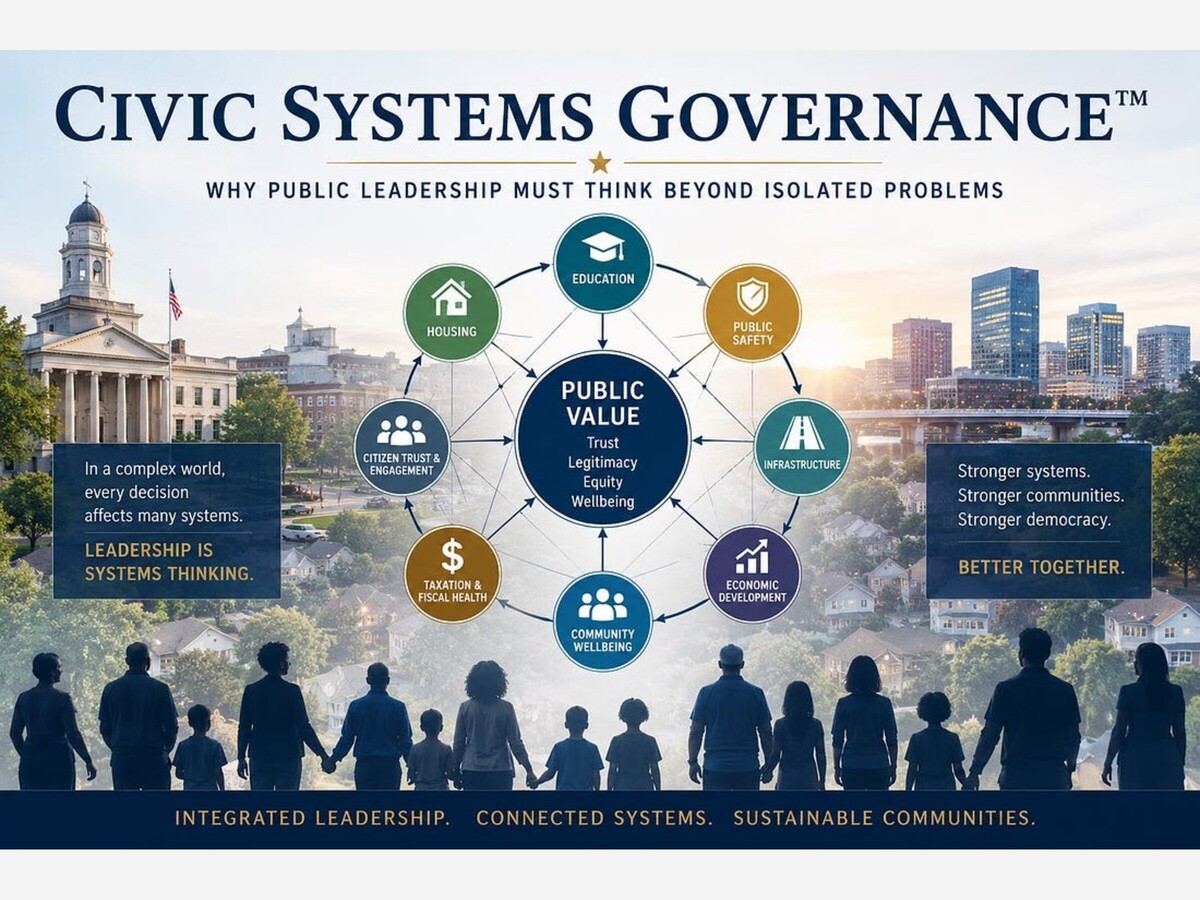



Modern governance increasingly operates within a climate of complexity, fragmentation, and declining public trust. Across the United States, citizens routinely experience the consequences of governmental systems that appear disconnected from one another despite serving the same communities. Housing policy affects education systems. Education outcomes affect economic development. Economic instability influences crime rates and public safety demands. Public safety pressures affect local budgets. Budgetary decisions shape taxation. Taxation affects affordability, migration, and ultimately public trust in government itself.
Yet despite these interconnected realities, governmental institutions often continue operating through isolated administrative silos that address symptoms independently rather than understanding how systems interact collectively.
This fragmentation represents one of the defining governance challenges of the modern era.
Public leaders frequently attempt to solve complex public problems through narrow interventions that fail to account for the broader institutional, social, economic, and technological systems surrounding those problems. Consequently, even well-intentioned policies can produce unintended downstream effects that weaken institutional legitimacy and erode public confidence.
Civic Systems Governance™ emerges from the recognition that public leadership must evolve beyond isolated problem solving toward a more integrated understanding of governance itself. Rooted in General Systems Theory, systems thinking, and public value theory, Civic Systems Governance™ proposes that effective governance requires leaders capable of understanding how public institutions, policies, citizens, and communities operate within interconnected civic ecosystems.
The future of effective governance may therefore depend not simply upon stronger policy positions, but upon stronger systems thinking.
The Origins of Systems Thinking
The intellectual foundations of systems thinking are deeply interdisciplinary, emerging from biology, organizational theory, cybernetics, engineering, and management science. Among the seminal contributors to this tradition was biologist Ludwig von Bertalanffy, whose General Systems Theory fundamentally challenged reductionist approaches to understanding complex phenomena.
Bertalanffy (1968) argued that systems could not be fully understood merely by analyzing individual components in isolation. Rather, systems possess interrelationships, interactions, and emergent properties that only become visible when examining the whole structure collectively. General Systems Theory therefore represented a shift away from fragmented analysis toward holistic understanding.
This intellectual transition proved profoundly influential across numerous disciplines, including public administration, organizational leadership, and governance studies.
Building upon systems-oriented concepts decades later, Peter Senge advanced systems thinking into organizational leadership theory through his influential work The Fifth Discipline(Senge, 1990). Senge argued that organizations frequently fail because leaders focus on isolated events rather than the underlying systemic structures producing recurring problems. Systems thinking, according to Senge, enables leaders to recognize patterns, feedback loops, delayed consequences, and interconnected institutional relationships that shape organizational outcomes over time.
Senge’s work remains especially relevant to modern governance because public institutions often experience recurring crises that are treated episodically rather than systemically.
For example, local governments may attempt to address homelessness through temporary shelter expansion while failing to account for interconnected drivers such as housing affordability, mental health access, substance abuse treatment, transportation limitations, workforce instability, and economic inequality. Similarly, public distrust in government is often treated as a communications problem rather than the cumulative outcome of institutional opacity, procedural inconsistency, civic disengagement, and governance fragmentation.
Systems thinking therefore challenges public leaders to move beyond reactive administration toward integrated governance awareness.
Civic Systems Governance™ and Public Administration
While systems theory and organizational systems thinking provide important foundations, governance requires an additional dimension beyond organizational efficiency alone. Public institutions ultimately exist to create legitimacy, trust, and public value.
This is where the work of public administration scholar Mark Moore becomes especially significant.
Moore’s Public Value Theory argues that public institutions should be evaluated not merely by efficiency or output, but by their ability to create legitimate public value within democratic society (Moore, 1995). Public value includes citizen trust, institutional legitimacy, procedural fairness, social wellbeing, and confidence in governance systems themselves.
Civic Systems Governance™ extends this perspective by arguing that public value cannot be sustainably achieved through fragmented governance structures operating without systemic awareness.
In practical terms, this means governance failures rarely originate from a single broken policy. Rather, failures often emerge from disconnected systems operating without sufficient integration, coordination, or long-term systems analysis.
For example, a locality may experience:
A fragmented governance approach treats each issue separately through isolated departments and reactive interventions.
A Civic Systems Governance™ approach instead asks:
This distinction is critically important because citizens do not experience government in departmental silos. They experience government holistically through their daily lives.
The Problem With Isolated Governance
One of the greatest weaknesses in contemporary governance is the persistence of institutional silo thinking.
Government agencies, departments, and governing bodies frequently specialize so heavily within narrow operational domains that broader systemic consequences become obscured. While specialization can improve technical efficiency, excessive fragmentation often undermines institutional coordination and long-term strategic thinking.
This becomes particularly visible in local government.
A county may approve aggressive residential development to increase short-term revenue growth while underestimating future pressures upon:
Similarly, technology modernization efforts may improve administrative efficiency while simultaneously weakening citizen trust if implemented without transparency, privacy protections, or accessibility considerations.
In many cases, governance failures emerge not from malicious intent, but from systemic blindness.
Public leaders may focus so heavily on solving immediate operational challenges that they fail to recognize how decisions reverberate across interconnected civic systems over time.
Systems thinking therefore introduces a fundamentally different leadership question:
What secondary and tertiary effects will this decision produce across the broader civic ecosystem?
This question is increasingly necessary within modern governance environments shaped by technological disruption, demographic shifts, economic volatility, and declining institutional trust.
Civic Systems Governance™ in Contemporary Public Leadership
Modern public leadership requires more than administrative competence. It increasingly requires systems literacy.
A systems-literate public leader recognizes that taxation cannot be discussed independently from housing affordability. Housing cannot be discussed independently from infrastructure. Infrastructure cannot be discussed independently from economic development. Economic development cannot be discussed independently from education, workforce readiness, transportation access, and public safety.
Likewise, public trust itself functions systemically.
Citizens who perceive government systems as opaque, inconsistent, inaccessible, or dismissive often withdraw civic participation over time. Reduced civic participation weakens public accountability, which may further erode institutional responsiveness and deepen distrust. This creates a reinforcing feedback loop that gradually weakens democratic legitimacy itself.
Conversely, transparent systems, responsive public service, procedural fairness, and ethical leadership can strengthen public confidence and reinforce civic engagement.
Civic Systems Governance™ therefore views governance not simply as policy execution, but as stewardship of interconnected institutional relationships affecting public life.
This perspective carries profound implications for public administration.
Public leaders operating within a Civic Systems Governance™ framework would prioritize:
Importantly, this approach does not reject specialization or technical expertise. Rather, it recognizes that technical expertise must operate within broader systemic awareness.
Systems Thinking and Local Government
Local government may represent the most important arena for Civic Systems Governance™ because local institutions most directly affect citizens’ daily lives.
Citizens encounter local government through:
Consequently, failures in local governance are often experienced personally and immediately.
For example, local taxation systems cannot be fully understood merely as revenue mechanisms. Taxation intersects with:
Similarly, public safety systems intersect with:
A systems-oriented local government leader therefore approaches governance not merely through departmental administration, but through institutional interconnectedness.
This perspective may become increasingly essential as local governments confront:
Conclusion
The governance challenges confronting modern society are increasingly systemic in nature. Fragmented institutions addressing isolated symptoms are often insufficient for resolving deeply interconnected public problems.
Civic Systems Governance™ proposes that effective public leadership requires systems-oriented thinking grounded in interconnected institutional awareness, ethical stewardship, and public value creation.
Drawing upon the foundational work of Bertalanffy, Senge, and Moore, this framework argues that governance must evolve beyond reactive administration toward integrated systems leadership capable of understanding how policies, institutions, and communities influence one another over time.
The future of democratic legitimacy may depend upon this evolution.
Citizens increasingly expect governments that are not only efficient, but also transparent, responsive, coordinated, and trustworthy. Meeting those expectations requires leaders capable of understanding governance not as isolated departments or disconnected policies, but as interconnected civic systems shaping public life collectively.
Ultimately, governance is not merely about managing institutions.
It is about stewarding the systems through which communities live, trust, and thrive.
References
Bertalanffy, L. von. (1968). General system theory: Foundations, development, applications. George Braziller.
Denhardt, J. V., & Denhardt, R. B. (2015). The new public service: Serving, not steering (4th ed.). Routledge.
Moore, M. H. (1995). Creating public value: Strategic management in government. Harvard University Press.
Senge, P. M. (1990). The fifth discipline: The art and practice of the learning organization. Doubleday.
Public Agenda is free today. But if you enjoyed this post, you can tell Public Agenda that the writing is valuable by pledging a future subscription. You won’t be charged unless payments are enabled.
Follow us on TikTok @DrShelliePublicAgenda
📢 Stay Connected with Public Agenda by Dr. Shellie M. Bowman
Let’s rebuild public leadership together; one insight, one question, one breakthrough at a time.
eLEADt On with Purpose.



Overcast, with a high of 71 and low of 56 degrees. Overcast during the morning, light rain overnight.