70° and Clear
Image
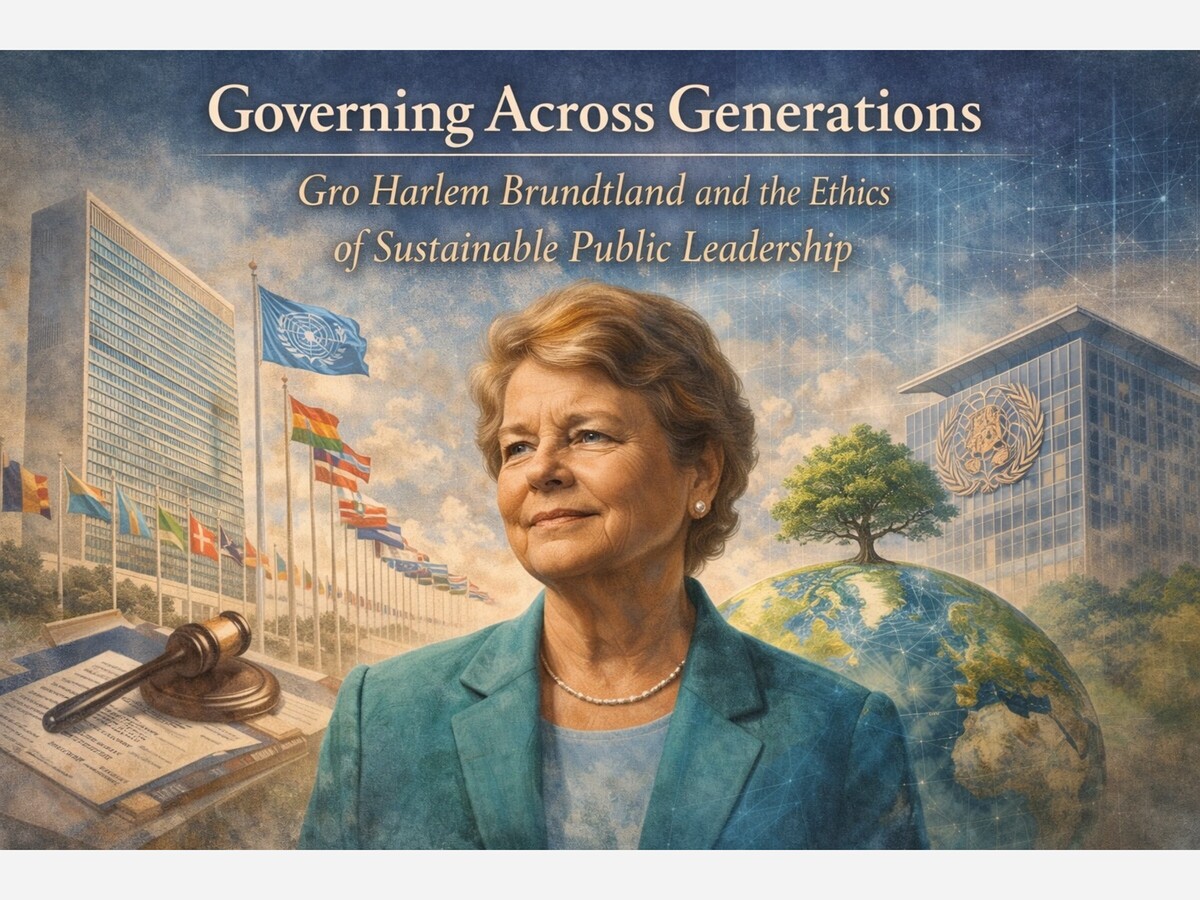



Women’s History Month invites recognition. Scholarship requires examination. Public administration demands both.
Among the global leaders whose work reshaped modern governance, Gro Harlem Brundtland occupies a distinct place. Her leadership did not merely expand women’s representation in executive office. It recalibrated the ethical boundaries of public administration itself.
Brundtland’s career illustrates that public leadership is neither confined to domestic institutions nor reducible to electoral authority. It is an exercise in intergenerational stewardship grounded in equality, accountability, and institutional responsibility.
Leadership Beyond Representation
Gro Harlem Brundtland served three terms as Prime Minister of Norway and later as Director General of the World Health Organization. Her professional formation as a physician informed her systems perspective. Governance, in her view, required diagnostic precision and preventative design.
Much attention is often given to the symbolic significance of women attaining executive office. Yet representation alone does not constitute transformation. Public administration scholarship suggests that representation strengthens institutional legitimacy when it translates into substantive policy influence (Meier & Nicholson Crotty, 2006). Brundtland’s tenure exemplified this principle. Her leadership did not rest on symbolic presence. It manifested in structural reform.
During her premiership, Norway institutionalized broader gender inclusion in cabinet leadership and policy design. This was not framed as accommodation. It was framed as democratic completeness. Governance structures, when reflective of the populations they serve, improve responsiveness and strengthen public trust.
Sustainable Development as Administrative Philosophy
Brundtland’s most enduring contribution emerged through her chairmanship of the World Commission on Environment and Development. The Commission’s 1987 report, Our Common Future, introduced a definition that has since shaped global governance discourse. Sustainable development was defined as development that meets present needs without compromising the ability of future generations to meet their own needs (World Commission on Environment and Development, 1987).
This definition transcended environmental policy. It articulated a governing ethic.
Public administration traditionally focused on efficiency, hierarchy, and control, particularly during its formative intellectual period in the early twentieth century (Waldo, 1948). Brundtland expanded the normative horizon of the discipline. She embedded intergenerational equity within administrative decision making.
In practical terms, this required governments to evaluate policy outcomes not only by immediate fiscal metrics but by long term ecological, social, and economic consequences. Administrative discretion, therefore, became an instrument of moral foresight.
Sustainability under Brundtland’s leadership was not an aspirational concept. It became a framework requiring coordination across ministries, collaboration across borders, and alignment between economic development and environmental protection.
Accountability in a Global Administrative Order
Public accountability is often discussed within national constitutional systems. Elections, legislative oversight, and audit mechanisms structure domestic accountability. Brundtland’s work extended the concept beyond sovereign boundaries.
Environmental degradation, public health crises, and economic instability operate transnationally. Addressing them requires governance networks rather than isolated bureaucracies. Scholars of collaborative public management describe this evolution as a shift toward interorganizational governance structures designed to manage complexity (Agranoff & McGuire, 2003).
Brundtland’s leadership at the World Health Organization further demonstrated this principle. She advanced the argument that health disparities represent systemic governance failures rather than isolated humanitarian concerns (Brundtland, 2002). By framing health as a development issue, she linked administrative accountability to human well being on a global scale.
In doing so, she expanded the operational scope of public administration. Agencies were no longer solely implementers of national mandates. They became participants in a global administrative order requiring coordination, transparency, and measurable impact.
Equality as Structural Design
Equality within administrative systems is often misunderstood as a question of access. In practice, equality is a design problem. It requires institutions to structure policies in ways that prevent the reproduction of inequity.
Representative bureaucracy research suggests that demographic representation within institutions can influence policy outcomes, particularly in areas affecting marginalized populations (Meier & Nicholson Crotty, 2006). Brundtland’s leadership anticipated this scholarship. Her governance philosophy treated equality as a structural objective embedded in decision making processes.
This perspective aligns with the normative tradition in public administration that views administrative action as inherently value laden (Waldo, 1948). Administrative discretion carries ethical weight. Budget allocations, regulatory enforcement, and program eligibility criteria are not neutral instruments. They shape distributive outcomes.
Brundtland’s integration of sustainability and equity demonstrates how public leadership can operationalize ethical commitments within institutional frameworks.
Stewardship as the Core of Public Leadership
Public administration literature increasingly emphasizes public value and service over managerial control (Denhardt & Denhardt, 2015). This evolution reflects recognition that democratic governance depends upon legitimacy, responsiveness, and trust.
Brundtland’s career offers a concrete model of this orientation. Her leadership approached governance as stewardship across time, geography, and institutional boundaries. She insisted that development policy must account for those not yet present to advocate for themselves.
Such foresight reframes administrative responsibility. It situates public leaders not merely as managers of present demands but as custodians of future conditions.
Women’s History Month rightly honors the expansion of opportunity for women in public life. Yet the deeper contribution of leaders such as Brundtland lies in intellectual architecture. She helped reshape the governing assumptions of modern public administration.
Why This Matters Now
Contemporary administrators confront interconnected crises including climate change, public health inequities, fiscal instability, and institutional distrust. Fragmented governance structures struggle to manage systemic problems.
Brundtland’s model offers guidance. Sustainable policy design requires integration across sectors. Equality requires structural attention to distributive consequences. Accountability must extend beyond electoral cycles.
Public administration is not a technical afterthought to politics. It is the mechanism through which democratic values become operational realities.
In recognizing Gro Harlem Brundtland during Women’s History Month, we acknowledge more than historic leadership. We examine a governing philosophy that insists public authority be exercised with intergenerational responsibility and ethical discipline.
Such leadership remains necessary.
Not as commemoration.
But as practice.
References
Agranoff, R., & McGuire, M. (2003). Collaborative public management: New strategies for local governments. Georgetown University Press.
Brundtland, G. H. (2002). Global health and international cooperation. Harvard University Press.
Denhardt, J. V., & Denhardt, R. B. (2015). The new public service: Serving, not steering (4th ed.). Routledge.
Meier, K. J., & Nicholson Crotty, J. (2006). Gender, representative bureaucracy, and law enforcement. Public Administration Review, 66(6), 850 to 860.
Waldo, D. (1948). The administrative state: A study of the political theory of American public administration. Ronald Press.
World Commission on Environment and Development. (1987). Our common future. Oxford University Press.



Sunny, with a high of 89 and low of 69 degrees. Sunny for the morning, clear in the afternoon and evening,