Image
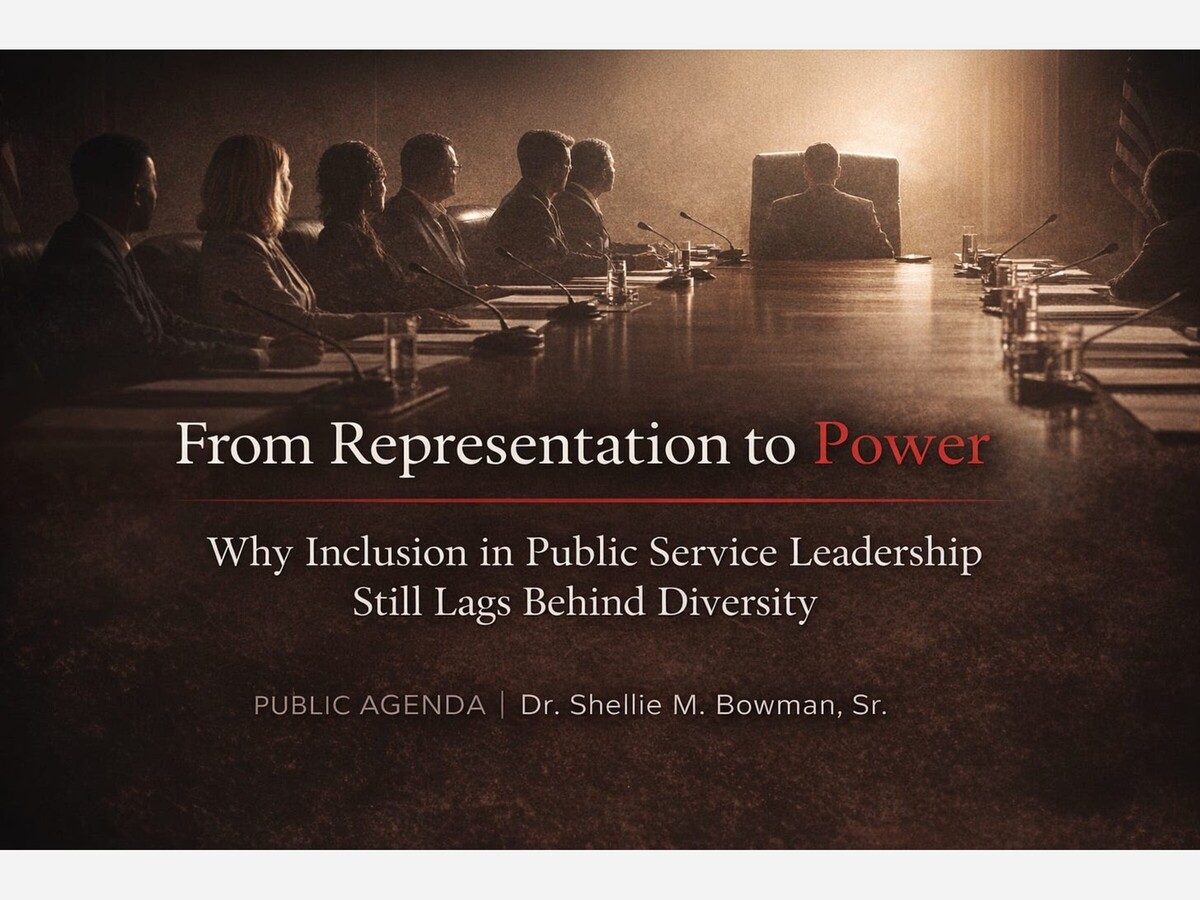



Diversity is widely discussed across public institutions. It is reported in dashboards, highlighted in annual reports, and frequently invoked in policy language. Yet inclusion, particularly the inclusion of marginalized groups in leadership roles within public service, remains comparatively underdeveloped, under-measured, and under-realized. This gap is not accidental. It reflects deeper structural, political, and cultural dynamics that shape how power is distributed and preserved.
This essay advances a central argument:
Public service has learned how to count diversity, but it has not yet learned how to transfer power.
The distinction between representation and inclusion is not semantic. It is foundational to democratic legitimacy. When inclusion lags, governance risks becoming procedurally representative but substantively unequal.
The Distinction Between Diversity and Inclusion
Public administration scholarship has long distinguished between passive representation and active representation. Passive representation refers to demographic similarity between public servants and the population. Active representation refers to the extent to which those individuals exercise influence on behalf of underrepresented groups (Mosher, 1982; Meier & Nicholson-Crotty, 2006).
Many public organizations have made progress in passive representation. Hiring practices have diversified entry-level and mid-level positions. However, inclusion in leadership requires more than presence. It requires authority, voice, and decision-making power.
Research indicates that organizations often prioritize visible diversity metrics because they are measurable and politically defensible, while inclusion requires cultural and structural change, which is more complex and less immediately observable (Naff & Kellough, 2003). This dynamic creates conditions where individuals from marginalized groups are present but not empowered.
This gap manifests in what has been described as tokenism, where representation exists without meaningful influence (Kanter, 1977). Individuals may be included in numbers but excluded from power. Over time, this produces not only frustration but also burnout, particularly when marginalized leaders are expected to carry institutional reform efforts without adequate authority or resources.
Structural Barriers in Public Service Leadership
Public service operates within highly institutionalized systems. These systems are designed for stability and continuity, but they can also reproduce inequality.
Bureaucratic Constraints
Public sector organizations are governed by rules, classifications, and processes that often appear neutral but can have disparate impacts. Civil service exams, credential requirements, and promotion pathways may unintentionally favor those with access to certain educational or professional networks (Riccucci, 2010). Residency requirements, language requirements, and rigid career ladders can also act as barriers depending on how they are structured and implemented.
These constraints do not need to be explicitly discriminatory to produce unequal outcomes. Structural inequality often operates through seemingly neutral systems that reflect historical inequities.
Pipeline and Representation Gaps
Empirical research consistently shows that marginalized groups, particularly Black, Indigenous, and other historically underrepresented populations, remain underrepresented in senior leadership roles despite gains at lower levels (Sabharwal, Levine, & D’Agostino, 2018). This creates a feedback loop. Without representation in leadership, organizational culture remains anchored in dominant norms, making it more difficult for emerging leaders to navigate and advance.
Data Limitations
Inclusion is also hindered by a lack of granular, leadership-level data. While many agencies track workforce diversity, fewer track who holds decision-making authority. Without clear indicators, accountability is diffuse and progress is difficult to measure.
Political and Cultural Constraints
Public service does not operate in a vacuum. It is shaped by political environments, public perception, and institutional norms.
Risk Aversion and Politicization
Public leaders operate under scrutiny. Decisions are subject to political interpretation and public reaction. This environment often produces risk-averse behavior, where leaders default to established practices rather than pursuing transformative change (Kettl, 2015). Inclusion, which requires altering power dynamics, can be perceived as politically risky.
Policy Backlash and Legal Constraints
In recent years, efforts aimed at expanding inclusion have faced legal and political challenges. Judicial decisions such as Students for Fair Admissions v. Harvard (2023) have reshaped the legal landscape around race-conscious policies. While this case is rooted in higher education, its implications extend into broader public discourse about equity and inclusion.
Additionally, state-level initiatives have sought to restrict or redefine diversity, equity, and inclusion programs. These developments contribute to an environment where inclusion efforts are contested and constrained, even when organizations recognize their importance.
Leadership Identity and Expectations
Public leaders are often expected to function as neutral administrators. While neutrality is essential for fairness, it can also be interpreted in ways that discourage servant leadership behaviors such as advocacy, empathy, and cultural responsiveness (Denhardt & Denhardt, 2015). This tension can limit the extent to which leaders actively cultivate inclusive environments.
Accountability Gaps and the Role of Bias
Inclusion lags in part because it is rarely tied to accountability mechanisms.
Weak Incentive Structures
Performance evaluations for public leaders often emphasize efficiency, compliance, and service delivery. Inclusion, when mentioned, is rarely operationalized into measurable expectations tied to promotion or advancement (Pitts, 2009). Without incentives, inclusion remains aspirational rather than actionable.
Implicit Bias and Network Effects
Implicit bias continues to shape hiring, promotion, and mentorship decisions. Research demonstrates that individuals tend to select and promote those who resemble themselves in background and experience, a phenomenon often described as homophily (Rivera, 2012). Over time, this reinforces existing leadership profiles and limits diversity at the top.
These dynamics are not always intentional, but they are consequential. They shape who is seen as “ready,” who is given opportunities, and who is included in informal networks where decisions are often influenced.
The Democratic Implications
When inclusion is limited, the effects extend beyond organizational culture. They impact democratic legitimacy.
Public administration is grounded in the principle that government should reflect and serve the people. When leadership does not reflect the diversity of lived experiences within a community, policy decisions risk being disconnected from those they affect most.
This disconnect can erode trust. Trust, as research shows, is both a product of performance and a condition for effective governance (Bouckaert & Van de Walle, 2003). When communities do not see themselves in leadership or do not feel heard, engagement declines. This weakens the feedback mechanisms that sustain a healthy democracy.
Bias, whether implicit or structural, therefore has systemic consequences. It does not only affect individuals. It shapes how institutions function and how democracy is experienced at the local, state, and national levels.
Reframing Affirmative Action and Structural Remedies
Affirmative action is often mischaracterized as preferential treatment. In reality, it emerged as a response to documented patterns of exclusion rooted in historical and structural inequities.
Policies associated with affirmative action were designed to address barriers created by discriminatory practices in education, employment, and public contracting. These policies do not guarantee outcomes. They create access to opportunity in systems where access has not been equally distributed.
Understanding this context is essential. Inclusion is not about lowering standards. It is about ensuring that standards are applied equitably and that pathways to meet those standards are accessible.
A Pathway Forward: From Representation to Inclusion
Advancing inclusion in public service leadership requires deliberate action across multiple dimensions.
1. Redefine Metrics of Success
Move beyond headcounts. Track:
2. Embed Accountability
3. Invest in Leadership Pipelines
Create structured pathways that:
4. Address Bias Systemically
Implement:
5. Strengthen Data and Transparency
Develop systems that:
6. Align Legal and Policy Frameworks
Ensure that policies designed to promote inclusion are:
Conclusion
The gap between diversity and inclusion in public service leadership is not a mystery. It is the result of structural inertia, political dynamics, and insufficient accountability.
Diversity can be achieved through hiring.
Inclusion requires sharing power.
This is the more difficult work. It challenges existing norms, redistributes opportunity, and requires sustained commitment. Yet it is essential. Without inclusion, representation remains incomplete, and democracy remains partially realized.
Public service leadership must therefore move beyond the language of diversity and embrace the practice of inclusion. The legitimacy of our institutions depends on it. The experiences of our communities demand it. Too many people have been hurt by this.
References
Bouckaert, G., & Van de Walle, S. (2003). Comparing measures of citizen trust and user satisfaction as indicators of good governance. International Review of Administrative Sciences, 69(3), 329–343.
Denhardt, J. V., & Denhardt, R. B. (2015). The new public service: Serving, not steering (3rd ed.). Routledge.
Kanter, R. M. (1977). Men and women of the corporation. Basic Books.
Kettl, D. F. (2015). The transformation of governance: Public administration for the twenty-first century. Johns Hopkins University Press.
Meier, K. J., & Nicholson-Crotty, J. (2006). Gender, representative bureaucracy, and law enforcement: The case of sexual assault. Public Administration Review, 66(6), 850–860.
Mosher, F. C. (1982). Democracy and the public service (2nd ed.). Oxford University Press.
Naff, K. C., & Kellough, J. E. (2003). Ensuring employment equity: Are federal diversity programs making a difference? International Journal of Public Administration, 26(12), 1307–1336.
Pitts, D. W. (2009). Diversity management, job satisfaction, and performance: Evidence from U.S. federal agencies. Public Administration Review, 69(2), 328–338.
Riccucci, N. M. (2010). Public administration: Traditions of inquiry and philosophies of knowledge. Georgetown University Press.
Rivera, L. A. (2012). Hiring as cultural matching: The case of elite professional service firms. American Sociological Review, 77(6), 999–1022.
Sabharwal, M., Levine, H., & D’Agostino, M. (2018). A conceptual content analysis of 75 years of diversity research in public administration. Review of Public Personnel Administration, 38(2), 248–267.
Students for Fair Admissions v. Harvard, 600 U.S. ___ (2023).
Public Agenda is free today. But if you enjoyed this post, you can tell Public Agenda that the writing is valuable by pledging a future subscription. You won’t be charged unless payments are enabled.
Follow us on TikTok @DrShelliePublicAgenda
Pledge your support📢 Stay Connected with Public Agenda by Dr. Shellie M. Bowman
Let’s rebuild public leadership together; one insight, one question, one breakthrough at a time.
eLEADt On with Purpose.


Sunny, with a high of 75 and low of 45 degrees. Sunny in the morning, clear in the afternoon and evening,