77° and Patchy light rain
Image
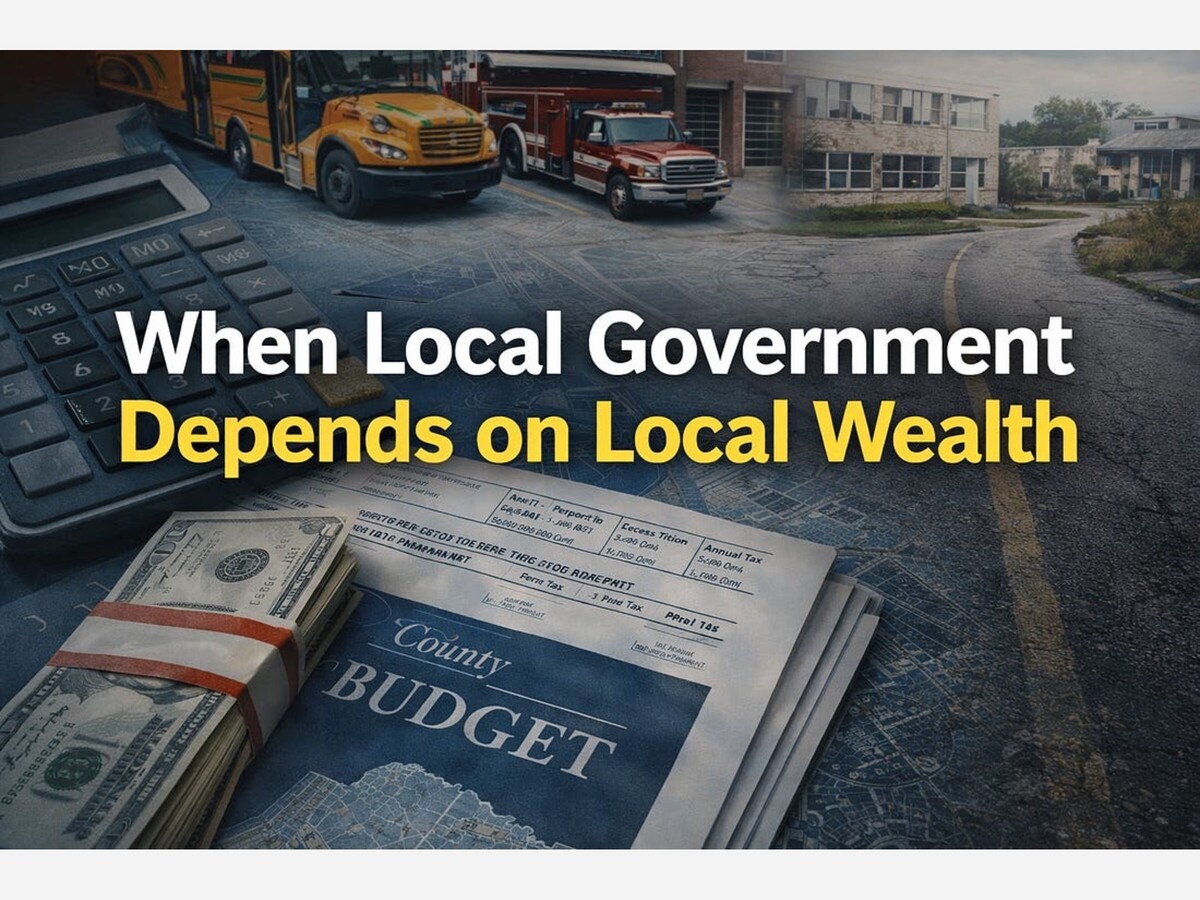



Local government is where public policy becomes personal. The quality of a child’s school, the condition of neighborhood roads, the availability of emergency response, and the capacity of local government to maintain parks, libraries, and infrastructure are shaped largely at the county and municipal level. Yet local governments are expected to provide these services with vastly different levels of fiscal capacity.
This is one of the least discussed consequences of American federalism.
In the United States, local governments are responsible for many of the services people rely upon most, but they are often required to fund those services largely through local wealth. As a result, some communities possess the financial capacity to provide strong schools, safe roads, and responsive public services, while others struggle to meet even basic needs. The result is a system in which where a person lives often matters as much as, or more than, the formal promises of equal citizenship.
American federalism divides power among federal, state, and local governments. In theory, this arrangement allows local governments to respond to the unique needs of their communities. In practice, however, it often produces unequal outcomes because local governments are given substantial responsibility without equal access to resources.
Counties and municipalities are typically expected to fund or support:
Yet the primary revenue sources available to local governments often include property taxes, local sales taxes, fees, and other locally generated revenue. This means that the ability of a local government to provide services depends heavily on the wealth of the community itself (Mikesell, 2014).
A community with high property values, a strong commercial base, and a growing economy can often generate substantial local revenue without placing extraordinary pressure on residents. A community with lower property values, higher poverty, or limited commercial development may face the opposite condition. It may have greater service needs, but less ability to fund them.
This creates what public finance scholars describe as unequal fiscal capacity. Two localities may have the same legal responsibilities, yet one possesses far greater ability to meet them simply because it has a stronger tax base (Fisher, 2018).
Property taxation remains the most important source of local government revenue in many parts of the United States. Local governments rely upon property taxes because they are stable, visible, and relatively predictable. However, dependence on property taxes creates a structural challenge.
Property values are not evenly distributed.
Communities with more expensive homes, stronger commercial property, and higher levels of private investment are able to raise more revenue even at lower tax rates. Communities with lower property values often must impose higher rates to generate the same amount of revenue, and even then may still collect less overall.
This means that local governments serving communities with greater poverty often face a painful dilemma. They must either reduce services, increase pressure on taxpayers, or both.
As a result, residents in some communities may pay more relative to their income while still receiving fewer public services. At the same time, local governments become increasingly dependent upon the very people who are least able to absorb additional costs.
The result is not simply a financial problem. It is a democratic problem.
When local government depends too heavily on local wealth concentrated in residential property, communities become vulnerable to cycles of fiscal stress. Rising costs, growing populations, and increasing service demands can place extraordinary pressure on residents, particularly when local governments possess few alternative sources of revenue.
The challenge becomes even more severe in communities with higher concentrations of poverty.
Research consistently demonstrates that communities with greater poverty often require greater investment in public services. Schools may require additional support for students facing food insecurity, housing instability, or limited access to health care. Public safety agencies may face higher demand. Infrastructure may be older and more costly to maintain. Local governments may need to devote greater resources to housing, transportation, and social services (Allard, 2009).
Yet these same communities often possess weaker tax bases.
This creates a paradox at the heart of American local government. The communities with the greatest need often possess the fewest resources with which to respond.
The consequences are visible in unequal educational outcomes, deteriorating infrastructure, disparities in public safety, and uneven access to opportunity. A child born in one locality may attend well-funded schools, live near well-maintained parks and roads, and benefit from strong public services. Another child, only a short distance away, may experience something entirely different.
Neither child chose the locality in which they were born.
Yet the structure of local government often determines the opportunities available to them.
These fiscal differences are not accidental. They reflect decades of public policy, housing segregation, uneven economic development, and unequal investment.
Communities with higher rates of poverty are often disproportionately Black and Hispanic, not because of inherent differences, but because of longstanding patterns of redlining, discriminatory lending, labor inequality, and exclusion from wealth-building opportunities (Rothstein, 2017).
As a result, local governments serving these communities frequently inherit a difficult combination: higher service demands and fewer fiscal resources.
This does not mean that every community fits the same pattern, nor does it mean that local government alone can solve these problems. It does mean, however, that local leaders must understand the relationship between poverty, place, and fiscal capacity.
Without that understanding, communities may continue to rely too heavily on residents while failing to examine whether their broader revenue systems are balanced, sustainable, and capable of supporting future growth.
The most important question is not whether local governments need revenue. They do.
The real question is whether the revenue structure is fair, balanced, and capable of sustaining the services residents expect.
Strong local government requires more than good intentions. It requires a thoughtful and disciplined approach to public finance. Local leaders must understand:
Communities cannot thrive if the only answer to rising costs is to ask more from the same people, year after year.
Public leadership requires more than managing today’s budget. It requires preparing for tomorrow’s reality.
American federalism gives local governments substantial responsibility, but it does not provide equal means with which to fulfill that responsibility. As long as local governments depend heavily on local wealth, some communities will possess greater opportunity than others.
This is not simply a question of economics. It is a question of fairness, governance, and equal access to public services.
When local government depends on local wealth, the consequences are felt in schools, roads, public safety, and the everyday lives of residents. Communities deserve revenue systems that are balanced, sustainable, and capable of supporting both present needs and future growth.
The challenge for public leaders is not simply to collect revenue.
It is to ensure that the system through which that revenue is generated works fairly for the people who depend upon it.
Allard, S. W. (2009). Out of reach: Place, poverty, and the new American welfare state. Yale University Press.
Fisher, R. C. (2018). State and local public finance (4th ed.). Routledge.
Mikesell, J. L. (2014). Fiscal administration: Analysis and applications for the public sector(9th ed.). Cengage Learning.
Rothstein, R. (2017). The color of law: A forgotten history of how our government segregated America. Liveright Publishi
Public Agenda is free today. But if you enjoyed this post, you can tell Public Agenda that the writing is valuable by pledging a future subscription. You won’t be charged unless payments are enabled.
Follow us on TikTok @DrShelliePublicAgenda
📢 Stay Connected with Public Agenda by Dr. Shellie M. Bowman
Let’s rebuild public leadership together; one insight, one question, one breakthrough at a time.
eLEADt On with Purpose.
Please write your comments below. If you want more articles like this please like them. Hashtag and Share our articles with others.

Patchy rain nearby, with a high of 98 and low of 70 degrees. Patchy rain nearby in the morning, sunny in the afternoon, patchy rain nearby in the evening, light rain overnight.