95° and Sunny
Image
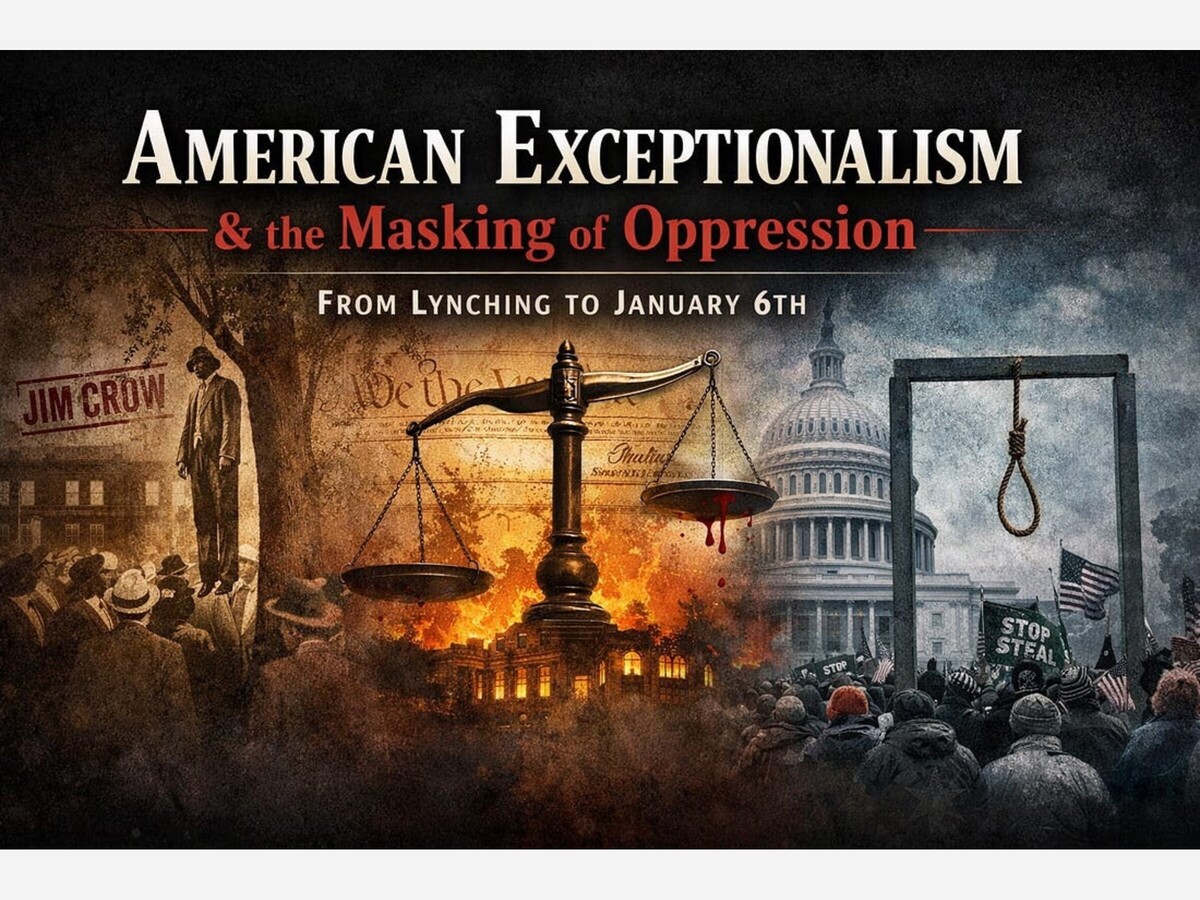



American exceptionalism is often invoked as a unifying national narrative. It suggests that the United States is uniquely committed to liberty, democracy, and the rule of law. In its most aspirational form, it reflects a belief in constitutional governance and equal protection. In practice, however, this narrative has also been used to obscure contradictions between stated ideals and lived realities. When unexamined, exceptionalism can function not as a reflection of democratic strength but as a rhetorical shield that normalizes or conceals systemic inequities.
This essay advances a public administration argument. American exceptionalism, when uncritically applied, can be weaponized to mask oppression by reframing administrative failures as anomalies, by legitimizing extrajudicial enforcement of social order, and by insulating systems of power from accountability. Drawing from the historical use of lynching as a form of governance, the displacement of Black Americans during the Great Migration, and contemporary events such as January 6, this analysis demonstrates how narratives of national identity can be mobilized to justify or obscure the breakdown of due process and equal protection.
Following the ratification of the Thirteenth, Fourteenth, and Fifteenth Amendments, the formal legal framework of the United States shifted toward expanded citizenship rights for Black Americans. Yet the administrative reality diverged sharply. Lynching emerged not as random violence, but as a patterned mechanism of social control that operated alongside, and often in place of, formal institutions (Equal Justice Initiative, 2017).
Public administration is fundamentally concerned with the provision of public goods, including security, justice, and due process. In the context of lynching, the failure to provide security was not merely a lapse. It was, in many documented cases, a deliberate administrative omission. Law enforcement officials frequently participated in, facilitated, or failed to prevent mob violence. Sheriffs and deputies, functioning as street-level bureaucrats, sometimes relinquished custody of detainees to mobs or declined to intervene, effectively transferring state authority to extralegal actors (Wells-Barnett, 1895; Equal Justice Initiative, 2017).
This phenomenon reflects what Lipsky (1980) identifies as discretionary behavior at the street level of bureaucracy. Discretion, when exercised without accountability, can produce outcomes that diverge from formal policy objectives. In this case, discretion enabled the selective withdrawal of protection from Black citizens, thereby reinforcing racial hierarchy under the guise of community order.
Lynchings also operated as a public spectacle. These events were often announced in advance, attended by large crowds, and documented through photographs and printed materials. This transformed violence into a civic ritual that communicated the boundaries of citizenship and the consequences of transgression. The spectacle functioned as governance. It conveyed policy without legislation, reinforcing social norms through terror rather than statute (Wood, 2009).
American exceptionalism, in this context, provided a narrative buffer. By framing the nation as fundamentally just, acts of lynching could be dismissed as aberrations rather than recognized as systemic failures of administration and law enforcement.
The cumulative effect of this administrative environment was profound. Between approximately 1915 and 1970, an estimated six million Black Americans left the Southern United States in what is known as the Great Migration. While economic opportunity is often cited as a motivating factor, scholarship emphasizes that violence and the absence of legal protection were central drivers (Wilkerson, 2010).
From a public administration perspective, this movement can be understood as a response to state failure. When a government does not provide basic protections, including physical safety and due process, affected populations may seek refuge elsewhere. In this sense, many Black migrants functioned as internal refugees, fleeing jurisdictions where the rule of law was selectively applied.
Lynchings were frequently directed at Black individuals who achieved economic success or accumulated property. In these cases, violence operated as a tool of economic regulation. It disrupted property ownership, undermined wealth accumulation, and reasserted racialized economic hierarchies. This bypassed formal legal processes such as probate and contract enforcement, replacing them with coercive redistribution through terror (Beck & Tolnay, 1990).
The exceptionalist narrative again played a masking role. By emphasizing opportunity and upward mobility as defining features of American life, it obscured the structural conditions that made such mobility precarious or unattainable for many.
The events of January 6, 2021, present a contemporary lens through which to examine the persistence of extrajudicial governance logics. The erection of gallows outside the United States Capitol and chants calling for the execution of the Vice President represent more than a symbolic protest. They reflect an assertion of what can be termed vigilante sovereignty.
Historically, mobs that engaged in lynching often justified their actions by claiming to correct perceived failures of the legal system. When courts did not produce desired outcomes, the mob asserted a right to intervene. This logic reappeared in January 6, where participants framed their actions as necessary to preserve the nation in the face of perceived institutional betrayal.
American exceptionalism plays a critical role in this dynamic. When individuals or groups believe that they embody the true essence of the nation, they may view themselves as operating above formal constraints. This belief can legitimize actions that bypass constitutional processes, under the assumption that such actions serve a higher patriotic purpose (Bonilla-Silva, 2018).
From a public administration standpoint, this represents a breakdown of procedural legitimacy. Democratic governance depends on adherence to established processes, even when outcomes are contested. When exceptionalist narratives are used to justify departures from those processes, they erode the foundations of administrative order.
The concept of the “black box” is useful for connecting historical and contemporary forms of unaccountable decision-making. In the era of lynching, the mob functioned as a black box. Decisions to punish or execute were made without transparency, due process, or avenues for appeal. Authority was diffuse, responsibility was obscured, and outcomes were final.
In modern governance, concerns about black box decision-making have shifted toward algorithmic systems and opaque legislative processes. Algorithms used in areas such as criminal justice, credit scoring, and public benefits can produce significant impacts on individuals’ lives while remaining difficult to scrutinize or challenge (Eubanks, 2018; Pasquale, 2015).
Similarly, legislative actions that restrict the teaching of historical injustices or that provide legal protections for certain uses of force can be understood as shaping the boundaries of accountability. When systems are designed in ways that limit transparency or review, they replicate key features of the historical black box.
American exceptionalism can again serve as a masking mechanism. By emphasizing national virtue, it can discourage critical examination of how power operates within these systems. This can lead to the normalization of practices that would otherwise be subject to democratic scrutiny.
American exceptionalism is not inherently problematic. It can inspire civic engagement and reinforce commitment to democratic ideals. The danger arises when it is used to deflect criticism, obscure systemic inequities, or justify departures from the rule of law.
The historical use of lynching as a form of extrajudicial governance demonstrates how administrative systems can fail to protect, or actively harm, marginalized populations. The Great Migration illustrates the human consequences of such failures. Contemporary events and emerging technologies reveal that the underlying dynamics of unaccountable power and selective enforcement have not disappeared.
A public administration framework demands more than aspiration. It requires accountability, transparency, and a commitment to equitable application of the law. If American exceptionalism is to retain its legitimacy, it must be reconciled with these principles. Otherwise, it risks functioning as a narrative that conceals, rather than confronts, the realities of governance.
Beck, E. M., & Tolnay, S. E. (1990). The killing fields of the Deep South: The market for cotton and the lynching of Blacks, 1882 to 1930. American Sociological Review, 55(4), 526–539.
Bonilla-Silva, E. (2018). Racism without racists: Color-blind racism and the persistence of racial inequality in America (5th ed.). Rowman & Littlefield.
Equal Justice Initiative. (2017). Lynching in America: Confronting the legacy of racial terror(3rd ed.). Equal Justice Initiative.
Eubanks, V. (2018). Automating inequality: How high-tech tools profile, police, and punish the poor. St. Martin’s Press.
Kirchler, E. (2007). The economic psychology of tax behaviour. Cambridge University Press.
Lipsky, M. (1980). Street-level bureaucracy: Dilemmas of the individual in public services. Russell Sage Foundation.
Pasquale, F. (2015). The black box society: The secret algorithms that control money and information. Harvard University Press.
Wells-Barnett, I. B. (1895). A red record: Tabulated statistics and alleged causes of lynching in the United States. Donohue & Henneberry.
Wilkerson, I. (2010). The warmth of other suns: The epic story of America’s great migration. Random House.
Wood, A. (2009). Lynching and spectacle: Witnessing racial violence in America, 1890–1940. University of North Carolina Press.
Public Agenda is free today. But if you enjoyed this post, you can tell Public Agenda that the writing is valuable by pledging a future subscription. You won’t be charged unless payments are enabled.
Follow us on TikTok @DrShelliePublicAgenda
📢 Stay Connected with Public Agenda by Dr. Shellie M. Bowman
Let’s rebuild public leadership together; one insight, one question, one breakthrough at a time.
eLEADt On with Purpose.


Patchy rain nearby, with a high of 98 and low of 70 degrees. Patchy rain nearby during the morning, sunny for the afternoon, patchy rain nearby in the evening, light rain overnight.