


Image
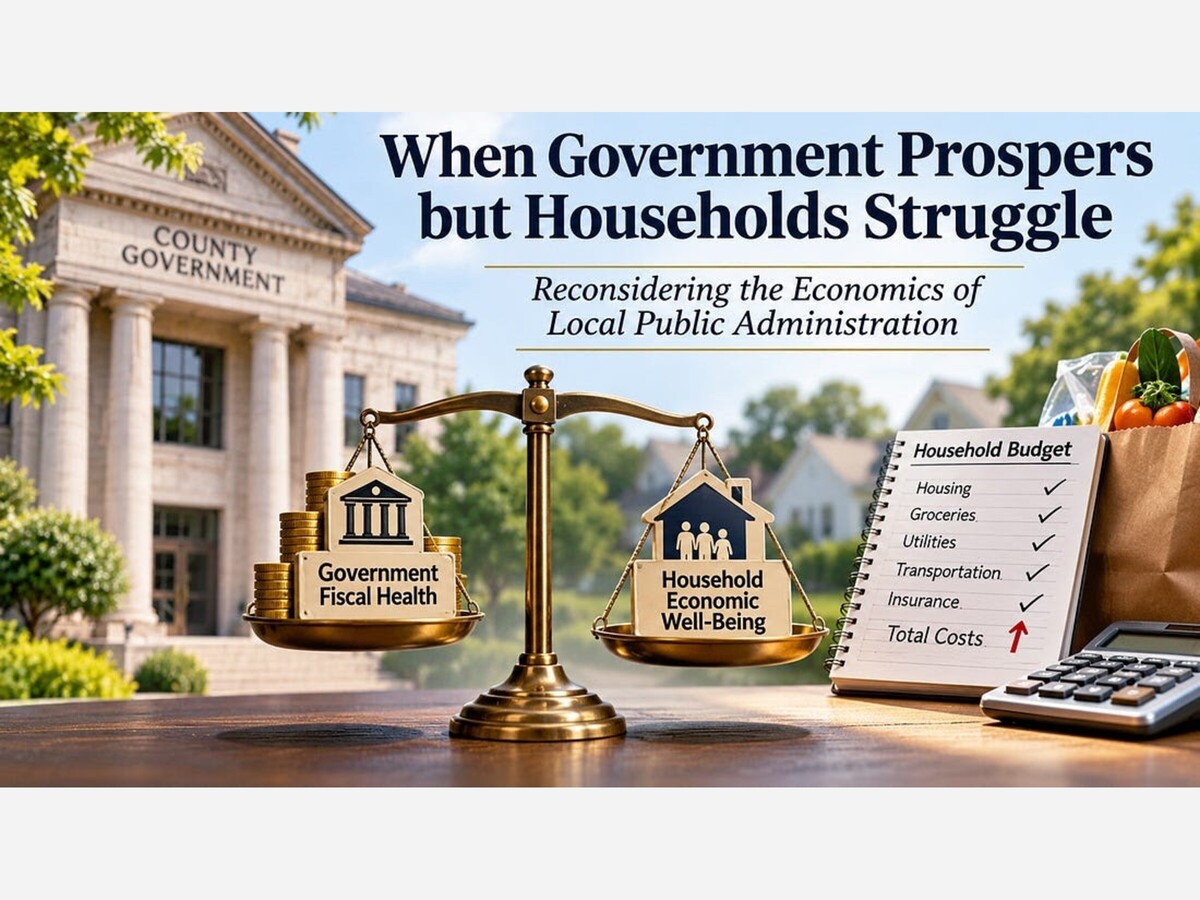
When Government Prospers but Households Struggle: Reconsidering the Economics of Local Public Administration
A local government can report growing revenues, healthy financial reserves, expanding development, and a balanced budget while the households financing that government struggle to maintain their purchasing power. This apparent contradiction raises an important question: Can government be considered fiscally successful when the economic circumstances of its residents tell a different story?
The question does not diminish the importance of fiscal discipline. Governments must maintain financial stability, meet legal obligations, and provide essential services. However, institutional fiscal health and household economic well-being are distinct outcomes. Understanding their relationship requires a broader examination of what constitutes successful public administration.
Public financial management traditionally emphasizes revenue adequacy, expenditure control, debt management, and long-term sustainability. These measures are indispensable. The Government Finance Officers Association (GFOA, 2022) recommends comprehensive long-term financial planning to anticipate fiscal pressures and strengthen governmental decision-making.
Yet a financially stable government does not necessarily indicate a financially secure population.
The Federal Reserve’s 2025 Survey of Household Economics and Decisionmaking found that 73% of American adults reported doing okay financially or living comfortably. Nevertheless, 58% indicated that changes in prices over the preceding year had worsened their financial circumstances (Board of Governors of the Federal Reserve System, 2026).
These national findings do not establish a causal relationship between local fiscal policies and household financial conditions. They do, however, demonstrate why institutional financial indicators alone cannot describe the economic experiences of citizens.
A locality may increase its revenue through expanding property values or commercial development while residents confront rising housing, transportation, insurance, and utility costs. The resulting tension deserves attention because fiscal growth and household prosperity, although related, are not interchangeable.
Public administration scholarship offers a foundation for reconsidering how government performance is evaluated.
Moore (1995) advanced the concept of public value, emphasizing that public managers must consider the value government creates through its activities. This perspective moves beyond administrative outputs toward the broader purposes of public institutions.
Applied to local finance, public value invites a consequential question: What economic benefits do households receive from the resources government collects and administers?
Consider infrastructure investment. A road improvement may increase public expenditures while reducing commuting time, vehicle maintenance costs, and barriers to employment. Conversely, an administratively inefficient process may impose additional expenses on residents without appearing as a direct expenditure in the government’s financial statements.
Herd and Moynihan (2018) explain that administrative burdens include learning, compliance, and psychological costs associated with interactions between citizens and government. These burdens reveal that the economic consequences of administration extend beyond formal taxation.
Thus, evaluating fiscal performance requires attention not only to what government spends, but also to the costs its decisions impose, prevent, or redistribute.
An opportunity exists to extend established public administration principles through what I propose calling household-centered fiscal governance.
This is not presented as an established theory. Rather, it is a proposed analytical framework for incorporating household economic capacity into the evaluation of local fiscal decisions.
Its central premise is straightforward: Government should examine institutional fiscal sustainability alongside the financial circumstances of the households affected by its policies.
Such an approach could introduce three considerations into fiscal decision-making.
First, household financial capacity should inform assessments of taxation, fees, and other public obligations. Understanding the distribution of economic burdens matters because households with different incomes, assets, and responsibilities may experience the same fiscal policy differently.
Second, net public value should guide the evaluation of economic development and infrastructure commitments. New investment may expand the tax base, create employment, and strengthen services. However, responsible analysis must also consider incentives, infrastructure obligations, future expenditures, and whether anticipated benefits reach residents.
Third, household economic resilience should receive greater attention. Local decisions affecting transportation, housing availability, service accessibility, and administrative costs can influence a household’s ability to absorb financial disruptions.
Importantly, this framework does not presume that reducing taxes always increases prosperity. Public investments can create substantial household benefits, while poorly designed tax reductions can compromise essential services. Nor can local government control national inflation, monetary policy, or every market condition influencing purchasing power.
The objective is therefore not to subordinate government finance to individual consumption, but to strengthen fiscal decision-making through a more complete understanding of public consequences.
The implications extend beyond economics into democratic accountability.
Residents are entitled to understand how public resources are collected, allocated, and managed. They should also have access to meaningful information about the anticipated benefits, costs, and risks associated with significant fiscal decisions.
A household-centered approach could complement existing financial reporting through fiscal impact assessments that consider affordability, distributional effects, and longer-term economic resilience.
Such assessments would require credible data, transparent assumptions, and acknowledgment of uncertainty. They would also need to distinguish outcomes directly attributable to government action from those shaped by broader economic forces.
This is not an argument for replacing conventional financial metrics. It is an argument for making them more informative.
Sound local public administration requires more than institutional solvency. It requires an informed understanding of how public decisions affect the people government exists to serve.
A balanced budget remains important. So do healthy reserves, responsible debt management, and sustainable revenue. Yet these indicators cannot independently establish whether public institutions are contributing to household economic well-being.
The challenge is to evaluate both dimensions without treating them as competing interests.
Ultimately, the financial strength of government should not be confused with the financial strength of its citizens. Responsible public administration must understand the relationship between the two.
If public value is the objective, household economic capacity deserves a meaningful place in how local government defines, measures, and communicates fiscal success.
Board of Governors of the Federal Reserve System. (2026). Economic well-being of U.S. households in 2025. https://doi.org/10.17016/8960.2
Government Finance Officers Association. (2022). Long-term financial planning. https://www.gfoa.org/materials/long-term-financial-planning
Herd, P., & Moynihan, D. P. (2018). Administrative burden: Policymaking by other means. Russell Sage Foundation. https://doi.org/10.7758/9781610448789
Moore, M. H. (1995). Creating public value: Strategic management in government. Harvard University Press. https://markmoore.scholars.harvard.edu/publications/creating-public-value-strategic-management-government-0
By Dr. Shellie M. Bowman · Launched 2 years agoPublic Agenda is a trusted voice at the intersection of democracy, leadership, and public trust, bringing clarity, courage, and conviction to the challenges that shape our common good.


Sunny, with a high of 51 and low of 36 degrees. Sunny during the morning, clear in the afternoon and evening, partly cloudy overnight.