49° and Clear
Image



By Dr Shellie M Bowman Sr
Every year, local governments confront a familiar challenge: the cost of providing public services continues, infrastructure requires maintenance, and communities expect their governments to respond to changing needs. Meanwhile, households and businesses must manage their own financial obligations, often with limited flexibility.
When expenditures increase faster than available resources, the public conversation frequently turns toward taxation. Should property tax rates increase? Are additional sales taxes necessary? Should governments introduce new fees or expand existing ones?
These are legitimate questions. Taxation is an essential instrument of public finance, supporting education, public safety, transportation, and other services that communities depend upon. Yet a more fundamental question deserves consideration before the discussion begins and should remain part of the discussion throughout:
Have local governments adequately examined how they generate, preserve, and manage revenue before asking residents to contribute more?
This question is not an argument against taxation. It is an argument for comprehensive fiscal stewardship, grounded in economic realities, legal authority, transparency, and the public interest.
Local governments rely on a combination of taxes, service charges, intergovernmental transfers, investment earnings, and other receipts. The composition varies significantly across states and localities, depending on economic conditions, governmental responsibilities, and statutory authority.
However, revenue systems do not necessarily evolve at the same pace as the economies they support.
The Government Finance Officers Association (GFOA, 2021) observed that traditional local revenue systems have become increasingly disconnected from modern economic activity. Property-based taxation remains important, but growing portions of economic value are associated with intangible assets, services, and other activities that do not necessarily translate into proportional growth in taxable property.
This disconnect presents a challenge. A community may experience considerable commercial development while residents continue to question whether that growth has meaningfully improved the locality’s fiscal position.
The National League of Cities (NLC, 2022) similarly emphasized that local revenue systems should provide adequate resources, treat taxpayers fairly, and remain resilient during economic downturns.
The implication is significant: A growing economy does not automatically produce a fiscally stronger local government.
Economic development must be evaluated not merely by the amount of investment announced, but by the financial benefits actually realized and retained for public purposes.
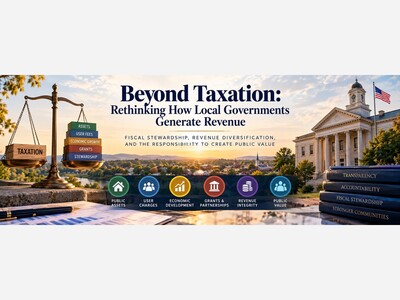
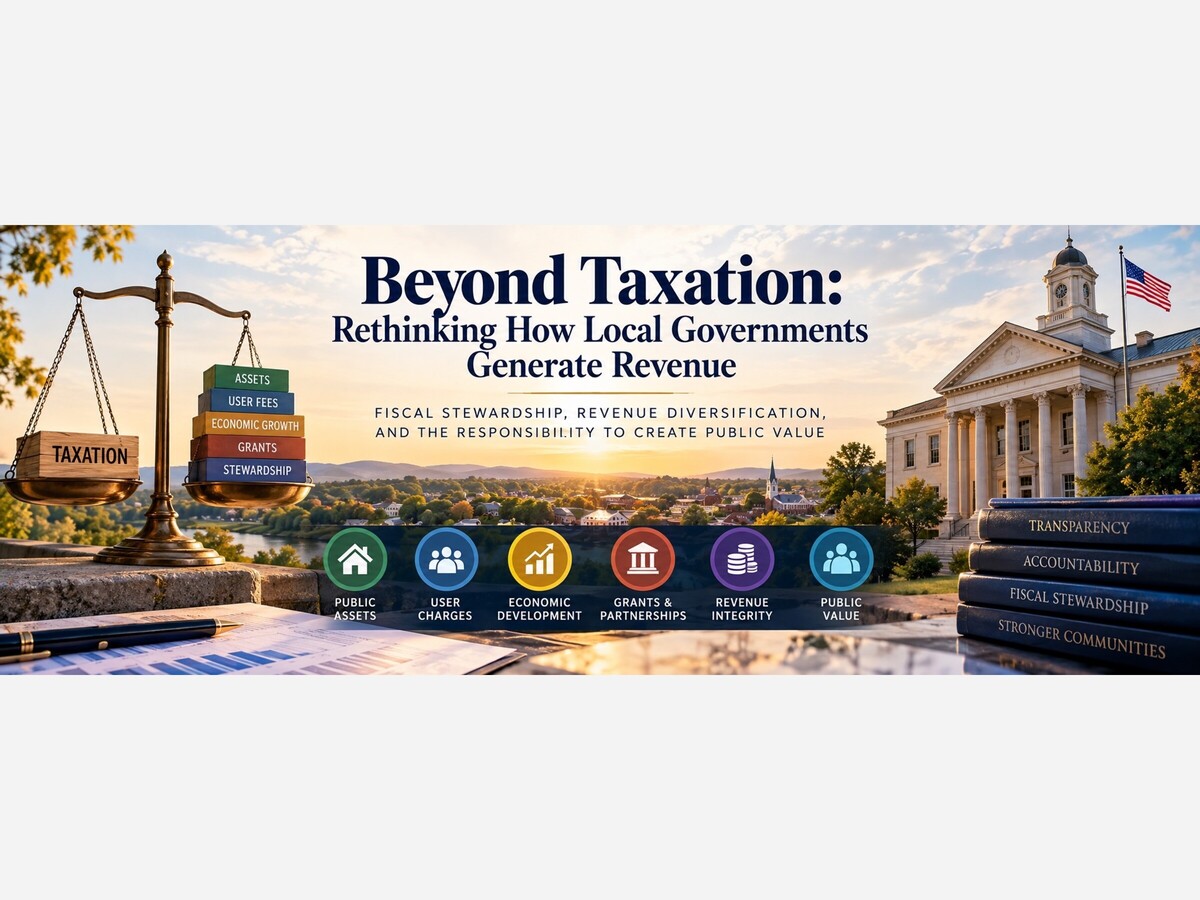
Revenue diversification involves examining multiple lawful and sustainable sources of public funding rather than relying excessively on any single mechanism.
Importantly, diversification is not synonymous with creating new taxes. It can also involve improving the management of existing resources, developing appropriate non-tax revenues, and reducing financial exposure.
Several approaches warrant consideration.
Local governments frequently own land, buildings, facilities, rights-of-way, and other assets. Some serve essential governmental purposes, while others may have additional economic utility.
Depending on state law and local circumstances, governments may generate revenue through appropriate leasing arrangements, facility use agreements, telecommunications infrastructure agreements, or carefully structured partnerships.
However, public ownership carries responsibilities beyond financial return. A government should not compromise public access, environmental protections, or long-term community needs simply to generate immediate receipts.
Asset utilization should therefore begin with a comprehensive inventory, a determination of public purpose, and an evaluation of potential financial and social consequences.
The central question is not whether every public asset can generate revenue, but whether public assets are being managed responsibly throughout their useful lives.
Certain public services provide identifiable benefits to particular users. Examples may include recreational programs, specialized permits, utility services, and the use of government facilities.
Appropriately designed charges can help recover the costs of delivering those services.
GFOA’s budgeting best practices recommend that local governments establish user fee policies rather than rely on inconsistent or ad hoc decisions (GFOA, n.d.-b).
Nevertheless, cost recovery introduces questions of equity. A fee that appears financially efficient may impose an unreasonable burden on low-income households, seniors, or individuals who require essential public services.
Furthermore, not every public service should operate according to a fee-for-service model. Public safety, education, and other collective responsibilities produce benefits extending beyond individual users.
Responsible cost recovery therefore requires distinguishing services suitable for user charges from those that should remain supported by broad-based public funding.
Economic development agreements can support employment, business expansion, infrastructure improvements, and growth in the tax base.
But economic activity and net public revenue are not interchangeable.
A development project may generate substantial gross tax receipts while simultaneously requiring public infrastructure, financial incentives, grants, service expansion, or contractual revenue reimbursements.
Consequently, the public should be able to understand not only the projected economic benefits but also the government’s associated financial commitments.
GFOA (2017) recommends establishing formal policies governing economic development incentives, including parameters for their use and procedures for implementation.
This raises an important question for every locality:
After accounting for incentives, public expenditures, and continuing obligations, how much additional revenue is actually available to support public services?
A credible answer requires more than a headline investment figure. It requires documented assumptions, realistic financial projections, performance measures, and subsequent evaluation of actual results.
A financially beneficial development agreement can advance the public interest. An agreement that fails to deliver its promised benefits warrants scrutiny and, where appropriate, corrective action.
Federal and state governments provide funding opportunities for infrastructure, public safety, transportation, environmental protection, and other public priorities.
Local governments can pursue grants, reimbursements, and cooperative arrangements to support qualifying initiatives.
Yet external funding should not automatically be regarded as free money.
Grants may require local matching contributions, impose restrictions on eligible expenditures, or create continuing operating and maintenance obligations after the original funding expires.
The appropriate measure of success is not simply the amount of outside funding awarded. It is whether the funding advances a legitimate public objective without creating unsustainable future costs.
This requires coordination among finance officers, department administrators, governing bodies, and other responsible institutions.
Before creating new revenue instruments, local governments should also examine the integrity of their existing revenue systems.
Are taxable activities properly identified? Are assessments accurate and legally defensible? Are applicable exemptions administered consistently? Are receivables managed effectively? Are investment and cash management practices consistent with governing law and fiduciary obligations?
These questions are not merely administrative.
Revenue omitted through inaccurate records, inconsistent procedures, or ineffective coordination may affect a locality’s ability to finance public services. At the same time, correcting errors must never become an excuse for improper assessments or denying lawful taxpayer protections.
Revenue integrity means collecting what the law authorizes, no more and no less.
Similarly, improving procurement, controlling unnecessary expenditures, and managing the lifecycle costs of public assets can preserve fiscal capacity.
Such savings are not technically new revenue. However, they may reduce the need for additional revenue by allowing existing resources to serve the public more effectively.
Although local revenue strategies involve numerous public officials, the role of tax administration deserves particular attention.
In Virginia, the Commissioner of the Revenue is a constitutional officer whose responsibilities are further defined by statute. Among those responsibilities, Virginia Code § 58.1-3107 addresses obtaining required taxpayer returns, § 58.1-3108 requires specified taxpayer assistance, and § 58.1-3109 establishes duties concerning personal property, income, and licenses (Commonwealth of Virginia, n.d.).
These responsibilities are important because sound fiscal planning depends, in part, on reliable information about the taxable base and lawful administration of revenue measures.
The Commissioner does not independently establish tax rates, approve economic development agreements, or determine county spending priorities. Those decisions belong to other legally authorized institutions.
Nevertheless, accurate assessments, statutory compliance, taxpayer education, and dependable administrative information contribute to the integrity of the broader public finance system.
Across the United States, similar functions may be performed by assessors, auditors, treasurers, tax administrators, or finance departments. Titles and authority vary, but the underlying public responsibility remains important.
Tax administration should protect both the government’s lawful revenue interests and the taxpayer’s rights.
This is where professional competence, transparent procedures, and public service intersect.
Revenue diversification is not automatically equitable.
A locality might reduce reliance on property taxes while increasing charges that fall disproportionately on households with limited financial resources. Another might attract commercial development but incur infrastructure or service costs that diminish the anticipated fiscal benefit.
Consequently, evaluating revenue policy requires examining who pays, who benefits, and how financial risks are distributed.
The GFOA’s Rethinking Revenue initiative emphasizes that fairness, economic realities, and community values belong at the center of revenue policy discussions (GFOA, 2022).
This perspective challenges the assumption that the most productive revenue instrument is necessarily the most appropriate.
A sound fiscal system should be evaluated through several dimensions: adequacy, stability, administrative feasibility, economic effects, transparency, and equity.
No single revenue source performs equally well across every dimension.
Property taxes may provide relatively stable revenues but create affordability concerns. Consumption-based taxes can broaden revenue sources but fluctuate with economic activity and may impose relatively greater burdens on lower-income households. Service charges can connect payment to usage but may restrict access when affordability protections are absent.
The objective is not to eliminate these trade-offs. It is to acknowledge them and make informed decisions with the public’s interests in view.
Residents should not need specialized training in governmental accounting to understand the basic financial consequences of major public decisions.
When governments announce economic development projects, issue debt, adopt new fees, or propose tax increases, the public should have access to understandable explanations of the anticipated benefits, financial commitments, and material risks.
Transparency involves more than publishing lengthy financial documents. It requires presenting information in ways that permit meaningful public evaluation.
For example, an economic development agreement should be accompanied by a clear explanation of anticipated public revenues, incentive commitments, infrastructure responsibilities, relevant performance measures, and the assumptions supporting long-term projections.
Likewise, a proposal to increase taxes should explain the underlying service needs, available alternatives, expected distribution of costs, and consequences of maintaining existing revenues.
The public may ultimately support additional taxation when the need is substantiated. Responsible fiscal stewardship does not guarantee that every tax increase can or should be avoided.
Rather, it requires governments to demonstrate that decisions are informed by evidence, legal authority, and consideration of reasonable alternatives.
The discussion about local government revenue should not begin and end with whether taxes are too high or too low.
A more productive conversation asks whether the revenue system is sufficiently diversified, whether economic development produces measurable public benefits, whether existing assets are managed responsibly, and whether fiscal decisions distribute costs fairly.
It also asks whether government has the institutional capacity to evaluate those questions competently.
Local governments operate within real constraints. State laws limit available revenue instruments. Communities differ in economic opportunity, population, infrastructure, and service responsibilities. Some jurisdictions have substantial commercial tax bases, while others depend heavily on residential property.
There is no universal revenue formula.
But there can be a consistent standard of public accountability.
Before asking residents to contribute more, local governments should be prepared to explain what resources they already possess, how effectively those resources are managed, which lawful alternatives have been evaluated, and why the proposed fiscal course best serves the community.
That expectation should not be interpreted as opposition to taxation. It reflects the responsibilities accompanying the authority to tax.
Ultimately, responsible revenue generation is not measured solely by the amount of money collected.
It is measured by how effectively, equitably, and transparently government converts public resources into lasting public value.
For citizens, this provides a basis for informed participation. For Commissioners of the Revenue and other fiscal professionals, it reinforces the importance of sound administration. For governing bodies, it offers a standard against which revenue proposals and economic development decisions can be examined.
And for every community, it returns the discussion to its proper starting point: government finance exists to serve the people.
Commonwealth of Virginia. (n.d.). Code of Virginia, Title 58.1, Chapter 31, Article 1: Commissioners of the revenue. Virginia Legislative Information System. https://law.lis.virginia.gov/vacodefull/title58.1/chapter31/article1/
Government Finance Officers Association. (2017). Establishing an economic development incentive policy. https://www.gfoa.org/materials/establishing-an-economic-development-incentive-policy
Government Finance Officers Association. (2021). Part 1: Rethinking local government revenue systems. https://www.gfoa.org/materials/rethinking-local-government-revenue-systems
Government Finance Officers Association. (2022). Part 2: Rethinking local government revenue systems. https://www.gfoa.org/materials/rethinking-local-government-revenue-systems-p2
Government Finance Officers Association. (n.d.-a). Rethinking revenue. https://www.gfoa.org/rethinking-revenue
Government Finance Officers Association. (n.d.-b). Budgeting best practices. https://www.gfoa.org/best-practices/budgeting
National League of Cities. (2022, January 31). Rethinking local government revenue. https://www.nlc.org/article/2022/01/31/rethinking-local-government-revenue/
Public Agenda is free today. But if you enjoyed this post, you can tell Public Agenda that the writing is valuable by pledging a future subscription. You won’t be charged unless payments are enabled.
Follow us on TikTok @DrShelliePublicAgenda


Sunny, with a high of 65 and low of 46 degrees. Sunny for the morning, clear during the afternoon and evening,