

Image
By Dr Shellie M Bowman Sr
Some lessons about government cannot be fully learned from textbooks, campaign speeches, policy white papers, or televised debates.
Some lessons arrive through observation. Some arrive through scholarship. Some arrive through service.
And some arrive after institutions break down.
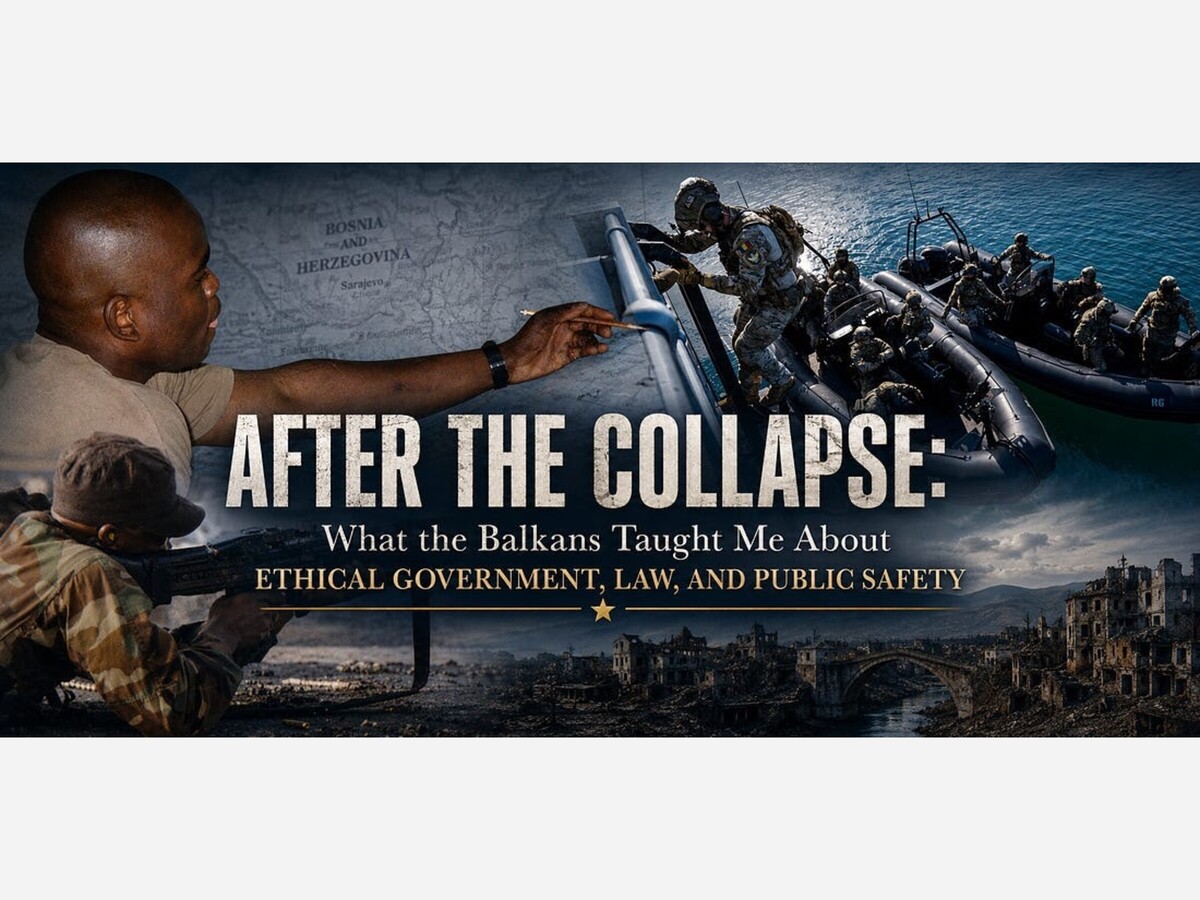
As a United States Navy veteran and Special Warfare Combatant-Craft Crewman assigned to Special Boat Unit 20, I deployed as part of a special operations contingent attached to a larger Amphibious Ready Group during the era surrounding the implementation and stabilization efforts associated with the Dayton Peace Agreement. I did not deploy as a politician, a scholar, or a commentator. I deployed as a service member participating in a much larger mission occurring in the shadow of a fractured region struggling to emerge from war, ethnic division, and institutional collapse.
What I witnessed left a lasting impression on my understanding of public leadership, ethical government, and the profound importance of law-abiding institutions.
The Balkans taught me something many societies forget during seasons of relative stability: ethical government is not an abstract aspiration. It is a public safety issue.
When ethical leadership collapses, ordinary people pay the price.
When Rules Die, People Die
In stable democracies, discussions about ethics in government can sometimes feel theoretical.
People debate transparency policies, ethics rules, constitutional limits, administrative procedures, oversight frameworks, and conflicts of interest. These conversations matter greatly. Yet in functioning societies, it is easy to forget what these structures are protecting us from.
The former Yugoslavia offered a devastating reminder.
The wars that engulfed the Balkans during the 1990s were marked by ethnic cleansing campaigns, mass displacement, systematic violence against civilians, detention camps, mass graves, and widespread destruction of communities that once included neighbors living side by side (Glenny, 1996; Judah, 2000). The genocide at Srebrenica alone resulted in the murder of more than 8,000 Bosniak men and boys, becoming one of the most documented atrocities in Europe since the Second World War (United Nations, 1999).
These were not random acts of chaos detached from governance.
They emerged from the corrosion of institutions, the weaponization of identity, and the abandonment of legal and ethical restraints by political actors who increasingly treated state power as an instrument of exclusion and domination.
The lesson is uncomfortable but important.
When leaders abandon law, fairness, and ethical restraint, the consequences do not remain confined to committee rooms or election cycles.
They reach neighborhoods.
They reach families.
They reach gravesites.
This reality continues to shape my understanding of public leadership. Whether one serves in federal government, local government, nonprofit leadership, elected office, military command, or administrative management, ethical conduct is not cosmetic. It is foundational infrastructure for human safety.
The Day Public Trust Breaks
One of the most sobering observations associated with institutional collapse is the speed with which public trust can evaporate.
In healthy societies, people generally assume certain systems will function.
The police will respond fairly.
Courts will apply laws consistently.
Public officials will administer responsibilities within constitutional boundaries.
Citizens may criticize institutions, sometimes vigorously, while still believing the underlying system retains legitimacy.
But when corruption, favoritism, factionalism, or selective enforcement become dominant features of governance, trust begins to fracture.
The Balkans demonstrated what happens when large segments of the population no longer believe institutions belong to everyone.
Scholars of civil conflict frequently note that weakened institutional legitimacy increases the likelihood of fragmentation, informal violence, and the emergence of parallel power structures to fill governance vacuums (Fearon & Laitin, 2003).
When citizens stop trusting neutral governance, they begin seeking security elsewhere.
Militias.
Ethnic factions.
Criminal networks.
Informal protection arrangements.
Fear replaces confidence.
Identity replaces citizenship.
Suspicion replaces civic cohesion.
The implications extend far beyond conflict zones.
Ethical, competent, law-abiding leadership matters not because it produces perfect societies. Human institutions are imperfect by nature. Ethical leadership matters because legitimate governance creates conditions in which disagreements can remain political instead of becoming existential.
This lesson profoundly informs my own understanding of public service.
My commitment to ethical, accountable government is not rooted in party affiliation.
It is rooted in lived experience.
Democrat, Republican, Independent, or otherwise, public leaders bear responsibility to all people.
There is no substitute for fair, competent, and law-abiding leadership.
When Propaganda Replaces Truth
Every broken institution has a story about information.
The Balkan conflicts were fueled not only by military operations and political fragmentation but also by powerful campaigns of nationalist rhetoric, historical grievance amplification, and media manipulation. Political actors and state-controlled communication channels frequently reinforced narratives that inflamed fear, deepened division, and dehumanized perceived adversaries (Thompson, 1999).
Propaganda does not merely distort facts.
It alters moral boundaries.
It creates alternate realities in which neighbors become enemies, procedural fairness becomes weakness, and violence becomes reframed as necessity.
That lesson remains relevant well beyond war zones.
Ethical public leadership requires a relationship with objective truth.
Not convenient truth.
Not partisan truth.
Not strategically edited truth.
Objective truth.
Transparent communication, accurate public information, and intellectual honesty are not luxuries reserved for idealistic governance models. They are stabilizing forces.
Citizens cannot make informed decisions without trustworthy information.
Institutions cannot maintain legitimacy when public communication becomes consistently manipulative or detached from verifiable reality.
As both a scholar of public administration and a public servant committed to accountability, I regard truthful governance as an ethical obligation.
People deserve honesty from those entrusted with authority.
When Government Fails, Someone Else Must Carry the Burden
One reality that often receives insufficient attention in discussions about failed governance is who ultimately inherits the consequences.
When local institutions collapse, the burden rarely disappears.
It transfers.
During stabilization operations associated with IFOR and SFOR, international military forces became involved in responsibilities extending beyond conventional warfighting functions. Stabilization required separating factions, supporting security conditions, helping secure movement routes, and contributing to environments in which reconstruction and governance restoration could begin (Dobbins et al., 2003).
This is not a criticism of military service.
I am extraordinarily proud of mine.
It is, however, a reminder of what ethical political leadership helps prevent.
When governance fails catastrophically, service members are often asked to enter environments shaped by accumulated political failures, institutional collapse, and broken civil trust.
They do so willingly.
They do so professionally.
They do so at personal risk.
As a veteran, this lesson carries particular weight for me.
The cost of unethical leadership is not paid exclusively by civilians trapped inside collapsing societies.
It is also paid by service members tasked with helping restore order after leaders fail to uphold their obligations.
Good governance is not anti-military.
Good governance honors military sacrifice by reducing the likelihood that preventable institutional failures will require costly stabilization efforts later.
Accountability Is Not Punishment. It Is Protection.
One of the most important lessons from the post-conflict environment involved accountability.
Peace did not emerge merely because violence became unsustainable.
Peace required frameworks.
Boundaries.
Enforcement mechanisms.
Legal commitments.
International engagement.
Institutional reconstruction.
The Dayton Accords created a legal architecture intended to halt conflict and establish a foundation for political stabilization and governance reconstruction (Holbrooke, 1998).
The process was imperfect. Post-conflict reconstruction always is.
But the broader lesson remains essential.
Safety is tied to enforceable rules and leaders constrained by law.
Constitutional limits matter.
Independent institutions matter.
Oversight matters.
Administrative competence matters.
Ethics rules matter.
Accountability is not the enemy of effective leadership.
Accountability is one of the conditions that make legitimate leadership possible.
This belief continues to shape my own commitment to public service and ethical leadership.
Not because ethical government guarantees universal agreement.
It does not.
Not because law alone solves human division.
It does not.
But because accountable governance creates structures through which societies can pursue justice, manage disagreement, and protect human dignity without descending into institutional chaos.
Why This Matters to Me Today
People occasionally ask why ethical leadership, accountability, competent administration, and lawful government remain such central themes in my work.
Part of the answer is academic.
Part of the answer is professional.
Part of the answer is personal.
I have seen enough to understand that functioning institutions should never be taken for granted.
Public trust is easier to erode than rebuild.
The rule of law is more fragile than many citizens realize.
Government integrity matters at every level.
Federal.
State.
Local.
Nonprofit.
Administrative.
Military.
Civic.
Political party affiliation does not relieve leaders of their ethical obligations.
Public office is not a license for selective accountability.
Leadership is a stewardship responsibility.
My lived experiences, combined with scholarship, professional service, and public administration practice, continue to drive my belief that government must remain accountable to the people it serves.
Not some people.
All people.
That conviction does not belong to a political party.
It belongs to responsible public leadership.
The Balkans taught me many things.
Among them was this enduring truth: when institutions collapse, rebuilding trust, safety, and legitimacy is difficult, costly, and deeply human work.
It is far wiser to protect ethical governance before collapse occurs.
To our public leaders, public servants, service members, veterans, and citizens, I offer this simple encouragement: guard your institutions carefully, hold leadership accountable fairly, pursue truth honestly, and never underestimate the public value of ethical, law-abiding government.
May our service remain principled.
May our leadership remain accountable.
And may all service members, their families, and the people be safe and well.
References
Dobbins, J., Jones, S. G., Crane, K., DeGrasse, B., Rathmell, A., Steele, R., Teltschik, R., & Timilsina, A. R. (2003). America’s role in nation-building: From Germany to Iraq. RAND Corporation.
Fearon, J. D., & Laitin, D. D. (2003). Ethnicity, insurgency, and civil war. American Political Science Review, 97(1), 75–90.
Glenny, M. (1996). The fall of Yugoslavia: The third Balkan war (3rd ed.). Penguin Books.
Holbrooke, R. (1998). To end a war. Modern Library.
Judah, T. (2000). The Serbs: History, myth and the destruction of Yugoslavia (2nd ed.). Yale University Press.
Thompson, M. (1999). Forging war: The media in Serbia, Croatia, Bosnia, and Hercegovina. University of Luton Press.
United Nations. (1999). Report of the Secretary-General pursuant to General Assembly resolution 53/35: The fall of Srebrenica.
Public Agenda is free today. But if you enjoyed this post, you can tell Public Agenda that the writing is valuable by pledging a future subscription. You won’t be charged unless payments are enabled.
Follow us on TikTok @DrShelliePublicAgenda
📢 Stay Connected with Public Agenda by Dr. Shellie M. Bowman
Let’s rebuild public leadership together; one insight, one question, one breakthrough at a time.
eLEADt On with Purpose.


Overcast, with a high of 72 and low of 61 degrees. Patchy rain nearby in the morning, overcast in the afternoon, patchy rain nearby during the evening, mist overnight.