

Image
By Dr Shellie M Bowman Sr
May 26, 2026
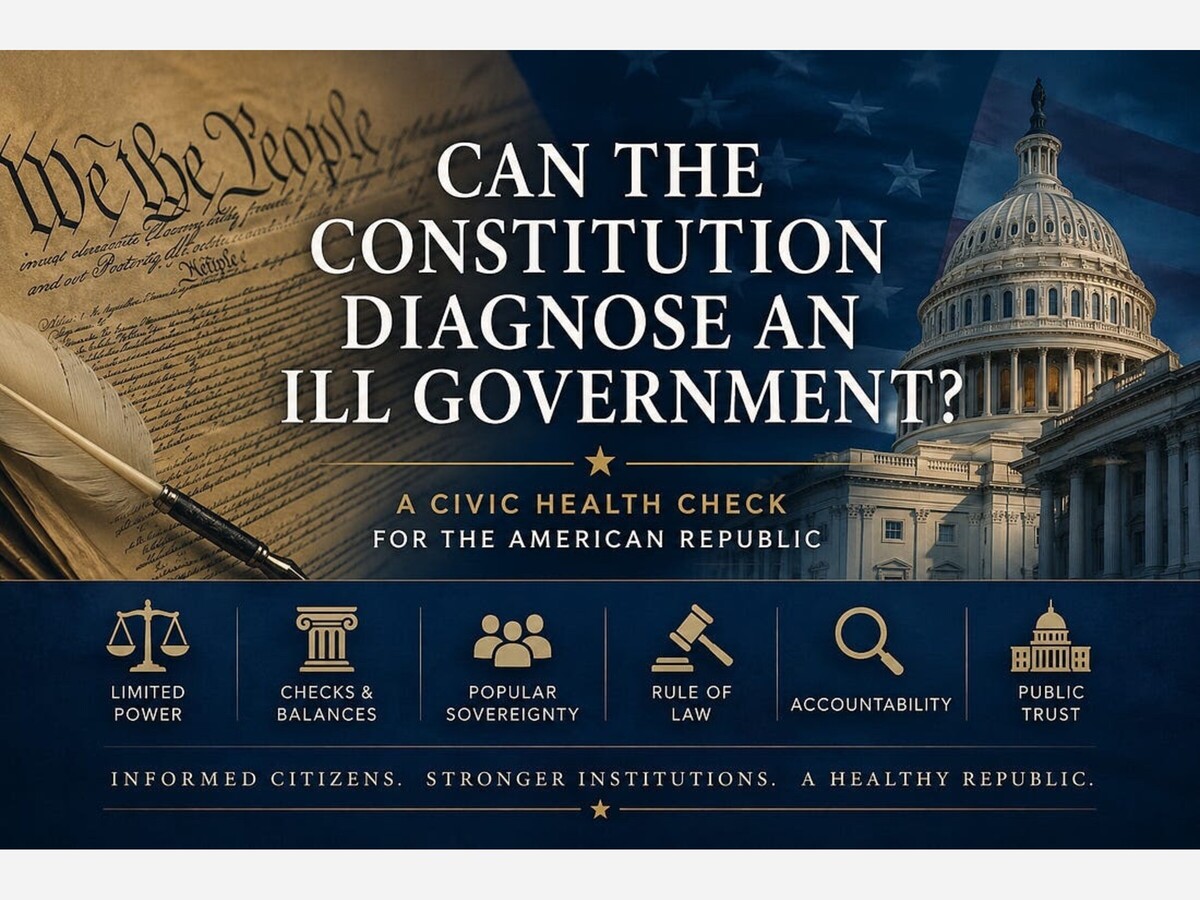
The Constitution as America’s Diagnostic Instrument
When Americans think about the United States Constitution, many think of rights, elections, or the branches of government. Fewer think of it as a diagnostic instrument.
Yet that may be one of its most important functions.
A physician evaluates the human body through vital signs, organ systems, and observable symptoms. Likewise, citizens can evaluate the health of the government through constitutional indicators. The Framers did not write the Constitution because they assumed government would always act wisely. They wrote it because they understood human nature, distrusted concentrated power, and sought safeguards against governmental illness and tyranny (Madison, 1788/2003).
The Constitution was not designed merely to establish government. It was designed to restrain it.
Vital Sign One: Is Power Properly Balanced?
One of the Constitution’s clearest diagnostic tools is the separation of powers.
Legislative, executive, and judicial powers were intentionally divided because the Framers feared concentrated authority. In Federalist No. 51, James Madison argued that institutional controls were necessary because power must be checked by power (Madison, 1788/2003).
A constitutional health question, therefore, becomes:
Is power properly balanced, or is authority becoming overly concentrated?
Symptoms of governmental imbalance may include weak oversight, institutional passivity, blurred authority, or unchecked decision-making.
The Constitution anticipates conflict among branches not as failure, but as protection. Friction, debate, oversight, and accountability are features of constitutional governance.
A government with no meaningful checks should concern citizens regardless of political ideology.
Vital Sign Two: Does the Rule of Law Govern Power?
Healthy constitutional systems rely upon the rule of law.
The law must be larger than personalities, parties, administrations, or temporary political victories. Constitutional governance requires lawful authority, procedural fairness, and institutional consistency.
This raises another diagnostic question:
Is the government operating under the rule of law, or is power increasingly shaping the law to suit itself?
The Constitution’s structure assumes that law should discipline power. Public administration scholarship similarly emphasizes accountability, legitimacy, and procedural integrity as essential to democratic governance (Denhardt & Denhardt, 2000).
When rules appear selectively applied, transparency weakens, accountability erodes, and public trust suffers.
Trust matters because democracies depend not only on laws, but on public confidence that institutions remain worthy of lawful obedience.
Vital Sign Three: Does Government Remain Accountable to the People?
The Constitution begins with three consequential words:
“We the People.”
Those words establish popular sovereignty as a constitutional cornerstone.
The government does not own the people. The government derives authority from them.
This principle creates a third diagnostic question:
Does government remain meaningfully accountable to the people it serves?
Citizens possess constitutional tools for answering this question:
When participation declines, accountability often weakens.
Political scientist Robert Dahl (1989) argued that democratic systems require meaningful opportunities for citizen participation and institutional responsiveness. Governmental health, therefore, depends partly upon civic engagement.
The Constitution cannot fully protect a disengaged republic from itself.
Recognizing the Symptoms of Democratic Illness
Tyranny does not always arrive dramatically.
Sometimes democratic weakening appears quietly through declining transparency, weak oversight, civic disengagement, institutional distrust, or normalized unaccountability.
These warning signs are not inherently partisan.
Bad government is bad for conservatives, liberals, independents, moderates, and nonvoters alike.
Waste, misallocation, self-serving governance, and institutional dysfunction expose citizens to greater vulnerability from national systems down to local communities.
The Constitution provides a framework for recognizing these conditions precisely because it was written with human imperfection in mind.
Its safeguards assume ambition, faction, disagreement, and competing interests will always exist (Hamilton et al., 1788/2003).
The constitutional question is not whether conflict exists.
The question is whether the system still possesses sufficient safeguards to channel conflict toward accountability rather than abuse.
The People Are Not Powerless
The Constitution’s greatest democratic insight may be this:
The ultimate power in the American system remains with the people.
That power is imperfect. It requires effort, participation, education, and responsibility.
But it remains powerful.
Citizens possess lawful mechanisms to influence institutional health through voting, public accountability, civic education, local engagement, and constitutional participation.
Young voters matter.
First-time voters matter.
Informed citizens matter.
Constitutional systems weaken when people conclude their participation is meaningless. They strengthen when citizens understand that democratic accountability is cumulative, measurable, and collective.
The American constitutional system was never intended to run on autopilot.
It depends upon an informed public willing to examine government honestly, defend constitutional principles consistently, and recognize that accountability is not hostility toward government. It is one of democracy’s essential maintenance functions.
The Constitution does not merely establish the American government.
It helps citizens diagnose whether the government remains faithful to the constitutional vision under which it was created.
That makes constitutional literacy not simply a legal exercise.
It is a civic responsibility.
Stay engaged!
-Dr. Shellie
References
Dahl, R. A. (1989). Democracy and its critics. Yale University Press.
Denhardt, J. V., & Denhardt, R. B. (2000). The new public service: Serving rather than steering. Public Administration Review, 60(6), 549–559.
Hamilton, A., Madison, J., & Jay, J. (2003). The Federalist Papers (C. Rossiter, Ed.). Signet Classics. (Original work published 1788)
Madison, J. (2003). Federalist No. 51. In A. Hamilton, J. Madison, & J. Jay, The Federalist Papers (C. Rossiter, Ed.). Signet Classics. (Original work published 1788)
Public Agenda is free today. But if you enjoyed this post, you can tell Public Agenda that the writing is valuable by pledging a future subscription. You won’t be charged unless payments are enabled.
Follow us on TikTok @DrShelliePublicAgenda
📢 Stay Connected with Public Agenda by Dr. Shellie M. Bowman
Let’s rebuild public leadership together; one insight, one question, one breakthrough at a time.
eLEADt On with Purpose.


Overcast, with a high of 72 and low of 61 degrees. Patchy rain nearby in the morning, overcast in the afternoon, patchy rain nearby during the evening, mist overnight.