


Image
By Dr Shellie M Bowman Sr
Democratic government was never intended to function as a spectator system. From local councils to federal agencies, public institutions derive legitimacy from the people they serve. Yet across the United States, many citizens increasingly express frustration with government responsiveness, fiscal stewardship, and institutional trustworthiness. Concerns over opaque decision-making, inefficient spending, politicized governance, and declining civic confidence have intensified public demands for accountability. The challenge, however, is that accountability is not self-executing. It requires informed citizens, transparent institutions, and systems designed to encourage oversight rather than discourage it.
In public administration scholarship, accountability is commonly understood as the obligation of public officials to explain and justify their actions to citizens and oversight bodies (Bovens, 2007). Accountability exists not merely to punish misconduct, but to preserve democratic legitimacy, improve institutional performance, and ensure that public power is exercised in the public interest. When accountability weakens, public trust often declines alongside it.
The relationship between accountability and public trust is particularly important in democratic governance. Citizens generally cannot directly manage government operations themselves. Instead, they delegate authority to elected officials, public administrators, and agencies with the expectation that these actors will govern fairly, transparently, and responsibly. This arrangement requires continual public oversight. Without it, democratic participation risks becoming symbolic rather than substantive.
Scholars have long argued that transparency serves as one of the foundational mechanisms for democratic accountability (Fox, 2007). Transparency allows citizens to understand governmental actions, monitor expenditures, evaluate policy outcomes, and identify inconsistencies between public promises and operational realities. Transparency also reduces information asymmetry, which occurs when government actors possess significantly more information than the public they serve. Excessive information asymmetry weakens democratic participation because citizens cannot meaningfully evaluate what they cannot see.
This concern becomes especially relevant when examining public expenditures and strategic planning. Budgets reflect governmental priorities. They communicate which programs receive investment, which communities receive support, and which problems are considered urgent. Public budgeting, therefore, represents far more than accounting. It is an expression of governance values and political priorities (Rubin, 2019). When citizens fail to monitor public spending, important fiscal decisions may occur with little meaningful scrutiny.
One of the most powerful but underutilized tools available to citizens is the government audit process. Audits provide systematic evaluations of financial integrity, compliance, operational efficiency, and program effectiveness. State auditors, inspectors general, and independent oversight bodies routinely identify waste, inefficiencies, and control weaknesses across government operations. Yet many citizens rarely review these findings despite their public availability.
Performance auditing is particularly important because it moves beyond simple financial review and asks whether programs are actually achieving intended outcomes. According to the Government Accountability Office, performance audits help determine whether government programs operate efficiently, effectively, and in accordance with applicable laws and public expectations. These evaluations can reveal structural weaknesses that significantly affect citizens’ quality of life.
Equally important is the public’s ability to request information directly from government agencies through freedom of information laws. At the federal level, the Freedom of Information Act established the principle that government records generally belong to the public unless legally exempted. Similar laws exist across states and localities. These laws empower citizens, journalists, researchers, and advocacy organizations to request records related to spending, contracts, communications, policies, and governmental operations.
FOIA requests and open records laws are not merely procedural tools for attorneys or investigative journalists. They are democratic instruments intended to reinforce public oversight. Research demonstrates that access to government information strengthens civic engagement and institutional accountability by increasing public awareness and reducing opportunities for corruption (Cucciniello et al., 2017).
Citizens can also exercise accountability through fiscal literacy. Following the “money trail” of government spending often reveals whether public priorities align with actual expenditures. Reviewing publicly available budgets, procurement contracts, capital improvement plans, grant allocations, and audit reports can provide valuable insights into governmental decision-making. Public procurement, in particular, warrants careful attention because it accounts for a significant share of government expenditures and may expose vulnerabilities to favoritism, inefficiency, or inadequate oversight if not closely monitored.
At the local level, accountability is often more tangible because government decisions directly shape everyday life. Public schools, emergency services, infrastructure maintenance, land use planning, housing policy, and tax administration all affect household stability and community well-being. Citizens therefore benefit from understanding how local decisions are made, who makes them, and what evidence informs those decisions.
This reality underscores the importance of strategic alignment in public governance. Effective government requires alignment between citizen concerns, jurisdictional capabilities, strategic plans, and operational priorities. Public institutions should not simply pursue initiatives because they are politically expedient or administratively convenient. Rather, governmental decision-making should reflect identified public needs, fiscal realities, and long-term community objectives.
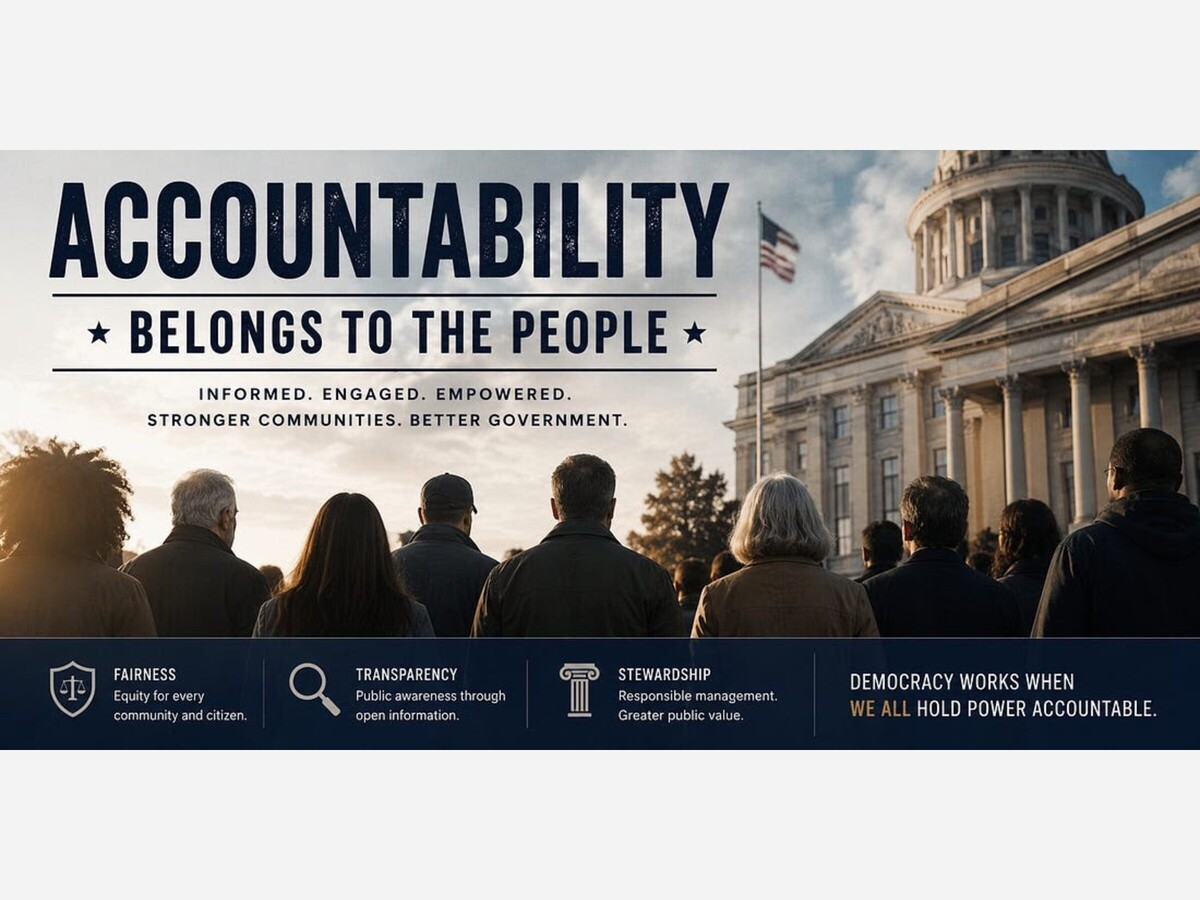
Within this framework, three governance principles deserve renewed emphasis: fairness, transparency, and stewardship.
Fairness reflects the obligation to administer public systems equitably and consistently. In public administration, fairness extends beyond procedural compliance. It concerns whether citizens experience government as impartial, accessible, and just. Equity-focused governance requires awareness that policies and administrative practices may affect communities differently based on socioeconomic conditions, geography, access to resources, and institutional barriers. Fairness, therefore, strengthens legitimacy because citizens are more likely to trust systems perceived as equitable and unbiased.
Transparency strengthens public awareness by enabling citizens to understand how decisions are made and how public resources are allocated. Transparency reduces confusion, encourages participation, and allows citizens to hold institutions accountable using verifiable information rather than speculation. Transparency also improves organizational learning because public scrutiny often encourages stronger internal controls, clearer communication, and more disciplined governance processes.
Stewardship focuses on the responsible management of public resources and institutional trust. Stewardship recognizes that public officials serve as temporary custodians of taxpayer resources, governmental authority, and public confidence. This principle aligns closely with public value theory, which argues that government institutions should generate measurable societal value through ethical and effective governance (Moore, 1995). Stewardship, therefore, requires leaders to think beyond short-term political wins and consider long-term institutional health, fiscal sustainability, and community outcomes.
Importantly, accountability should not be viewed solely through the lens of punishment or scandal. Healthy accountability systems are developmental as much as corrective. They improve governmental effectiveness by encouraging continuous evaluation, adaptive leadership, and evidence-informed decision-making. Jurisdictions that embrace accountability often demonstrate stronger organizational learning, better citizen engagement, and improved public trust outcomes.
Citizens themselves also bear responsibility within democratic accountability systems. Civic disengagement creates environments where poor governance can flourish with minimal resistance. Voting remains important, but accountability extends far beyond election cycles. Attending public meetings, reviewing budgets, participating in community discussions, requesting records, engaging oversight bodies, and remaining informed about policy decisions all represent meaningful forms of democratic participation.
In an era characterized by polarization, misinformation, and declining institutional confidence, accountability must be reclaimed as a shared democratic responsibility rather than a partisan weapon. Government accountability is not anti-government. Rather, it represents one of democracy’s most important safeguards against institutional complacency, inefficiency, and abuse of power.
The future of democratic governance may depend less on whether government possesses authority and more on whether citizens insist that such authority be exercised fairly, transparently, and responsibly. Accountability is not merely a technical process within public administration. It is an ongoing expression of democratic stewardship between governments and the people they serve.
Bovens, M. (2007). Analysing and assessing accountability: A conceptual framework. European Law Journal, 13(4), 447–468. https://doi.org/10.1111/j.1468-0386.2007.00378.x
Cucciniello, M., Porumbescu, G. A., & Grimmelikhuijsen, S. (2017). 25 years of transparency research: Evidence and future directions. Public Administration Review, 77(1), 32–44. https://doi.org/10.1111/puar.12685
Fox, J. A. (2007). The uncertain relationship between transparency and accountability. Development in Practice, 17(4–5), 663–671. https://doi.org/10.1080/09614520701469955
Moore, M. H. (1995). Creating public value: Strategic management in government. Harvard University Press.
Rubin, I. S. (2019). The politics of public budgeting: Getting and spending, borrowing and balancing (9th ed.). CQ Press.
Public Agenda is free today. But if you enjoyed this post, you can tell Public Agenda that the writing is valuable by pledging a future subscription. You won’t be charged unless payments are enabled.
Follow us on TikTok @DrShelliePublicAgenda
📢 Stay Connected with Public Agenda by Dr. Shellie M. Bowman
Let’s rebuild public leadership together; one insight, one question, one breakthrough at a time.
eLEADt On with Purpose.



Overcast, with a high of 71 and low of 56 degrees. Overcast during the morning, light rain overnight.