82° and Partly Cloudy
Image
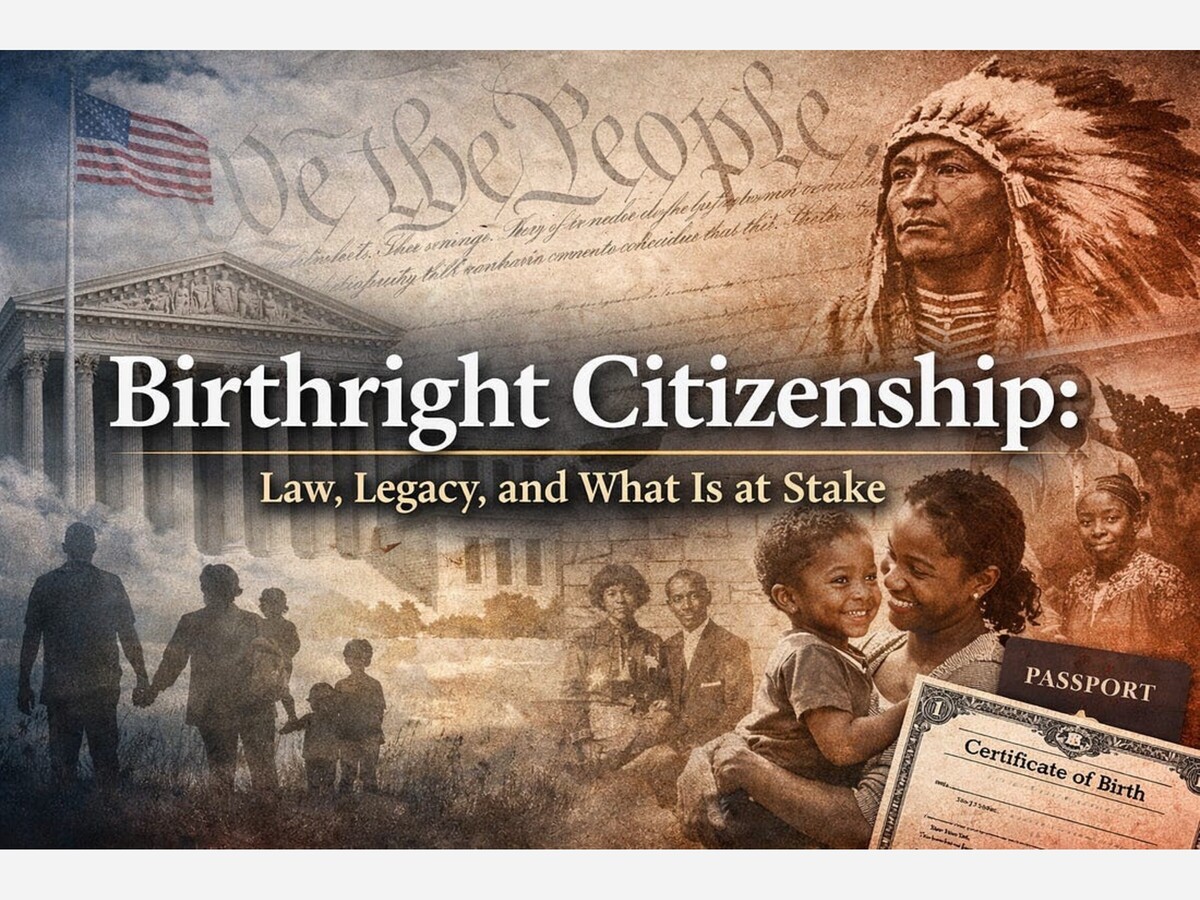



On April 1, 2026, the Supreme Court of the United States argued about birthright citizenship. At the core of the proceedings, United States v. Wong Kim Ark, 169 U.S. 649 (1898), established precedent to which the Court referred. It was fascinating to hear the country’s greatest legal minds battling an agenda steeped in personal perspective.
I can personally argue that this is a matter of perspective, because the Court case itself corroborates the point. As I listened very intently, I could not help but reflect on what this might mean for millions of U.S. citizens. At the time of this writing, SCOTUS is still hearing the case. The President was present in the Court, and the U.S. Solicitor General is making the case for the U.S. government, whose position is challenging birthright citizenship, as we know it today.
To understand what is at stake, we must first define birthright citizenship not as a political slogan, but as a constitutional doctrine grounded in law. Birthright citizenship in the United States is derived from the Citizenship Clause of the Fourteenth Amendment, which provides that “all persons born or naturalized in the United States, and subject to the jurisdiction thereof, are citizens of the United States” (U.S. Const. amend. XIV, § 1). This clause, ratified in 1868, was designed to settle the question of national belonging in the aftermath of slavery and the Civil War.
Legally, birthright citizenship operates under the principle of jus soli, meaning right of the soil. Under this doctrine, citizenship is conferred based on place of birth rather than lineage. In United States v. Wong Kim Ark (1898), the Supreme Court affirmed that a child born in the United States to foreign parents is a U.S. citizen at birth, so long as those parents are subject to U.S. jurisdiction. The Court grounded its reasoning in English common law and constitutional interpretation, concluding that the Fourteenth Amendment codified a broad and inclusive understanding of citizenship (United States v. Wong Kim Ark, 1898).
The phrase “subject to the jurisdiction thereof” has long been central to legal interpretation. The Court has historically understood this to exclude only narrow categories, such as children of foreign diplomats and certain members of sovereign tribal nations, who historically maintained separate political status. This exception reflects the unique legal position of American Indian tribes as domestic dependent nations, possessing inherent sovereignty recognized by the federal government (Cherokee Nation v. Georgia, 1831). Over time, Congress addressed this distinction through the Indian Citizenship Act of 1924, extending U.S. citizenship to Native Americans while preserving aspects of tribal sovereignty (Indian Citizenship Act of 1924).
The Citizenship Clause must also be understood in its historical context. It was a direct response to Dred Scott v. Sandford (1857), in which the Supreme Court held that Black individuals, whether enslaved or free, could not be citizens of the United States. The Fourteenth Amendment repudiated that decision and established that Black Americans, particularly those who are descendants of enslaved Africans, are citizens by birth. This was not a symbolic correction. It was a constitutional guarantee intended to prevent the exclusion of an entire class of people from the political community (U.S. Const. amend. XIV; Foner, 2019).
Today, birthright citizenship applies broadly to nearly all individuals born on U.S. soil. It provides immediate and unquestioned legal status as a citizen, including the right to reside in the United States, access public education, work lawfully, participate in civic life, and receive the protections of the Constitution. It eliminates ambiguity at birth and establishes a clear legal identity that does not depend on parental status or subsequent government approval.
In contemporary times, birthright citizenship functions as a stabilizing force within the legal system. It ensures that millions of individuals are not rendered stateless or subject to prolonged legal uncertainty. It simplifies administrative processes, supports social integration, and reinforces the principle that the law applies equally at the moment of birth.
If the Court were to find in favor of the government and deny or significantly narrow birthright citizenship, the implications would be profound. First, it would introduce a conditional framework for citizenship, requiring the government to assess the legal status of parents at the time of a child’s birth. This would fundamentally alter the current system, which confers citizenship automatically and uniformly.
Second, it could create a class of individuals born in the United States who are not recognized as citizens. Such a shift would raise complex legal questions regarding their rights, status, and access to basic services. The administrative burden on federal and state systems would increase significantly, as agencies would be required to verify citizenship eligibility at birth rather than rely on the clear standard currently in place.
Third, it would reopen constitutional questions that the Fourteenth Amendment was designed to settle. The Amendment established a national baseline for citizenship that could not be easily altered by shifting political priorities. To reinterpret or limit that guarantee would invite further legal challenges and potential fragmentation in how citizenship is defined and applied.
This is where the matter moves beyond legal doctrine and into lived reality.
For Black Americans whose citizenship was once denied by law, the Fourteenth Amendment is not abstract. It is the constitutional line that affirms their full membership in the nation. For Native communities, the history of sovereignty and subsequent recognition of citizenship reflects a complex relationship between self governance and federal authority. For immigrant families and their children, birthright citizenship represents clarity, belonging, and legal protection from the moment of birth.
When the Court considers this issue, it is not only interpreting text. It is determining whether the meaning of citizenship remains fixed in its constitutional foundation or becomes subject to reinterpretation based on contemporary perspective.
If citizenship becomes conditional, then belonging becomes uncertain.
And when belonging becomes uncertain, the relationship between the people and their government begins to shift in ways that are not easily reversed.
References
Cherokee Nation v. Georgia, 30 U.S. (5 Pet.) 1 (1831).
Dred Scott v. Sandford, 60 U.S. (19 How.) 393 (1857).
Foner, E. (2019). The second founding: How the Civil War and Reconstruction remade the Constitution. W. W. Norton & Company.
Indian Citizenship Act of 1924, Pub. L. No. 68-175, 43 Stat. 253.
United States v. Wong Kim Ark, 169 U.S. 649 (1898).
U.S. Const. amend. XIV, § 1.


Sunny, with a high of 82 and low of 58 degrees. Sunny in the morning, overcast during the afternoon and evening, clear overnight.