63° and Overcast
Image
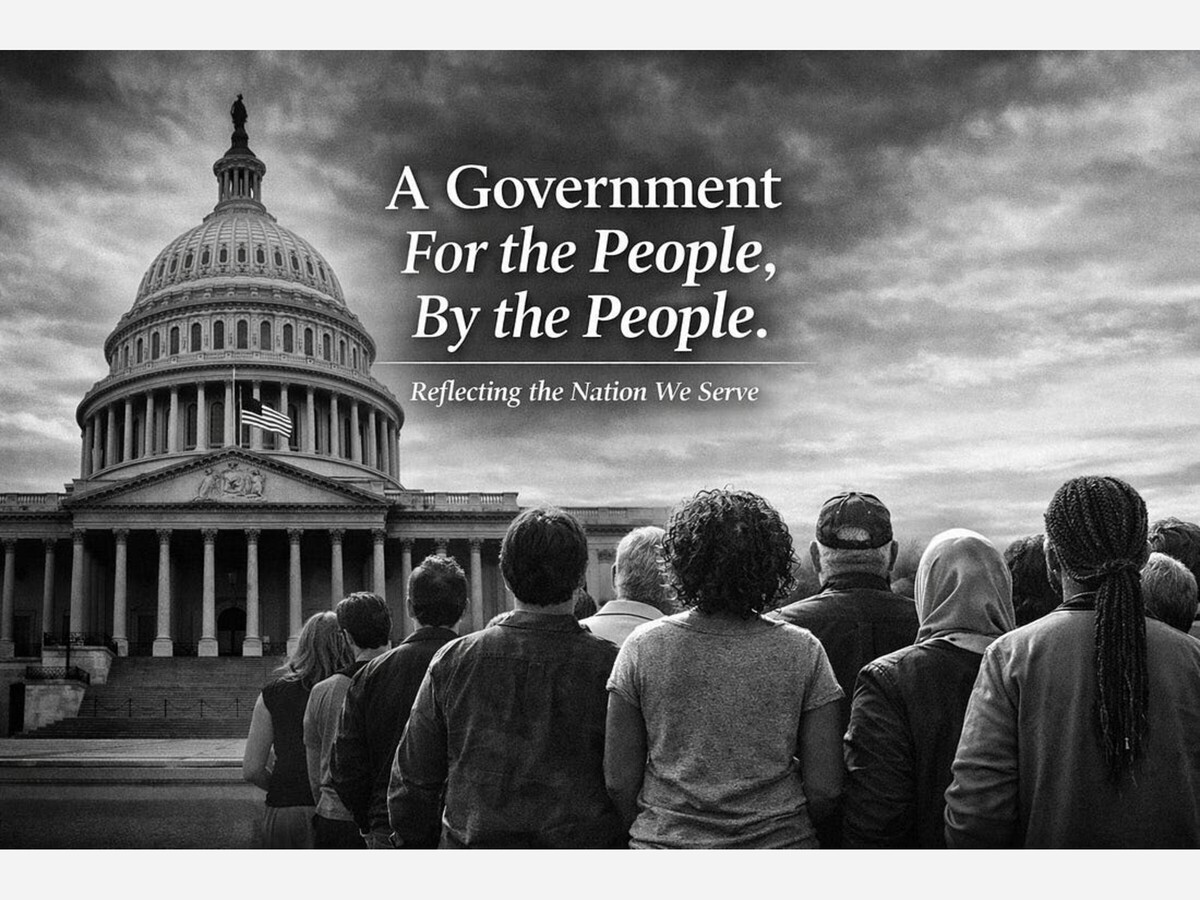



There is a phrase that has echoed through American civic life for generations: “a government for the people, by the people.” It is often quoted, rarely interrogated, and even less frequently realized in practice. At its core, this statement is not symbolic. It is structural. It defines the legitimacy of governance itself.
To say that government is “for the people” is to assert that its policies, institutions, and decisions must serve the collective well-being of society. To say that it is “by the people” is to require that those entrusted with authority emerge from, understand, and remain accountable to the full breadth of the population they represent. This is not merely about elections. It is about representation in its most substantive form, which includes lived experience, cultural understanding, and the ability to interpret the needs of diverse communities with competence and care.
Political theorists have long argued that representative government must mirror the society it governs to function effectively. Hanna Pitkin (1967) distinguished between descriptive representation, which reflects the demographic characteristics of the population, and substantive representation, which advances the interests of those populations in decision-making. Both are necessary. Without descriptive representation, entire groups may remain unseen. Without substantive representation, those same groups may be seen but not served.
Diversity, therefore, must be understood beyond race alone. It encompasses cultural background, gender identity, socioeconomic status, professional experience, geography, and lifestyle. Each dimension contributes to how individuals experience government systems. A working parent navigating childcare and employment policies, a rural resident facing limited broadband access, a veteran transitioning to civilian life, and a young person preparing for adulthood all encounter public institutions differently. When these perspectives are absent from decision-making spaces, policy becomes abstract, disconnected from the realities it is meant to address.
Empirical research reinforces this point. Studies have shown that diverse governing bodies are more likely to produce policies that are responsive to a wider range of community needs and that improve institutional trust (Page, 2007). Similarly, research on public administration demonstrates that representative bureaucracy, where public servants reflect the populations they serve, can lead to more equitable policy outcomes and improved service delivery (Meier & Nicholson-Crotty, 2006). These findings are not theoretical aspirations. They are observable patterns that speak to the practical necessity of inclusive representation.
At every level of government, from local offices to federal institutions, representation shapes not only what decisions are made, but how they are made. When governing bodies include individuals who understand the cultural, economic, and social realities of their communities, they are better equipped to anticipate unintended consequences, identify blind spots, and design policies that are both effective and just. Conversely, when those bodies are narrow in composition, even well-intentioned policies can fail because they are built on incomplete understandings of the people they affect.
This is where the phrase “by the people” demands deeper reflection. It is not enough that leaders are elected through democratic processes. They must also be reflective of the people in meaningful ways and possess the competence required to govern responsibly. Representation without capability risks symbolic inclusion without tangible progress. Capability without representation risks technically sound decisions that lack legitimacy and public trust. The two must coexist.
The consequences of failing to achieve this balance are not abstract. When government is not realistically or reasonably reflective of the people it serves, a fracture emerges. Communities begin to feel unseen, unheard, and ultimately unvalued. Trust erodes. Engagement declines. Policies are met with skepticism, not because people reject governance itself, but because they no longer see themselves within it.
This is where the emotional truth becomes unavoidable.
When a young person looks at government and does not see anyone who understands their reality, they begin to question whether their future is being considered. When a family struggles within systems that seem designed without their circumstances in mind, they begin to feel that those systems were never meant for them. When entire communities experience decisions that overlook their lived experiences, the message received is not neutral. It is personal.
It says, whether intended or not, that their voice does not carry equal weight.
Over time, that message compounds. It shapes how people view authority, how they engage with civic life, and how they define their place within society. The absence of representation becomes more than a structural flaw. It becomes a lived experience of exclusion.
A government that truly represents all of its people does more than distribute resources or enforce laws. It affirms dignity. It communicates that every individual, regardless of background, identity, or circumstance, is seen as a full participant in the democratic project. It ensures that decisions are not made in isolation from the realities of those who must live with them.
This is the standard implied by “a government for the people, by the people.” It is not a passive condition. It is an active responsibility. It requires intentional inclusion, rigorous competence, and a commitment to ensuring that governance reflects not only the will of the majority, but the lived experiences of the whole.
Anything less is not simply ineffective governance. It is a departure from the very principle upon which democratic legitimacy rests.
References
Meier, K. J., & Nicholson-Crotty, J. (2006). Gender, representative bureaucracy, and law enforcement. Public Administration Review, 66(6), 850–860.
Page, S. E. (2007). The difference: How the power of diversity creates better groups, firms, schools, and societies. Princeton University Press.
Pitkin, H. F. (1967). The concept of representation. University of California Press.



Overcast, with a high of 75 and low of 62 degrees. Overcast in the morning, clear in the afternoon and evening, overcast overnight.