70° and Clear
Image



By Dr Shellie M Bowman Sr
Editor, Public Agenda
Senior Contributor, The Spotsylvania Gazette
In national political discourse, public attention often gravitates toward presidential elections, congressional debates, and national policy conflicts. Yet the daily experience of governance for most Americans occurs much closer to home. Local politics determines how communities function, how services are delivered, and how households experience the fiscal realities of taxation. The late Speaker of the United States House of Representatives, Tip O’Neill, famously observed that “all politics is local,” capturing the enduring reality that government decisions closest to the people often have the most direct impact on their lives (O’Neill & Novak, 1987).
Local governance structures are complex and often misunderstood. Citizens frequently encounter a mixture of constitutional offices, elected political leadership, and administrative agencies. Understanding the distinctions between these institutional roles is essential for civic literacy and democratic accountability. When these roles function as designed, they promote fiscal fairness, transparency, and institutional balance. When they do not, the consequences are felt directly in household budgets and community trust.
In many states, particularly in Virginia and other parts of the United States with similar governance traditions, certain local offices are established by constitutional mandate rather than by local ordinance or political appointment. These constitutional offices often include positions such as the Commissioner of the Revenue, Treasurer, Sheriff, Commonwealth’s Attorney, and Clerk of the Court. These offices exist because the state constitution recognizes their importance in maintaining independent administrative oversight of core governmental functions (Virginia Constitution, Article VII).
Political offices within local government typically include members of the city council or county board of supervisors, mayors, and other elected officials responsible for legislative and policy direction. These offices shape budgets, establish ordinances, and determine the strategic direction of local governance. Their authority is inherently political because it reflects the electoral preferences of the community.
Constitutional offices, by contrast, are designed to perform administrative functions that require a degree of independence from political influence. These functions often include tax assessment, revenue administration, law enforcement, judicial recordkeeping, and prosecutorial responsibilities. The separation between policy making and administrative enforcement exists to protect fairness and prevent undue political pressure on functions that require neutrality and professional judgment.
Public administration scholars have long emphasized the importance of maintaining this distinction. The field historically recognized that effective governance requires both political direction and professional administration operating within defined boundaries of authority (Waldo, 1948).
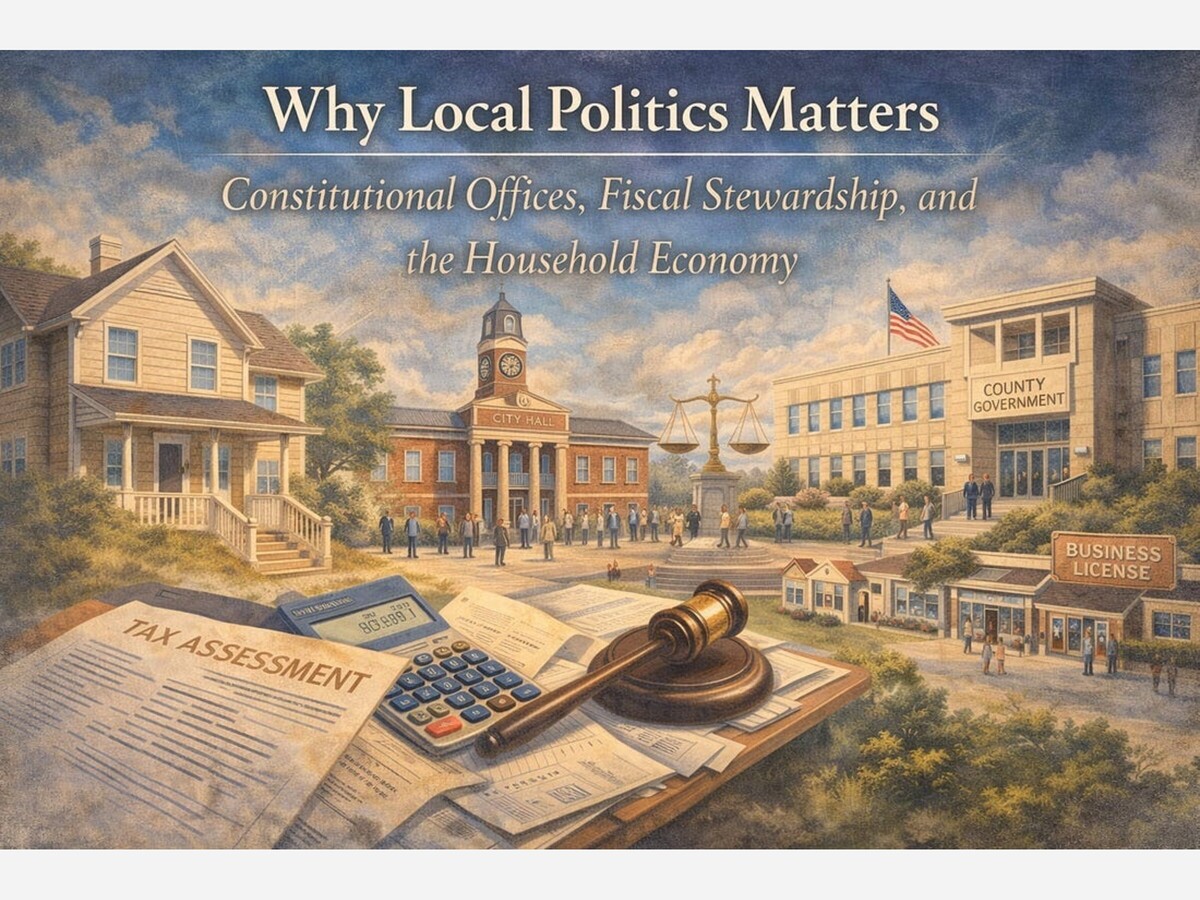
For many families, the practical effects of local governance appear most clearly in financial obligations tied to property ownership, vehicle ownership, and small business activity. Property taxes, business license fees, and local assessments are administered through systems that rely on accurate valuation, consistent enforcement, and transparent communication.
Property tax assessments are a particularly significant example. Local property values determine tax obligations that fund public schools, emergency services, infrastructure, and community development initiatives. The official responsible for property assessment must ensure that valuation practices are applied consistently and equitably across the jurisdiction. If assessments are improperly administered, households may experience disproportionate tax burdens that strain family finances.
Similarly, local business licensing requirements influence the viability of small enterprises that form the backbone of many communities. Licensing structures and tax obligations must be administered in a manner that balances fiscal sustainability for local government with economic opportunity for entrepreneurs. Administrative discretion in these areas has direct implications for economic growth, employment opportunities, and household financial stability.
Research in public finance consistently demonstrates that local tax systems influence household decision making, including housing choices, business formation, and long term financial planning (Oates, 1999). When citizens engage with local government, they are often engaging with the administrative systems that shape these financial realities.
The independence of constitutional offices serves as a structural safeguard within local governance. By design, these offices operate independently from legislative bodies that establish policy and budgets. This separation ensures that administrative decisions involving taxation, law enforcement, and judicial processes are carried out according to law and professional standards rather than political preference.
Institutional independence helps preserve procedural fairness. For example, a tax administrator responsible for assessing property values must apply valuation standards consistently across the community. If the administrator were directly subordinate to political leadership, there could be pressure to manipulate assessments for political advantage or fiscal expediency. Independence protects against such pressures and reinforces public confidence in the system.
The principle of administrative independence also aligns with foundational theories in public administration. Woodrow Wilson’s early articulation of the distinction between politics and administration emphasized that administrative functions should be carried out by professionals guided by expertise and legal frameworks rather than partisan considerations (Wilson, 1887).
Although modern scholarship recognizes that politics and administration inevitably intersect, maintaining institutional boundaries remains essential for preserving integrity and accountability.
When the independence between political offices and constitutional offices weakens, governance risks increase. Administrative decisions may become subject to political pressure, leading to inconsistent enforcement of regulations or inequitable application of tax policies. Such conditions undermine the legitimacy of public institutions and erode citizen trust.
In practical terms, the erosion of institutional independence can result in unpredictable tax assessments, uneven regulatory enforcement, and diminished transparency in public administration. These outcomes create uncertainty for households and businesses alike. Families may struggle to plan financially when property assessments fluctuate without clear rationale. Small businesses may face inconsistent licensing requirements that complicate long term investment decisions.
Public trust in government depends on the perception that rules are applied fairly and consistently. Scholars of democratic governance emphasize that institutional legitimacy is strengthened when citizens believe administrative systems operate according to law rather than political favoritism (Denhardt & Denhardt, 2015).
Understanding the structure and function of local governance is a critical component of civic engagement. Citizens who understand how constitutional offices operate are better equipped to evaluate the performance of public officials and to participate meaningfully in democratic processes.
Local elections often receive less public attention than national contests, yet the officials chosen in these elections directly influence taxation systems, public safety, and administrative transparency. Engagement with local politics is therefore not merely an exercise in civic duty. It is an investment in community stability and household well being.
Tip O’Neill’s observation that politics is local remains relevant because it highlights the relationship between governance and lived experience. The decisions made in local government chambers, administrative offices, and public finance departments shape the daily realities of communities across the nation.
Local politics is the arena where governance becomes tangible. It is where policies translate into tax bills, business regulations, public safety operations, and community services. Constitutional offices and political offices perform distinct but complementary roles within this system. Their independence from one another preserves fairness, protects institutional integrity, and strengthens public trust.
When citizens understand how these offices function and why their independence matters, they become more informed participants in democratic life. Such understanding fosters accountability and ensures that local government remains responsive to the people it serves.
In the end, the strength of democracy depends not only on national institutions but also on the integrity of local governance. The everyday work of administration, often conducted outside the spotlight of national politics, is where the principles of fairness, transparency, and fiscal stewardship are either upheld or diminished.
For households balancing budgets, businesses navigating licensing requirements, and communities striving for equitable service delivery, local politics is not distant. It is immediate. It is consequential. And it deserves our careful attention.
References
Denhardt, J. V., & Denhardt, R. B. (2015). The new public service: Serving, not steering (4th ed.). Routledge.
Oates, W. E. (1999). An essay on fiscal federalism. Journal of Economic Literature, 37(3), 1120 to 1149.
O’Neill, T., & Novak, W. (1987). Man of the House: The life and political memoirs of Speaker Tip O’Neill. Random House.
Virginia Constitution. (1971). Article VII: Local government. Commonwealth of Virginia.
Waldo, D. (1948). The administrative state: A study of the political theory of American public administration. Ronald Press.
Wilson, W. (1887). The study of administration. Political Science Quarterly, 2(2), 197 to 222.
Public Agenda is free today. But if you enjoyed this post, you can tell Public Agenda that the writing is valuable by pledging a future subscription. You won’t be charged unless payments are enabled.
Follow us on TikTok @DrShelliePublicAgenda
📢 Stay Connected with Public Agenda by Dr. Shellie M. Bowman
Let’s rebuild public leadership together; one insight, one question, one breakthrough at a time.
eLEADt On with Purpose.



Sunny, with a high of 89 and low of 69 degrees. Sunny for the morning, clear in the afternoon and evening,