61° and Clear



Image
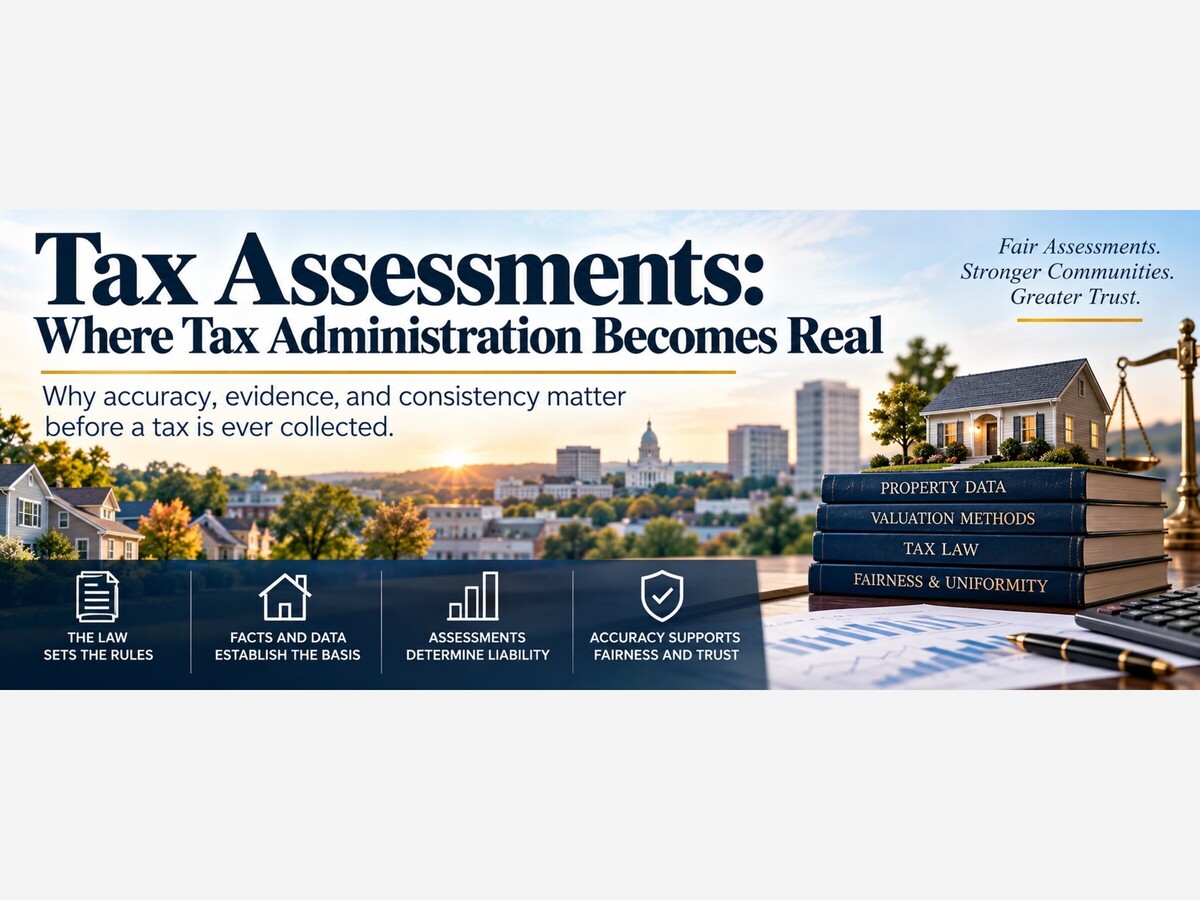
Most people encounter taxation at the end of the process.
They see a tax return, a property assessment notice, a balance due, or a payment leaving their bank account. By then, however, something important has already happened. The government, the taxpayer, or both have determined what is taxable and how much tax liability results.
That determination is broadly connected to what tax administration calls an assessment.
The word can mean different things depending on the tax involved. In federal taxation, assessment has a specific legal meaning associated with recording a tax liability. In property taxation, assessment commonly involves determining the taxable value of property. In a self-assessment system, taxpayers themselves initially report information and calculate their tax liability.
These processes are not identical. However, they share an important characteristic:
Before a tax can be administered fairly, someone must accurately determine what is subject to taxation and apply the governing law to it.
That makes assessment one of the most consequential, and sometimes least understood, parts of taxation.
What Is a Tax Assessment?
At its simplest, assessment connects the law imposing a tax with the facts determining the amount owed.
Consider federal income taxation. The United States largely operates under a system of self-assessment. Taxpayers report relevant financial information, apply tax rules, calculate their liability, and file a return. The Internal Revenue Service describes compliant self-assessment as requiring taxpayers to know the applicable filing and payment rules, while the agency provides information intended to help taxpayers comply (Internal Revenue Service [IRS], 2025).
Federal law then gives the Secretary of the Treasury authority and responsibility to make determinations and assessments of taxes imposed by the Internal Revenue Code. The Code specifically provides for assessment of taxes reported by taxpayers as well as taxes otherwise determined by the government (26 U.S.C. § 6201, 2026).
Technically, the IRS describes assessment as the statutorily required recording of the tax liability (IRS, 2004).
Property taxation uses the term somewhat differently. There, assessment often concerns the value assigned to taxable property under the laws of the particular state or jurisdiction. Professional assessment practice includes property data, market evidence, valuation models, appraisal methods, ratio studies, quality controls, and procedures for reviewing results. The International Association of Assessing Officers maintains professional standards addressing mass appraisal, data quality, ratio studies, assessment appeals, property-tax policy, and related disciplines (International Association of Assessing Officers [IAAO], n.d.).
Consequently, “assessment” should not be treated as though it describes one identical procedure throughout American taxation.
Its precise legal meaning depends upon the tax and jurisdiction.
Where Does an Assessment Come From?
An assessment does not create legitimate taxing authority by itself.
Its authority begins with law.
In the United States, taxing powers are distributed through the federal system. Federal taxes originate in federal law, while state constitutions and statutes establish state tax systems and define much of the authority available to political subdivisions. The resulting administrative structures vary considerably across the country.
That means an assessment is not simply an opinion about what someone should pay.
There should be a chain:
Law → Tax Base → Information → Valuation or Calculation → Assessment → Tax Liability
The law identifies the taxable subject and establishes the applicable rules. Facts and records establish the taxpayer’s circumstances or the characteristics of taxable property. Valuation or calculation methods translate those facts into an administrable amount. The assessment formalizes the result in the manner prescribed by the governing system.
This distinction is important because assessment and tax rate are not necessarily the same thing.
A property may be accurately valued while taxpayers reasonably debate the tax rate applied to it. Likewise, disagreement over tax policy does not establish that an underlying assessment is inaccurate.
Good tax administration requires separating those questions.
Why Accuracy Matters
Suppose two substantially comparable properties are valued differently because one record contains inaccurate square footage. Or imagine taxable income being calculated from an information return attributed to the wrong taxpayer. The tax law itself may be perfectly clear, yet the result can still be wrong because the information entering the system was wrong.
That reveals a basic principle:
Tax accuracy is not produced by law alone. It depends upon the quality of the information and administration through which the law is applied.
For property taxation, professional standards emphasize both appraisal level and uniformity. IAAO’s 2025 mass-appraisal standard discusses statistical measures used to evaluate whether assessments are reasonably uniform across groups of properties and whether valuation results exhibit price-related bias (IAAO, 2025).
Ratio studies are particularly important because individual assessments can appear reasonable while systematic patterns remain hidden. Research examining assessment practices across U.S. states and other jurisdictions shows that ratio studies are widely used to evaluate assessment levels, uniformity, and related performance characteristics (Baer et al., 2023).
Accuracy, therefore, is more than getting one number right.
It includes consistency.
Accuracy Is Also an Equity Question
This is where assessment becomes especially important.
Imagine two taxpayers whose circumstances are materially alike under the governing tax rules. If one is systematically assessed differently because of poor data, inconsistent methodology, outdated records, or administrative error, the problem is no longer merely technical.
The administration of the tax burden has become uneven.
Property taxation illustrates this particularly well. Modern mass appraisal can involve statistical models capable of estimating large numbers of property values. Research by the Lincoln Institute of Land Policy and IAAO describes accurate and consistent assessments as critical to an equitable property-tax system and reports that automated valuation models can improve efficiency and, under appropriate conditions, accuracy and uniformity (Bidanset & Rakow, 2022).
But technology does not eliminate the need for professional judgment or oversight.
A sophisticated model built on poor data can produce sophisticated-looking errors.
Consequently, assessment quality requires reliable underlying records, appropriate methodologies, testing, review, transparency, and mechanisms for correcting mistakes.
The Right to Question the Number Matters
No assessment system should be treated as infallible.
Properties change. Records can be incorrect. Tax returns can contain mistakes. Information can be incomplete. Models have limitations. Taxpayers and administrators can interpret facts differently.
That is why review and appeal mechanisms are not evidence that an assessment system has failed. Properly designed, they are part of its quality-control structure.
The IRS, for example, recognizes circumstances in which taxpayers may challenge proposed adjustments or seek reconsideration of certain audit assessments when relevant information was not previously considered or when processing or computational errors occurred (IRS, n.d.).
Property assessment systems similarly employ review and appeal procedures, and IAAO’s professional standards specifically address assessment appeals as part of assessment administration.
An accurate system should therefore do more than produce a number.
It should be able to explain the number.
What information was used?
What law applied?
What methodology produced the result?
What can a taxpayer do if the underlying information is wrong?
Those questions matter because transparency and accuracy reinforce one another.
Assessment Before Collection
Tax debates often begin with rates.
How high should taxes be? Who should pay more? Who should receive relief? Which activities should governments tax?
Those are important policy questions. But there is another question that logically comes first:
Are we accurately identifying and measuring what the law says is taxable?
A tax rate applied to inaccurate information does not become accurate because the arithmetic is correct.
A sophisticated valuation model cannot compensate indefinitely for unreliable data.
And an assessment system that produces inconsistent results can undermine the administration of an otherwise lawful tax.
That is why assessment deserves greater public attention.
It sits between tax policy and tax collection, translating legal rules and real-world facts into administrable tax liabilities.
When that process works well, taxpayers may barely notice it.
When it does not, the consequences can appear on a property assessment, a tax return, an audit adjustment, a business account, or ultimately a tax bill.
The objective should not be the highest possible assessment.
Nor should it be the lowest.
The objective should be the correct assessment, reached through lawful, evidence-based, consistent, and reviewable administration.
Because before we debate what someone should pay, we should have confidence in something even more fundamental:
Did we get the assessment right?
References
Baer, M., Kuijper, M., Dornfest, A., & International Association of Assessing Officers Research and Standards Committee. (2023). Ratio study practices in the United States, Canada, and the world: Results of the 2022 survey. Journal of Property Tax Assessment & Administration, 20(1). https://doi.org/10.63642/3067-4816.1257
Bidanset, P., & Rakow, R. (2022). 2019 survey on the use of automated valuation models (AVMs) in government assessment offices: An analysis of AVM use, acceptance, and barriers to more widespread implementation. Lincoln Institute of Land Policy.
Internal Revenue Service. (2004). Procedures for assessment of tax. Internal Revenue Manual § 35.9.2.
Internal Revenue Service. (2025). Introduction and penalty relief. Internal Revenue Manual § 20.1.1.
Internal Revenue Service. (n.d.). Understanding taxes: Assessment: The taxpayer’s rights.
International Association of Assessing Officers. (2025). Standard on mass appraisal of real property.
International Association of Assessing Officers. (n.d.). IAAO technical standards.
26 U.S.C. § 6201 (2026).


Sunny, with a high of 82 and low of 58 degrees. Sunny in the morning, overcast in the afternoon and evening, clear overnight.