62° and Clear



Image
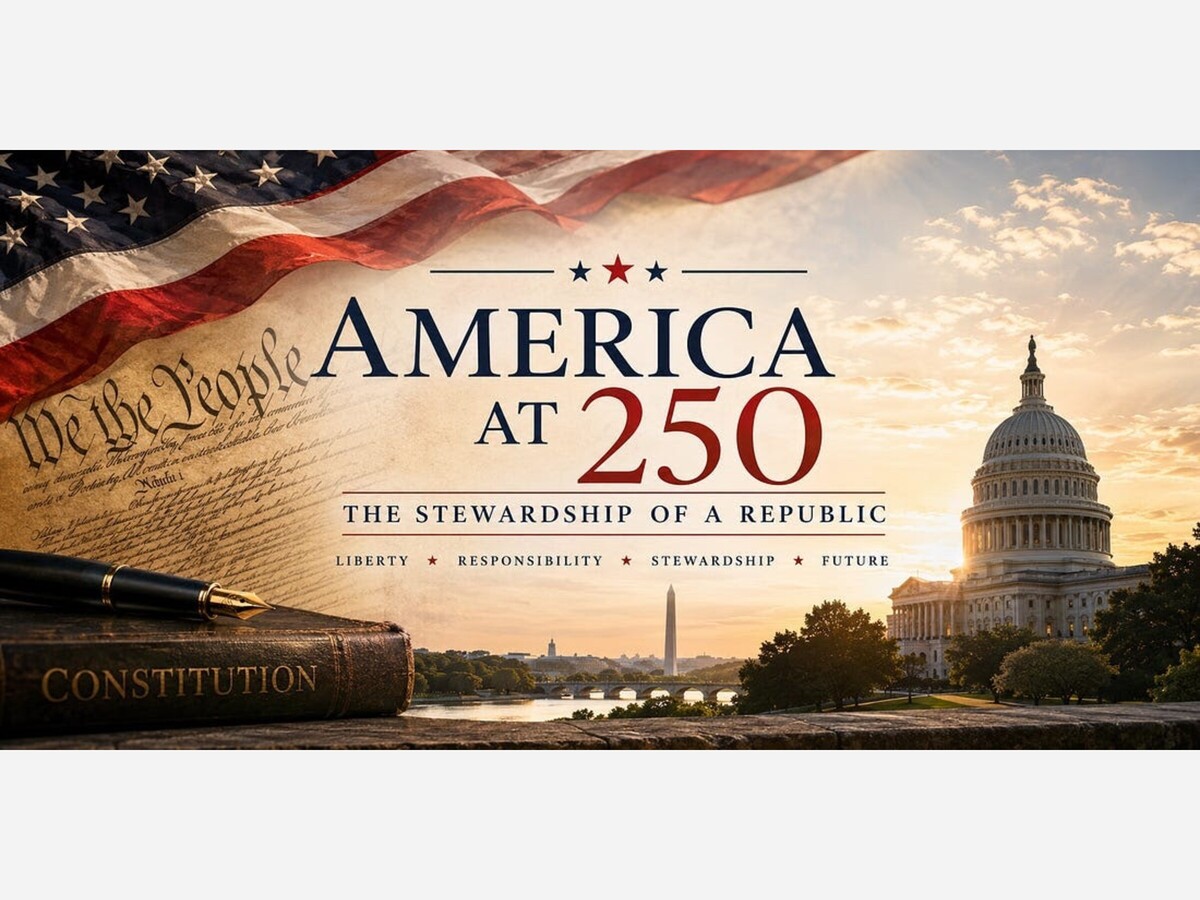
“The American experiment is sustained not only by the Constitution we inherit, but by the stewardship we exercise.”
In 2026, the United States commemorates the 250th anniversary of the Declaration of Independence. Across the nation, communities will celebrate the courage of those who challenged tyranny and proclaimed that all people possess certain unalienable rights. The anniversary rightly invites reflection upon the nation’s founding principles, its remarkable achievements, and the sacrifices that have preserved the Republic through war, economic hardship, social change, and political disagreement.
Yet anniversaries should serve more than remembrance.
America’s Semiquincentennial provides an opportunity to ask a more enduring question: What responsibilities accompany the privilege of self-government?
The Declaration of Independence announced the birth of a nation. The Constitution established the framework through which that nation would govern itself. Together, these documents created an unprecedented experiment in constitutional democracy, one founded upon the belief that free people, governed by laws rather than individuals, could preserve both liberty and ordered government.
Two hundred fifty years later, the continued success of that experiment depends not simply upon constitutional structures, but upon the stewardship exercised by each generation entrusted with preserving them.
History often celebrates the Revolutionary War as the defining achievement of America’s founding generation. While independence secured political freedom, it did not guarantee effective government.
The founders understood that liberty alone could not sustain a nation.
In The Federalist No. 51, James Madison observed that because government is administered by human beings, constitutional systems must both empower government to govern and restrain government from abusing its authority (Madison, 1788/2009). The American constitutional system was intentionally designed around accountability, separation of powers, and checks and balances because its architects recognized that institutions matter.
The Republic would ultimately depend not merely upon written laws, but upon citizens and public servants willing to honor them.
America’s greatest achievement therefore is not simply that independence was declared in 1776.
Its greatest achievement is that constitutional self-government has endured for two and a half centuries.
Public administration seldom occupies the center of public conversation. Elections, legislation, and judicial decisions understandably command attention. Yet democracy functions each day because thousands of public servants quietly administer the institutions that citizens depend upon.
Teachers educate future generations.
Public safety professionals protect communities.
Election officials safeguard democratic processes.
Constitutional officers administer elections, maintain public records, assess property, collect revenue, and ensure that government functions fairly and efficiently.
Most citizens encounter government not through Congress or the White House, but through local institutions.
These interactions shape public trust.
Public trust, in turn, becomes one of democracy’s most valuable assets.
Trust cannot be legislated.
It must be earned through competence, integrity, transparency, and stewardship.
As Simon (1997) argued, effective public administration depends upon rational decision making grounded in evidence rather than impulse. While perfect information is rarely available, responsible leaders have an obligation to seek sufficient information before making decisions affecting the public. I refer to this governing prudence as stewardship.
Stewardship therefore begins long before policies are implemented.
It begins with disciplined judgment.
Government exists to serve the public.
Consequently, public resources should always be managed with the same care one would expect of resources held in trust.
Taxpayer dollars are not government property.
They are public resources entrusted to government for lawful public purposes.
This distinction carries profound implications.
Responsible fiscal stewardship requires more than balancing budgets. It requires strategic planning, thoughtful capital investment, transparent budgeting, and careful evaluation of long-term obligations before public funds are committed.
Every public expenditure represents an opportunity cost.
Every capital investment creates future obligations.
Every acquisition should advance an identified public purpose.
The measure of responsible government is therefore not how much it spends, but how wisely it invests.
Citizens deserve confidence that public decisions reflect careful analysis rather than expediency.
The founders envisioned citizenship as active participation rather than passive observation.
Voting remains among the most visible expressions of civic engagement. Yet constitutional self-government requires much more.
Citizens strengthen democracy when they attend public meetings, serve on local boards and commissions, volunteer within their communities, remain informed about public issues, and respectfully engage those with whom they disagree.
Likewise, public officials strengthen democracy when they communicate honestly, administer laws fairly, and remain accountable to those they serve.
Democracy flourishes when both citizens and institutions recognize that self-government is a shared responsibility.
The health of the Republic depends not only upon elected officials, but upon millions of ordinary Americans who faithfully fulfill extraordinary civic responsibilities every day.
Anniversaries naturally encourage reflection upon the past.
Stewardship requires equal attention to the future.
The next chapter of American democracy will confront challenges unimaginable to the founding generation. Emerging technologies, demographic changes, artificial intelligence, cybersecurity, public finance, environmental sustainability, and evolving expectations of government will require thoughtful leadership grounded in enduring constitutional principles.
The solutions may change.
The principles should not.
Integrity.
Accountability.
Transparency.
Stewardship.
Respect for the rule of law.
Commitment to constitutional government.
These values have sustained the Republic for two and a half centuries.
They remain equally essential today.
America’s 250th anniversary is appropriately a celebration.
It is also an invitation.
An invitation to remember that constitutional government is not self-sustaining.
Every generation inherits institutions built through the sacrifices of those who came before.
Every generation bears responsibility for strengthening those institutions for those who follow.
The American experiment has endured because generations of citizens accepted the responsibilities accompanying liberty.
As we commemorate America’s Semiquincentennial, perhaps the most meaningful tribute we can offer the founding generation is not merely remembering what they accomplished, but faithfully stewarding what they entrusted to us.
The future of the Republic will not be determined solely by those who hold public office.
It will be shaped equally by citizens who choose integrity over expediency, stewardship over self-interest, and service over indifference.
The next 250 years begin with us.
Madison, J. (2009). The Federalist No. 51. In I. Shapiro (Ed.), The Federalist Papers. Yale University Press. (Original work published 1788)
Simon, H. A. (1997). Administrative behavior: A study of decision-making processes in administrative organizations (4th ed.). Free Press.
Public Agenda is free today. But if you enjoyed this post, you can tell Public Agenda that the writing is valuable by pledging a future subscription. You won’t be charged unless payments are enabled.
Follow us on TikTok @DrShelliePublicAgenda
📢 Stay Connected with Public Agenda by Dr. Shellie M. Bowman
Let’s rebuild public leadership together; one insight, one question, one breakthrough at a time.
eLEADt On with Purpose


Sunny, with a high of 88 and low of 60 degrees. Overcast for the morning, clear for the afternoon and evening, overcast overnight.