56° and Light drizzle



Image
By Dr Shellie M Bowman Sr
People frequently say they are unhappy with government.
Taxes are too high. Housing is increasingly unaffordable. Roads are congested. Schools need resources. Public services may seem unresponsive. Economic development can transform a community while residents question whether they are receiving an equitable share of its benefits. At the national level, Americans express similar concerns about the economy, immigration, health care, public debt, public safety, civil rights, foreign policy, and confidence in public institutions.
Dissatisfaction is not inherently wrong. In a representative democracy, disagreement with government is not a defect in the system. It is expected.
The more consequential question is what citizens do with that dissatisfaction.
Complaining about government may express frustration, but it does not change who governs. Elections provide citizens with the constitutional means to determine who receives public authority. Exercising that power effectively, however, requires more than arriving at a polling place and selecting the names we recognize.
It requires intention.
Begin With the Issues That Affect Your Life
Before beginning with candidates, begin with your life.
What government decisions materially affect your household, business, neighborhood, or community?
Perhaps it is property taxation, housing affordability, employment opportunities, transportation, education, public safety, economic development, utility costs, land use, environmental concerns, or access to public services. Whatever the issue, identify it clearly.
Then comes a question voters sometimes overlook: Which part of government actually has authority to do something about it?
Local, state, and federal governments possess different powers. Even within the same locality, elected offices may have substantially different statutory responsibilities. A county governing body may establish certain tax rates, while a constitutional officer administers responsibilities assigned independently by law. Congress possesses powers that local governments do not, just as local officials make decisions over matters that Congress ordinarily does not control.
That distinction matters because informed voting requires evaluating candidates against the responsibilities of the offices they are actually seeking.
Before deciding whether someone has done, or promises to do, a good job, first understand what the job is.
Move From Opinion to Evidence
Knowing the issue is only the beginning.
Next, investigate it.
Government budgets, audited financial reports, tax ordinances, statutes, economic development agreements, meeting minutes, planning documents, agency reports, Census data, election records, inspector general reports, and other public records allow citizens to move beyond what they have heard toward what the evidence demonstrates.
This is where civic participation becomes more demanding.
A social media post may raise an important question, but it should rarely be the end of the inquiry. A campaign advertisement may identify an issue, but the campaign has an obvious interest in how that issue is presented. The same caution should apply to political parties, advocacy organizations, commentators, news coverage, and even articles such as this one.
Go to the source whenever reasonably possible.
Evidence does not require people to surrender their values. Quite the opposite. Evidence gives citizens a stronger foundation from which to apply those values.
Two thoughtful people can examine the same budget, statute, economic conditions, or policy outcome and still disagree about what government should do. Democracy accommodates that disagreement.
The danger is not disagreement.
The danger is surrendering our responsibility to know enough to make the disagreement meaningful.
Decide What You Want Government to Become
Research leads naturally to another question: What do you actually want from government?
It is easy to identify what we oppose. Building an alternative requires considerably more thought.
What should government do well?
Which services should it provide?
What should those services reasonably cost?
What should the tax burden look like?
Where should government invest?
What should it stop doing?
Which responsibilities properly belong to individuals, businesses, nonprofit organizations, communities, or other institutions?
Most importantly, what outcomes would tell you that government is actually improving?
These questions force us beyond slogans.
If citizens simultaneously demand substantially lower revenues and substantially greater public services, for example, those preferences eventually encounter arithmetic. Roads cost money. Schools cost money. Public safety costs money. Employees must be compensated. Debt must be serviced. Infrastructure must be maintained.
Government, therefore, is not exclusively ideological business. Much of it is quantitative business.
Revenue must be collected. Expenditures must be prioritized. Programs must be funded. Risks must be evaluated. Assets must be managed. Outcomes should be measured. Every decision carries an opportunity cost.
Citizens do not need degrees in economics, accounting, law, or public administration to participate effectively. They do, however, need to ask sufficiently informed questions to determine whether those seeking governmental authority understand the work they are asking voters to entrust to them.
Look Beyond Familiarity
Once you know the issues, examine the evidence, and determine the government you want, the ballot begins to look different.
Now evaluate the people asking to govern.
Familiarity has value. Community relationships matter. Experience matters. Longevity in public life can provide useful institutional knowledge.
But familiarity is not the same thing as capability.
For each candidate, ask what the office actually requires. Then examine whether the person’s experience, education, professional record, judgment, temperament, accomplishments, and demonstrated competencies correspond to those responsibilities.
Read candidate biographies, but do not stop there. Watch debates. Attend forums. Examine published positions. Review professional histories. Look at prior public records when applicable. Compare claims against independently verifiable evidence.
Then apply the same standard to everyone.
That last point is important.
Research should not become an exercise in finding evidence against the candidate we already oppose while searching for reasons to excuse the candidate we already support. If capability matters, it should matter regardless of the name beside it.
An informed voter should be willing to ask a difficult question even of a familiar candidate:
Is this the person best prepared to exercise the particular powers of this office?
Capability Is Not Enough
Still, technical competence cannot be the only consideration.
Government entrusts people with extraordinary responsibilities. Public officials may exercise authority over public money, confidential information, taxation, regulation, enforcement, contracts, public employees, land, infrastructure, and decisions affecting thousands or even millions of people.
That is why character matters.
Dwight D. Eisenhower expressed the principle succinctly:
“The supreme quality for leadership is unquestionably integrity.”
The broader statement attributed to Eisenhower emphasizes that success in leadership cannot be separated from integrity, whether leadership occurs in an army, an office, athletics, or ordinary work (Eisenhower Foundation, n.d.).
The point transcends political affiliation.
A highly capable person without integrity can misuse capability. Conversely, good intentions without sufficient competence may produce poor outcomes despite honorable motives.
Public service demands both.
Voters should therefore consider whether candidates demonstrate honesty when facts are inconvenient, accountability when mistakes occur, respect for lawful authority, consistency between public principles and private conduct, willingness to explain decisions, and respect toward people with whom they disagree.
We should not expect human beings to be flawless. We should expect those seeking public trust to demonstrate that they understand what trust is.
Then Vote With Intention
Eventually, all of this research must reach the ballot box.
Here the quantitative nature of democracy becomes impossible to ignore.
In Virginia’s 2022 general election, 6,132,331 people were registered to vote. Only 3,021,956 cast ballots, producing a turnout of 49.28% (Virginia Department of Elections, n.d.-b).
Consider what that means.
Approximately 3.11 million registered Virginians did not vote.
In other words, more registered Virginians stayed home than participated in that election.
Virginia’s 2024 presidential election produced considerably higher turnout. Of 6,434,637 registered voters, 4,535,314 voted, resulting in 70.48% turnout (Virginia Department of Elections, n.d.-b). Yet even then, approximately 1.9 million registered Virginians did not cast a ballot.
The national numbers tell a similar story. The U.S. Census Bureau reported that 73.6% of the citizen voting-age population was registered for the 2024 presidential election, while 65.3% reported actually voting (U.S. Census Bureau, 2025).
Those numbers should cause us to think differently about political power.
A citizen can have a carefully researched position, a compelling vision for government, and a candidate who appears exceptionally capable of implementing it. None of those things produces electoral authority by itself.
Elections are decided by votes.
One vote expresses one citizen’s choice. Governing majorities emerge when enough citizens make aligned choices.
That is why democracy does not end with becoming an informed voter.
Your Vote Is Powerful. Your Influence Multiplies It.
If your research persuades you that government should move in a particular direction, talk with other people.
Not merely those who already agree with you.
Share the public records you found. Discuss the evidence. Invite someone to a candidate forum. Encourage a neighbor to research an unfamiliar candidate. Help a family member understand what an office actually does. Ask friends whether they know what will appear on their ballots.
Most importantly, encourage people to conduct their own research.
Persuasion in a democracy should not mean demanding obedience to our conclusions. It means making a case strong enough that another citizen can examine the evidence, challenge our assumptions, and reach an informed conclusion.
Sometimes that person will agree with us.
Sometimes that person will not.
The legitimacy of representative government depends upon respecting both outcomes.
But if you want your vision of government to prevail, arithmetic remains unavoidable. You must vote, and enough other people must ultimately share that vision to vote for it too.
That is not manipulation.
That is representative democracy.
September 18: Intention Becomes Action
For Virginians, this discussion is about to become tangible.
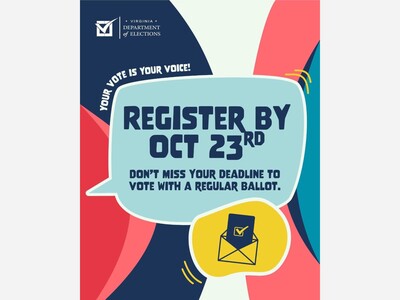
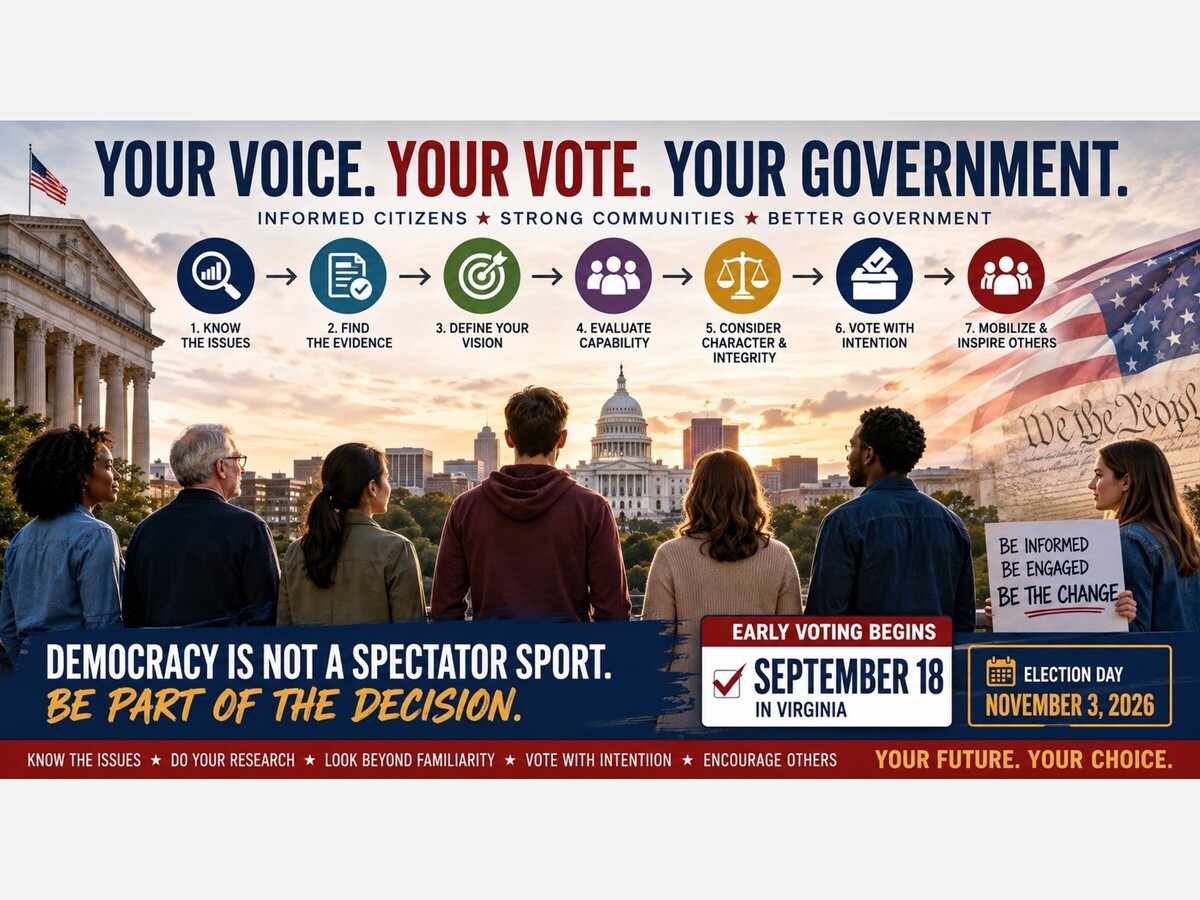
The November 3, 2026, general election includes races for the U.S. Senate, U.S. House of Representatives, and applicable local offices. Virginia’s early in-person voting period begins Friday, September 18, 2026, and continues through 5:00 p.m. Saturday, October 31, 2026. The regular deadline to register or update an existing registration is October 23, although Virginia permits eligible voters registering afterward to cast provisional ballots under the Commonwealth’s same-day registration procedures (Virginia Department of Elections, n.d.-a).
Election Day is Tuesday, November 3, 2026 (Virginia Department of Elections, 2026).
So between now and the moment you cast your ballot, do the work.
Know what is affecting your life.
Determine which government officials actually possess authority over it.
Find the evidence.
Decide what you believe government ought to be doing.
Understand the capabilities the office requires.
Study the people asking you to entrust them with that authority.
Look beyond familiarity.
Examine competence.
Consider character.
Demand integrity.
Then vote with intention.
If you believe government should change, democracy does not guarantee that your preferred outcome will prevail. Nor does it entitle any of us to the agreement of our neighbors.
What it gives us is far more consequential: the right to participate in deciding who governs.
But rights left unused cannot cast ballots.
A vision left unspoken cannot persuade a neighbor.
Dissatisfaction without participation cannot produce an electoral majority.
Government is ultimately shaped by those willing to participate in choosing it.
So research with rigor. Question with courage. Discuss with respect. Persuade with evidence. Look beyond the names you already know. Then bring your judgment to the ballot box.
Do not merely ask whether your government represents the future you want.
Beginning September 18, help choose it.
References
Eisenhower Foundation. (n.d.). Dwight D. Eisenhower legacy organizations. https://eisenhowerfoundation.net/legacy
U.S. Census Bureau. (2025, April 30). 2024 presidential election voting and registration tables now available. https://www.census.gov/newsroom/press-releases/2025/2024-presidential-e…
Virginia Department of Elections. (n.d.-a). November 3, 2026 – General election. https://www.elections.virginia.gov/style-guide/components/q--a-type-com…
Virginia Department of Elections. (n.d.-b). Registration/turnout reports. https://www.elections.virginia.gov/resultsreports/registrationturnout-s…
Virginia Department of Elections. (2026). Schedule of general elections: 2026–2030. https://www.elections.virginia.gov/media/boardpapers/calendar/Five_year…
For The Spotsylvania Gazette, the established policy should remain:
The Spotsylvania Gazette does not endorse political candidates.
The paper can thoroughly cover candidates—their backgrounds, records, positions, debates, campaign statements, finances and public forums—but should leave the ultimate decision to voters.
Dr. Shellie Bowman’s Public Agenda pieces can express the contributor’s analysis or viewpoint, but they should be clearly identified as contributed commentary and separated from the Gazette’s independent news reporting. Publication of a contributed column does not constitute a Gazette endorsement of any candidate, party or political position.
That approach fits the Gazette’s larger philosophy:
CHERISH THE PAST. BUILD THE PRESENT. EXPAND THE FUTURE.

Light drizzle, with a high of 59 and low of 45 degrees. Light drizzle during the morning, overcast in the afternoon, patchy rain nearby overnight.